Talk:Incorrect predictions
Major cleanup needed[edit]
I've just restructured this article along Wikiquote standards, chiefly:
- Separating quotes into sourced, attributed, and misattributed quotes. "Sourced" means having a specific published or recorded source that can be used to verify the quote. Magazines should have dates or at least issue numbers. Quotes from books should include the title (chapters are highly desirable; pages are better but should include edition [w/ ISBN if available], as page numbers vary between editions). Speeches and other spoken quotes should have publications listed from which they are quoted. Audiovisual clips should have a link to a reliable website.
- Converting manually-crafted headings into TOC-compliant wiki headings.
The result demonstrates that we still have considerable work to do on this article:
- The vast majority of quotes aren't properly sourced.
- Many of them seem to have been copied directly from Things People Said - Bad Predictions, which can be construed as a copyright violation. I am not a lawyer, but I know that although one cannot copyright facts (like quotes themselves, perhaps), one can copyright presentation and explanatory text, all of which appear to have been copied in their entirety into this article. We probably don't need much of the explanations; these lines should be replaced or at least amended by including the source information once found.
- There doesn't appear to be any organization of quotes in each section. Common methods include alphabetical by quote or by author surname, or chronological.
- Many elements in the source information that is in the article have no links. I haven't tested the ones that do yet. Also, magazine, book, and film titles should be italicized per Wikiquote style guidelines.
I ask all editors involved in this article to help clean it up to meet Wikiquote standards of accuracy, verifiability, and style. Thank you. ~ Jeff Q (talk) 20:22, 15 February 2006 (UTC)
questions about relevancy[edit]
There are a number of quotes on this page which don't really seem to be predictions. for example:
- "The multitude of books is a great evil. There is no limit to this fever for writing; every one must be an author; some out of vanity, to acquire celebrity and raise up a name, others for the sake of mere gain." -- Martin Luther, German Reformation leader, Table Talk, 1530s(?).
unless this means that there is a limit to the "fever for writing"? Certainly you don't believe Martin Luther believed that "every one must be an author" -- clear hyperbole. What exactly do you claim Luther was predicting?
another oddity:
- "Where a calculator on the ENIAC is equipped with 18,000 vacuum tubes and weighs 30 tons, computers in the future may have only 1,000 vacuum tubes and weigh only 1.5 tons." -- Popular Mechanics, March 1949
Well, if the stats for the ENIAC are correct, and my laptop has zero vacuum tubes and weighs 8 pounds, don't you suppose there might have been one in between? First blush internet search turns up the IBM 709 Data Processing System: 2000 tubes and a weight of 2110 lbs. The quote isn't really that far off. Sure, computers got smaller than they predicted, but they were only predicting based on the vacuum tube -- and they were about right...
--- Removed this quote. The prediction that computers would get smaller was completely accurate. ~~
Yet another one:
- "I see no good reasons why the views given in this volume should shock the religious sensibilities of anyone." -- Charles Darwin
Perhaps the quote should be read again with the emPhasis on the other syLLable? He's stating an opinion "I see no good reasons", had he been prognosticating he would have said something like "There will never be a reason...". I suspect that the reason this quote was placed on this page may be POV. I'd ignore that if it clearly belonged.
fourth:
- "Dear Mr. President: The canal system of this country is being threatened by a new form of transportation known as 'railroads' ... As you may well know, Mr. President, 'railroad' carriages are pulled at the enormous speed of 15 miles per hour by 'engines' which, in addition to endangering life and limb of passengers, roar and snort their way through the countryside, setting fire to crops, scaring the livestock and frightening women and children. The Almighty certainly never intended that people should travel at such breakneck speed." -- Martin Van Buren, Governor of New York, 1865(?).
While an amusing quote, there's no prediction here. "The Almighty certainly never..." is the closest thing, and if you can verify that the good governor is correct I'd suggest a CAT scan.
fifth:
- "Sensible and responsible women do not want to vote." -- Grover Cleveland, U.S. President, 1905.
Opinion. Perhaps his definition of a sensible and responsible woman precluded the desire? I'm not saying he's right, just that this isn't a prediction.
sixth:
- "That virus is a pussycat." -– Dr. Peter Duesberg, molecular-biology professor at U.C. Berkeley, on HIV, 1988
Um, this quote is so ambiguous I don't even know where to start. *If* he means that the virus is not very aggressive, then he's very very correct. Hemorragic fever beats it hands down in efficacy, and most variants of the flu spread more easilly. If he means that it is not very dangerous then I'm not sure what he's comparing it to. There are some (very knowlegable) people who question the tie between AIDS (the life threatening syndrome) and HIV (the virus).
Anyway, like I said above these are either opinions which cannot be verified true or false, are hyperbole, or aren't predictions of any kind.
- You raise many good points, SpeedBump. I'll address them in three groups:
- I'm not sure why the Luther quote about "every one must be an author" was added, but I'd suggest that the current spate of blogging, personal websites, and other forms of modern communication actually confirm Luther's statement (if not his moral judgment on the practice, which itself isn't a clear "prediction"). I've removed the quote.
- Duesberg's HIV statement lacks the context to make his meaning clear, so I've removed that as well. If someone wants to restore it, I recommend providing a verifiable source. (In fact, that's important for all of these quotes.)
- The remaining quotes seem to have been added to demonstrate failures to sufficiently anticipate future changes in the world; i.e., the ENIAC successor, the "breakneck speed" of the first railroads, women voting. They might be categorized as inadequate anticipation, but that does raise the question of what constitutes an actual prediction, as opposed to now-antiquated world views. (And denial of women's suffrage isn't even antiquated for a dismayingly large portion of the world population, even today.) I'm not sure how we should handle these.
- Anyone else care to chime in? ~ Jeff Q (talk) 03:55, 17 March 2006 (UTC)
- I agree with many of Speedbump's points. Many of these "incorrect predictions" don't sound like anything of the sort. For example, take Darwin's foreward. Since he brought up the matter of "religious sensibilities", it seems that he thought it would be an issue; otherwise, why would he even mention it? By specifically saying he sees no "good reasons", it seems clear to me that he's implying "If what I'm about to say shocks your religious sensibilities, you're a dork". It's not an incorrect prediction; it's subtle and clever writing. Other oddities: Charlie Chaplin seems to have predicted the rise of reality TV. Spencer Silver's line isn't exactly a prediction. W.C. Heuper isn't predicting anything, but declaring the state of scientific knowledge. Simon Cameron is tired of science and wants to cut museum funding, but he's not predicting anything. Cheers! --EG
- Another quote I think is a problem is the one on WMDs in Iraq. This is still an issue of controversy and it is clearly POV to place a quote claiming the existence of WMDs in Iraq in an article titled "Incorrect predictions." I'm removing this quote as long as nobody has any objections. 67.171.43.170 20:04, 25 June 2006 (UTC)
Innovation[edit]
"The fact is that innovation was a little different in the 20th century. It's not easy (now) to come up with greater and different things. If you're looking for the next big thing, stop looking. There's no such thing as the next big thing."[1] (Nicholas Donofrio, IBM's executive vice president of innovation and technology) Just wanted to add this in for addition to the article in the future. -- Zanimum 21:25, 30 March 2006 (UTC)
- Do you have a source for that? And when did he say this? ~ Jeff Q (talk) 22:11, 30 March 2006 (UTC)
- http://news.com.com/IBM+The+next+big+thing+no+longer+exists/2100-1008_3-6050056.html?tag=nefd.top "Nicholas Donofrio, Big Blue's executive vice president of innovation and technology, made the declaration on Tuesday in an interview with ZDNet Asia. He was in Singapore for the first gathering of the Infocomm International Advisory Panel, organized by the Infocomm Development Authority of Singapore."
Remote shopping[edit]
"Remote shopping, while entirely feasible, will flop—because women like to get out of the house, like to handle merchandise, like to be able to change their minds." – Time, 1966, in one sentence writing off e-commerce long before anyone had ever heard of it.
Why is that in there? If I were picking these I would say that one is not necessarily wrong. --59.167.118.38 10:07, 20 June 2006 (UTC)
E-commerce (remote shopping) has not flopped, though, so the statement would indeed appear to be incorrect. -- 63.114.138.2 22:46, 9 October 2007 (UTC)
Neville Chamberlain[edit]
OK, it's kinda minor, but to be fair, he and everyone else *knew* that war with Germany was around the corner, and he was just buying time. Of course, he *did* say that, but he didn't believe it. —The preceding unsigned comment was added by 137.165.203.21 (talk • contribs) 03:46, 22 June 2006 (UTC)
Andrew Hamilton "Computers" Quote[edit]
Sorry, but I fail to see how this is an incorrect prediction in any way. He merely predicted that computers would get smaller, which they did, it doesn't make it any less correct that they continued to get a lot smaller than he predicted.
Bicycle Vs Automobile usage[edit]
""The ordinary "horseless carriage" is at present a luxury for the wealthy; and although its price will probably fall in the future, it will never, of course, come into as common use as the bicycle." – Literary Digest, 1899." Is this prediction actually incorrect? Obviously for the USA, but India, China? I a superficial google didn't give me any hard stats, but a figure of 77% bicycle usage in a Chinese city has stayed in my mind. —The preceding unsigned comment was added by 86.4.223.79 (talk • contribs) 18:58, 30 June 2006 (UTC)
- Very good point. -- Zanimum 19:47, 5 February 2007 (UTC)
I thought the same thing, I found a graphic that claims there are 1.4 billion bikes in service, and only about 400 million cars. http://www.princeton.edu/~ina/images/infographics/transportation_big.jpg
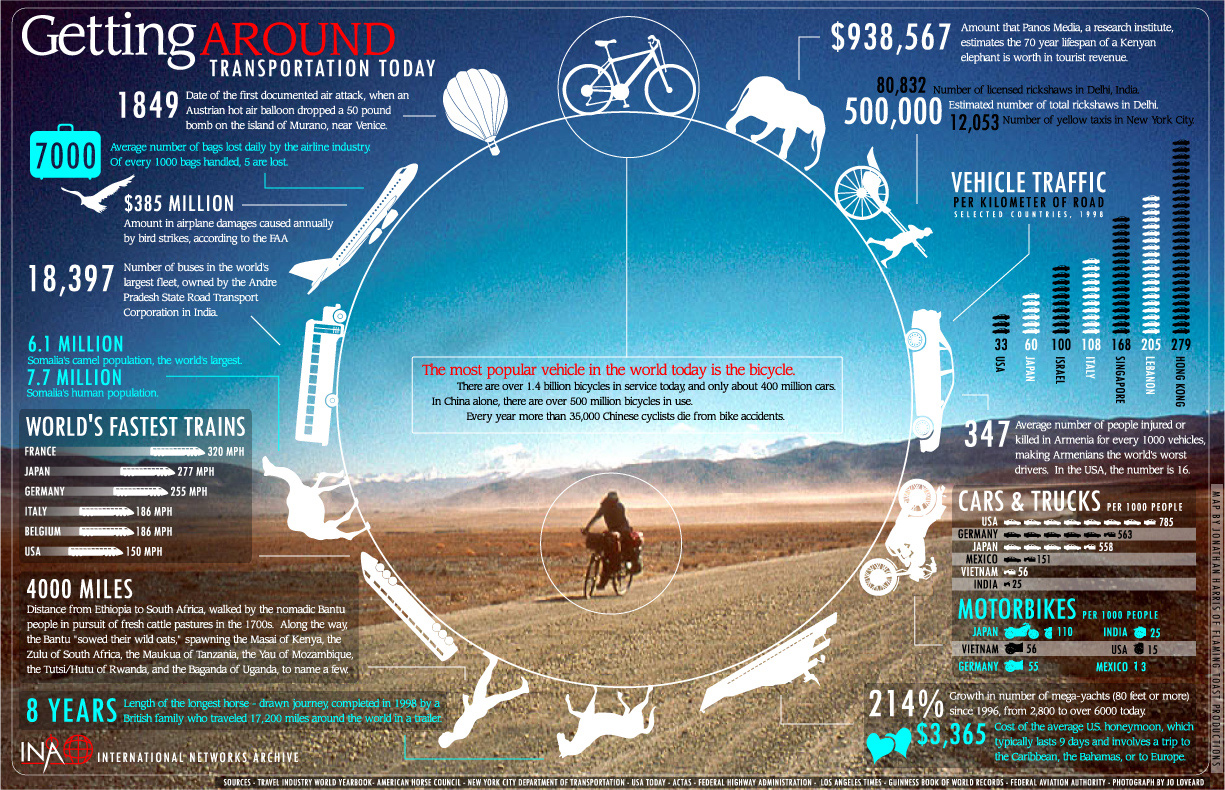
global car sales have never beaten global bicycle sales. Yes cars are now very common, but there are still and have always been over 3 bicycle sold per vehicle sold per year. You can see here: http://www.worldometers.info/bicycles/ Bicycles have always outnumbered cars.
Herbert Hoover[edit]
This hasn't been discussed in awhile, but I just noticed this quote from Hoover on Prohibition: "Our country has deliberately undertaken a great social and economic experiment, noble in motive and far reaching in purpose." That's clearly not intended as a prediction at all, just a statement, but apart from that, what's wrong about it? Prohibition was later repealed, of course, but Hoover didn't claim it was permanent, just "a great social and economic experiment." If one argues about motive and purpose, that still doesn't make it a failed *prediction*, since again nothing about the future is mentioned. I'm taking it out. -- Aleal 06:36, 26 August 2008 (UTC)
Maxim attribution[edit]
I think the Maxim quote about machine guns was actually from Hiram Maxim, the inventor, not his brother, Hudson. See the Ellis source text here: http://www.archive.org/stream/impressionscomme00elliiala/impressionscomme00elliiala_djvu.txt
Accuracy[edit]
- There is not the slightest indication that nuclear energy will ever be obtainable. It would mean that the atom would have to be shattered at will.
o Albert Einstein, 1932.
I'm sure this is incorrect + lacks citations. Can someone confirm? Einstein was a scientist, that wrote several letters to the then US president about the real threat of nuclear energy, hence my reason for incorrect quote 121.218.35.68 13:36, 21 September 2009 (UTC)
Thomas Edison Airplane Quote[edit]
Although the following quote is not the 1895 one referred to in the article, it certainly affirms it.
- The weak point of the present aeroplane, around which the Wright brothers will never be able to get, is that the operation of the machine lies wholly in the wonderful brain of its operator... One fractional mislevelment would mean destruction to the machine and operator. The dirigible balloon is a farce and the aeroplane impracticable... Long ago I saw the impracticability of the lighter-than-air machine... The aeroplane is a primitive adoption of the bird-wing theory, and, as we don't posses the divinity to acquire the automatic action of the bird, it is impossible. In commercializing any new invention, we must follow nature.
o Thomas Edison, 1908; excerpts from speech given Sept. 16, 1908, in Salt Lake City (St. Louis Post Dispatch, Sept. 17, 1908).
Blow Up the World[edit]
"No “scientific bad boy” ever will be able to blow up the world by releasing atomic energy." has been a correct prediction up to this point - the Earth is well and sound. I see no reason to include it in this list.
Unsourced[edit]
- Rail travel at high speed is not possible, because passengers, unable to breathe, would die of asphyxia.
- Dr Dionysius Lardner (1793–1859), professor of Natural Philosophy and Astronomy, University College London, 1823.
- Everyone acquainted with the subject will recognize it as a conspicuous failure.
- Henry Morton, president of the Stevens Institute of Technology, on Edison's light bulb, 1880.
- Transmission of documents via telephone wires is possible in principle, but the apparatus required is so expensive that it will never become a practical proposition.
- Dennis Gabor, British physicist and author of Inventing the Future, 1962.
- The horse is here to stay but the automobile is only a novelty—a fad.
- The president of the Michigan Savings Bank advising Henry Ford's lawyer not to invest in the Ford Motor Co., 1903.
- The ordinary 'horseless carriage' is at present a luxury for the wealthy; and although its price will probably fall in the future, it will never, of course, come into as common use as the bicycle.
- Literary Digest, 1899.
- Flight by machines heavier than air is unpractical (sic) and insignificant, if not utterly impossible.
- Simon Newcomb; The Wright Brothers flew at Kittyhawk 18 months later. Newcomb was not impressed.
- I am afraid I am not in the flight for "aerial navigation". I was greatly interested in your work with kites; but I have not the smallest molecule of faith in aerial navigation other than ballooning or of expectation of good results from any of the trials we hear of. So you will understand that I would not care to be a member of the aëronautical Society.
- Lord Kelvin, British mathematician and physicist, president of the British Royal Society, 1895.[not a prediction]
- It is apparent to me that the possibilities of the aeroplane, which two or three years ago were thought to hold the solution to the [flying machine] problem, have been exhausted, and that we must turn elsewhere.
- Thomas Edison, American inventor, 1895.
- There will never be a bigger plane built.
- Radio has no future.
- Lord Kelvin, Northern Irish mathematician and physicist, former president of the Royal Society, 1897.
- The wireless music box has no imaginable commercial value. Who would pay for a message sent to no one in particular?
- Associates of David Sarnoff responding to the latter's call for investment in the radio in 1921.
- While theoretically and technically television may be feasible, commercially and financially it is an impossibility, a development of which we need waste little time dreaming.
- Lee De Forest, American radio pioneer and inventor of the vacuum tube, 1926.
- Television won't last because people will soon get tired of staring at a plywood box every night.
- Darryl Zanuck, movie producer, 20th Century Fox, 1946.
- Television won't last. It's a flash in the pan.
- Mary Somerville, pioneer of radio educational broadcasts, 1948.
- There is no likelihood man can ever tap the power of the atom.
- Robert Millikan, American physicist and Nobel Prize winner, 1923.
- There is not the slightest indication that nuclear energy will ever be obtainable. It would mean that the atom would have to be shattered at will.
- Albert Einstein, 1932.
- The energy produced by the breaking down of the atom is a very poor kind of thing. Anyone who expects a source of power from the transformation of these atoms is talking moonshine.
- Ernest Rutherford, shortly after splitting the atom for the first time.
- Atomic energy might be as good as our present-day explosives, but it is unlikely to produce anything very much more dangerous.
- Winston Churchill, First Lord of the Admiralty, then soon-to-be British Prime Minister, 1939.
- The basic questions of design, material and shielding, in combining a nuclear reactor with a home boiler and cooling unit, no longer are problems.... The system would heat and cool a home, provide unlimited household hot water, and melt the snow from sidewalks and driveways. All that could be done for six years on a single charge of fissionable material costing about $300.
- Robert Ferry, executive of the U.S. Institute of Boiler and Radiator Manufacturers, 1955.
- Nuclear-powered vacuum cleaners will probably be a reality in 10 years.
- Alex Lewyt, president of vacuum cleaner company Lewyt Corp., in The New York Times in 1955.
- I have traveled the length and breadth of this country and talked with the best people, and I can assure you that data processing is a fad that won't last out the year.
- The editor in charge of business books for Prentice Hall, 1957.
- [By 1985], machines [computers] will be capable of doing any work Man can do.
- Herbert A. Simon, Nobel Laureate from Carnegie Mellon University, one of the founders of the field of artificial intelligence – speaking in 1965.
- There is practically no chance communications space satellites will be used to provide better telephone, telegraph, television, or radio service inside the United States.
- T. Craven, FCC Commissioner (USA), in 1961 (the first commercial communications satellite went into service in 1965).
- What, sir, would you make a ship sail against the wind and currents by lighting a bonfire under her deck? I pray you, excuse me, I have not the time to listen to such nonsense.
- Napoleon Bonaparte, when told of Robert Fulton's steamboat, 1800s.
- The phonograph has no commercial value at all.
- Thomas Edison, American inventor, 1880s.
- X-rays will prove to be a hoax.
- Lord Kelvin, President of the Royal Society, 1883.
- Fooling around with alternating current is just a waste of time. Nobody will use it, ever.
- Thomas Edison, American inventor, 1889 (Edison often ridiculed the arguments of competitor George Westinghouse for AC power).
- I must confess that my imagination refuses to see any sort of submarine doing anything but suffocating its crew and floundering at sea.
- H. G. Wells, British novelist, in 1901.
- The idea that cavalry will be replaced by these iron coaches is absurd. It is little short of treasonous.
- Comment of Aide-de-camp to Field Marshal Haig, at tank demonstration, 1916.
- Very interesting, Whittle, my boy, but it will never work.
- Cambridge Aeronautics Professor, when shown Frank Whittle's plan for the jet engine.
- The world potential market for copying machines is 5000 at most.
- IBM, to the eventual founders of Xerox, saying the photocopier had no market large enough to justify production, 1959.
- I would sooner believe that two Yankee professors lied, than that stones fell from the sky.
- Thomas Jefferson, U.S. President, on hearing reports of meteorites, 1790s(?).
- The abolishment of pain in surgery is a chimera. It is absurd to go on seeking it ... knife and pain are two words in surgery that must forever be associated in the consciousness of the patient.
- Dr. Alfred Velpeau, French surgeon, 1839.
- Louis Pasteur's theory of germs is ridiculous fiction.
- Pierre Pachet, British surgeon and Professor of Physiology at Toulouse, 1872.
- The abdomen, the chest, and the brain will forever be shut from the intrusion of the wise and humane surgeon
- John Eric Ericksen, British surgeon, appointed Surgeon Extraordinary to Queen Victoria, 1873.
- We are probably nearing the limit of all we can know about astronomy.
- Simon Newcomb, Canadian-born American astronomer, 1888.
- If excessive smoking actually plays a role in the production of lung cancer, it seems to be a minor one.
- W. C. Heuper, National Cancer Institute, 1954.
- Four or five frigates will do the business without any military force.
- British prime minister Lord North, on dealing with the rebellious American colonies, 1774.
- Ours has been the first [expedition], and doubtless to be the last, to visit this profitless locality.
- Lt. Joseph Ives, after visiting the Grand Canyon in 1861.
- They couldn't hit an elephant at this distance.
- Last words of Gen. John Sedgwick, spoken as he looked out over the parapet at enemy lines during the Battle of Spotsylvania Court House in 1864.
- No, it will make war impossible.
- Hiram Maxim, inventor of the machine gun, in response to the question "Will this gun not make war more terrible?" from Havelock Ellis, an English scientist, 1893.
- I am tired of all this sort of thing called science here.... We have spent millions in that sort of thing for the last few years, and it is time it should be stopped.
- Simon Cameron, U.S. Senator, on the Smithsonian Institution, 1901.
- Man will not fly for 50 years.
- Wilbur Wright, American aviation pioneer, to brother Orville, after a disappointing flying experiment, 1901 (their first successful flight was in 1903).
- The invention of aircraft will make war impossible in the future.
- George Gissing, 1903.
- Sensible and responsible women do not want to vote.
- Grover Cleveland, U.S. President, 1905.
- You will be home before the leaves have fallen from the trees.
- Kaiser Wilhelm, to the German troops, August 1914.
- Stocks have reached what looks like a permanently high plateau.
- Irving Fisher, economics professor at Yale University, 1929.
- This is the second time in our history that there has come back from Germany to Downing Street peace with honour. I believe it is peace for our time.
- Neville Chamberlain, British Prime Minister, September 30th, 1938.
- The Americans are good about making fancy cars and refrigerators, but that doesn't mean they are any good at making aircraft. They are bluffing. They are excellent at bluffing.
- Hermann Goering, Commander-in-Chief of the Luftwaffe, 1942.
- It will be gone by June.
- Variety, passing judgement on rock 'n roll in 1955.
- We will bury you.
- Nikita Kruschev, Soviet Premier, predicting Soviet communism will win over U.S. capitalism, 1958. Originally mistranslated, a better translation would be "We will be there when you are buried", a common Russian insult.
- In all likelihood world inflation is over.
- International Monetary Fund CEO, 1959.
- Reagan doesn't have that presidential look.
- United Artists Executive, rejecting Ronald Reagan as lead in 1964 film The Best Man.
- And for the tourist who really wants to get away from it all, safaris in Vietnam
- Newsweek, predicting popular holidays for the late 1960s.
- Remote shopping, while entirely feasible, will flop—because women like to get out of the house, like to handle merchandise, like to be able to change their minds.
- Time, 1966, in one sentence writing off e-commerce long before anyone had ever heard of it.
- If anything remains more or less unchanged, it will be the role of women.
- David Riesman, conservative American social scientist, 1967.
- It will be years—not in my time—before a woman will become Prime Minister.
- Margaret Thatcher, future Prime Minister, October 26th, 1969.
- Read my lips: NO NEW TAXES.
- George H. W. Bush, 1988.
- This antitrust thing will blow over.
- Bill Gates, founder of Microsoft.
- It doesn't matter what he does, he will never amount to anything.
- Albert Einstein's teacher to his father, 1895
- The war ... will last ... six days, six weeks ... I doubt six months.
- Donald Rumsfeld on the Iraq War
- If Beethoven's Seventh Symphony is not by some means abridged, it will soon fall into disuse.
- Philip Hale, Boston Music Critic, 1837.
- By the year 1982 the graduated income tax will have practically abolished major differences in wealth.
- Irwin Edman, professor of philosophy Columbia University, 1932.
- I'm just glad it'll be Clark Gable who's falling on his face, and not Gary Cooper.
- Gary Cooper, on declining the lead role in Gone with the Wind.
- We don't like their sound, and guitar music is on the way out.
- Decca Records, when they rejected The Beatles, 1962.
- The singer (Mick Jagger) will have to go; the BBC won't like him.
- First Rolling Stones manager Eric Easton to his partner after watching them perform.
- The case is a loser.
- Johnnie Cochran, on soon-to-be client O.J.'s chances of winning, 1994.
- Children just aren't interested in Witches and Wizards anymore.
- Anonymous publishing executive writing to JK Rowling 1996
- ... so many centuries after the Creation it is unlikely that anyone could find hitherto unknown lands of any value.
- Committee advising King Ferdinand and Queen Isabella of Spain regarding a proposal by Christopher Columbus, 1486.
- Drill for oil? You mean drill into the ground to try and find oil? You're crazy.
- Associates of Edwin L. Drake refusing his suggestion to drill for oil in 1859.
- No one will pay good money to get from Berlin to Potsdam in one hour when he can ride his horse there in one day for free.
- King William I of Prussia, on hearing of the invention of trains, 1864.
- The concept is interesting and well-formed, but in order to earn better than a 'C', the idea must be feasible.
- A Yale University management professor in response to a college assignment by Fred Smith proposing a reliable overnight delivery service, in 1966. Smith would later go on to found Federal Express Corp.
- A cookie store is a bad idea. Besides, the market research reports say America likes crispy cookies, not soft and chewy cookies like you make.
- Response to Debbi Fields' idea of starting Mrs. Fields' Cookies.
- The quote from Neville Chamberlain is sourced. Peace for our time - Just A Regular New Yorker (talk) 00:30, 20 February 2018 (UTC)
New York Times on rocketry[edit]
A story from the day before (1/12/1920) with the headline "Believes Rocket Can Reach Moon." (link: http://query.nytimes.com/mem/archive-free/pdf?res=FB0715FF3A55157A93C0A8178AD85F448285F9 )
"A rocket will never be able to leave the Earth's atmosphere." attributed to the New York Times, 1936
Regarding allegations of William H. Stewart's "incorrect prediction"[edit]
This page repeats the assertion that former Surgeon General William H. Stewart had stated that "[w]e can close the books on infectious diseases." I'm afraid there's no proof that Dr. Stewart ever said this. I'd amend the page itself, citing Spellberg & Taylor-Blake, On the exoneration of Dr. William H. Stewart: debunking an urban legend, Infect Dis Poverty, 2013 Feb 18;2(1):3. doi: 10.1186/2049-9957-2-3, but I'm a co-author on that paper and I recognize that any edit on my part may be doubly scrutinized. I'd be grateful if someone else could revisit the issue of whether Stewart ever made such a pronouncement. Thanks. Bonnie Taylor-Blake (talk), 3 October 2014.
De Forest quote[edit]
His quote is technically correct, in that Apollo never entered a stable lunar orbit.
The article should also be divided between engineers and nontechnical people, since almost all the quotes seem to be the latter. 2607:FB90:1316:7A35:F292:C02E:5F28:65DD 12:22, 26 December 2016 (UTC)