

Talk:Albert Einstein
Add topicUnsourced and dubious/overly modern sources
[edit]- Einstein is one of those major iconic figures to whom many statements become attributed; unsourced attributions to him should usually be treated with some skepticism, and often a great deal of it.
Please put unsourced quotes in alphabetical order for convenience.
- A clever person solves a problem. A wise person avoids it.
- Probably not real, earliest published version I found was this one from 1997, but it seems to have been on the internet slightly before that, see this post from 1996. Hypnosifl 18:17, 30 November 2011 (UTC). However in his 1986 college text book 'Tools for Thinking and Problem Solving', Moshe Rubinstein states "It has been said that a smart person manages to escape from unpleasant situations that a wise person would avoid in the first place" - a similar general meaning, with the similarity of names ( Rubinstein vs Einstein ) perhaps explaining the misattribution.
- A person starts to live when he can live outside himself.
- Earliest published source I could find was the 1993 book Zen and the Art of Making a Living by Laurence G. Boldt, p. 100. Was on the internet before that, as in this post from 1991. Hypnosifl 02:01, 1 December 2011 (UTC)
- A table, a chair, a bowl of fruit and a violin; what else does a man need to be happy.
- Earliest published source I find is the 2003 book Albert Einstein by Dana Meachen Rau, p. 19. But it appeared on the internet before that, earliest one I found was this post from 5 January 1993. Hypnosifl 01:11, 6 December 2011 (UTC)
- Any fool can know. The point is to understand.
- Not a lot of sources for this, see the search here, oldest one seems to be Precalculus mathematics in a nutshell: geometry, algebra, trigonometry by George Finlay Simmons, from 1981. Hypnosifl 02:14, 1 December 2011 (UTC)
- “Any man who can drive safely while kissing a pretty girl is simply not giving the kiss the attention it deserves.” - saw this on my Facebook today, and it's widely repeated on the web, with no good source. --Slashme (talk) 15:18, 12 August 2012 (UTC)
- Earliest source I see on google books that attributes it to Einstein is the 2002 book More Sex Talk by James Wolfe, p. 91. I did find earlier sources which give the same quote but without attributing it to Einstein (I did an advanced google books search for "kiss the attention it deserves" with the date range of 1900 - 2002), like the 1968 book 20,000 Quips and Quotes by Evan Esar, p. 452, or American Gas Journal vol. 184 from 1957, see this snippet from p. 155. This post from the snopes.com board claims to give a bunch of much earlier sources where the quote wasn't attributed to Einstein, but I can't check if the attributions to various newspapers below are actually accurate:
- [Tennessee Ernie Ford] notes that the man who can drive while kissing a pretty girl is not giving the kiss the attention it deserves. [From Larry Wolters's "Radio TV Gag Bab," The Chicago Daily Tribune, 3 April 1955, Pg. H16.]
- The current edition of the Hudson Motor Car Co.'s Newsletter contains the information that this safety-first sign appears on the Alaska Highway: "The man who can drive safely while kissing a pretty girl is not giving the kiss the attention it deserves." [From "Personal Notes," The Washington Post, 24 December 1951, Pg. B8.]
- Braddock Motor hints: Never allow a girl to kiss you when you are out driving with her, for if she can drive a car while kissing you, she's not giving the kiss the attention it deserves. [The Pittsburgh Courier, 24 November 1928, Pg. 6.]
- "Do you allow Jack to kiss you when you're out motoring with him?" "Never. If a man can drive safely when kissing me, then he's not giving the kiss the attention it deserves." [From The Pittsburgh Courier, 15 January 1927, Pg. 3.]
- One of our fluffy flappers allows no kissing when she is out riding. She says a man cannot drive a car and give the kiss the attention it deserves. [From "Pen Points," The Los Angeles Times, 12 June 1924, Pg. A4.]
- Dorcas -- "Do you ever allow a man to kiss you when you're out motoring with him? Philippa -- "Never. If a man can drive safely while kissing me, he is not giving the kiss the attention it deserves." [From "Safety First," which appeared in an automotive supplement to the Southtown [Chicago] Economist, 12 March 1924, Pg. 24.] Hypnosifl (talk) 17:45, 13 August 2012 (UTC)
- Anyone who has never made a mistake has never tried anything new.
- Earliest sources on this search are from 1999, but it appears on the internet before that, like this post from 1996. Hypnosifl 02:38, 1 December 2011 (UTC)
- As our circle of knowledge expands, so does the circumference of darkness surrounding it.
- Earliest variant I find is "As the area of light increases so does the circumference of darkness" in the 1971 book Cell and Molecular Biology by Eugene Rosenberg, p. 199. Hypnosifl 22:42, 30 November 2011 (UTC)
- Before God we are all equally wise, equally foolish.
- Appears in Albert Einstein: Maker of Universes from 1939 on p.80, but doesn't look like original source is mentioned. Hypnosifl 22:37, 30 November 2011 (UTC)
- Creativity is intelligence having fun.
- Coincidence is God's way of remaining anonymous.
- Earliest published source I found attributing it to Einstein is the 2000 book What every principal would like to say-- and what to say next time: quotations for leading, learning, and living by Noah benShea, p. 94. Quote itself is a lot older though, for example Love, medicine, & miracles by Bernie S. Siegel, from 1986, has this exact quote on p. 214. There are other variants before that, like in I Hurt Too Much for a Band-Aid by Kenneth J. Olson and Helen Lovell from 1980, which says on p. 111 "A coincidence is when God performs a miracle and chooses to remain anonymous". Hypnosifl 03:00, 1 December 2011 (UTC) CS Lewis "Coincidence is a miracle in which God chooses to remain anonymous."??--66.190.141.195 14:20, 7 March 2017 (UTC)
- Every day, man is making bigger and better foolproof things, and every day, Nature is making bigger and better fools. So far, I think Nature is winning.
- Alternate: There is a race between mankind and the universe. Mankind is trying to build bigger, better, faster, and more foolproof machines. The universe is trying to build bigger, better, and faster fools. So far the universe is winning.
- Zero hits for "Nature is making bigger and better fools" on google books. Earliest internet post I find with "Nature is making bigger and better fools" is this one from Dec 1999, but the rest of it is different and it doesn't say anything about Einstein. The next-earliest one I find is at the bottom of this one from Dec 2000, which has the full quote as above and it's attributed to Einstein. Hypnosifl 06:17, 3 December 2011 (UTC)
- By Rick Cook (1989): "Programming today is a race between software engineers striving to build bigger and better idiot-proof programs, and the Universe trying to produce bigger and better idiots. So far, the Universe is winning." --Traal (talk) 23:51, 10 June 2015 (UTC)
- Example isn't another way to teach, it is the only way to teach.
- Searching google books for "example", "isn't another way to teach" and "only way to teach", earliest instances are two books from 2002, here and here. Neither gives a source, and I didn't see a source in later books, so probably not trustworthy. As usual the original source is probably the internet since searching google groups shows posts using the quote before that, earliest one I found was at the bottom of this one from June 1998. Hypnosifl 06:27, 3 December 2011 (UTC)
- Everybody is a genius. But if you judge a fish by its ability to climb a tree, it will live its whole life believing that it is stupid.
- As quoted in The Rhythm of Life : Living Every Day with Passion and Purpose (2004) by Matthew Kelly, p. 80
- I am thankful to all those who said NO to me. It's because of them I did it myself
- This is being attributed to Einstein on the Internet, but it appears to come from Wayne W. Dyer's book You'll See It When You Believe It, page 54, according to Google Books. Dyer does not attribute it to Einstein, but mentions Einstein in the same paragraph.
- In my office I have two framed posters. One is a picture of Albert Einstein, beneath which are the words "Great spirits have always encountered violent oppostion from mediocre minds." The other poster is made up solely of words: "I am grateful to all those people who said no. It is because of them I did it myself." Great thoughts!
- Apparently someone misread this and thought the quote was from Einstein. I don't know who was the first to do this. Imaid (talk) 23:47, 12 March 2012 (UTC)
- This is being attributed to Einstein on the Internet, but it appears to come from Wayne W. Dyer's book You'll See It When You Believe It, page 54, according to Google Books. Dyer does not attribute it to Einstein, but mentions Einstein in the same paragraph.
- I believe no woman could have invented calculus.
- Zero published examples, and only two on google groups...I wonder if someone just made this one up to add to the wikiquote unsourced list (it was added in this edit from 25 March 2007, by a user whose only wikiquote contributions were adding this quote and bolding a few others). Searching for variants on google books did turn up a quote by someone called Edward Jewitt Wheeler, who in 1908 Current Literature wrote "No woman ever invented a calculus", but this is such an obscure source that I doubt it's the inspiration. Hypnosifl 05:40, 3 December 2011 (UTC)
- I could burn my fingers that I wrote that first letter to Roosevelt.
- Comment after the bombing of Hiroshima, regarding his letter to Roosevelt warning of the possibility of the development of a nuclear weapon.
- Earliest internet post I find is this one from 2002 where it seems to be part of a quote from a larger work, apparently this essay (link is to an archived copy from 22 Dec 1997, so it's at least that old) by someone called Richard V. Duffy. This 2002 book is the earliest published source with the quote, but it doesn't give a source and may have just gotten it from the internet. Hypnosifl 05:59, 3 December 2011 (UTC)
- I didn't arrive at my understanding of the fundamental laws of the universe through my rational mind.
- According to Google Books, the earliest appearance of this quote is in the 1971 book Be Here Now by Ram Dass.
- I don't believe in mathematics.
- He's quoted saying this sometime before 1910 on p. 3 of this paper, with the reference given as p. 21 of The Young Einstein by Lewis Pyenson. The paper talks about how his attitude towards mathematics evolved, he's also quoted at the top of p. 5 saying "I have become imbued with great respect for mathematics, the subtler part of which I had in my simple-mindedness regarded as pure luxury until now." Also, more context for the "don't believe in mathematics" comment is given on p. 76 of Einstein: A Life by Denis Brian, where Brian writes that Einstein "demonstrated his cavalier attitude toward math one afternoon in a café when he and engineer Gustave Ferriere were discussing math’s rigid rules. Einstein placed five matches on the table and asked, 'What is the total length of these five matches if each is two and a half inches long?' 'Twelve and a half inches,' Ferriere replied. 'That’s what you say,' said Einstein. 'But I very much doubt it. I don’t believe in mathematics.' " Hypnosifl 22:31, 2 December 2011 (UTC)
- I don't pretend to understand the universe — it's much bigger than I am.
- Only published example is this one from 2008 which gives no source. Was circulating on the internet long before that, earliest post I found with it was this one from 1991. Hypnosifl 06:37, 3 December 2011 (UTC)
- I fear the day when technology overlaps our humanity. It will be then that the world will have permanent ensuing generations of idiots.
- Above quote does not appear in The Ultimate Quotable Einstein compiled by Alice Calaprice, a renowned Einstein expert and of Princeton University Press.
- I must be willing to give up what I am in order to become what I will be.
- Attributed to Einstein on page 175 of Jill Bolte Taylor's My Stroke of Insight. Don't think this is necessarily a reliable source though.
- No published sources earlier than My Stroke of Insight, but it was on the internet long before then so she probably got it from there--earliest internet post I found was this one from 1992. Hypnosifl 06:40, 3 December 2011 (UTC)
- I never teach my pupils; I only attempt to provide the conditions in which they can learn.
- Earliest published source I find is the 1968 book Training within the organization: a study of company policy and procedures for the systematic training of operators and supervisors which on p. 126 says: "It was probably in the latter sense that Professor Einstein in talking about teaching once remarked: 'I never teach my pupils. I only attempt to provide the conditions in which they can learn.' " No source is given, and none of the other books I saw gave a source either. Hypnosifl 06:47, 3 December 2011 (UTC)
- I think and think, for months, for years. Ninety-nine times the conclusion is false. The hundredth time I am right.
- Earliest appearance seems to be the 1939 book Albert Einstein: Maker of Universes, p. 96. Just says this was a comment he made to "a friend" so it's not clear if the author actually got a firsthand account or was just repeating a story he heard through the grapevine (this is the same book that has the unsourced "Before God we are all equally wise, equally foolish" quote above). Hypnosifl 22:04, 5 December 2011 (UTC)
- I think that a particle must have a separate reality independent of the measurements. That is an electron has spin, location and so forth even when it is not being measured. I like to think that the moon is there even if I am not looking at it.
- Earliest published version found is the 1999 book Words Fail Me by Patricia O'Conner, p. 41. Earliest internet post is this one from 1996. The part about the moon is probably based on Abraham Pais' recollection in Albert_Einstein#Attributed_from_memory_and_posthumous_publications, "We often discussed his notions on objective reality. I recall that during one walk Einstein suddenly stopped, turned to me and asked whether I really believed that the moon exists only when I look at it." Hypnosifl 23:41, 6 December 2011 (UTC)
- I want to know how God created this world. I'm not interested in this or that phenomenon, in the spectrum of this or that element. I want to know His thoughts; the rest are details.
- said to be from E. Salaman, "A Talk With Einstein," The Listener 54 (1955), pp. 370-371 [1] Lanulos (talk) 19:10, 4 October 2012 (UTC)
- If at first the idea is not absurd, then there is no hope for it.
- Earliest references I found are two from 1996, Fad Surfing in the Boardroom and The Next Step in Database Marketing. None of the books that I saw gave an original source for the quote. Hypnosifl 19:37, 4 December 2011 (UTC)
- If I give you a penny, you will be one penny richer and I'll be one penny poorer. But if I give you an idea, you will have a new idea, but I shall still have it, too.
- Only published source found on google books with "Einstein" and "penny richer" is Open Life: The Philosophy of Open Source from 2006, which has it on p. 21. Hypnosifl 06:57, 3 December 2011 (UTC)
- If I had only one hour to save the world, I would spend fifty-five minutes defining the problem, and only five minutes finding the solution.
- I found LOTS of attributions of this quote including many books, but I couldn't find any that gave a source. Some references cite the ratio as 59:1. The furthest variation I found was here in another quote database. --WBTtheFROG 14:40, 10 January 2012 (UTC)
- Searching on google books shows it appears in a lot of business books and books on "creativity" but there don't seem to be any historical or scientific ones among them. Earliest I found was the 1995 book Creative Problem Solving and Opportunity Finding by J. Daniel Cougar, where it appears on p. 178. Hypnosifl 21:57, 10 January 2012 (UTC)
- If I knew what I was doing, it wouldn't be called research.
- Variant: If we knew what we were doing, it wouldn't be called research, would it?
- Earliest published variant I find attributing it to Einstein is "If we knew what it was we were doing, it wouldn't be called 'research,' would it?" from p. 272 of Natural Capitalism from 1999 (to see it, go to the amazon page and "search inside the book" for the word "Einstein"). Was attributed to Einstein on the internet befor that though, earliest I saw was this one from 26 April 1994. And if you search google books for "if we knew what we were doing" and "research" without Einstein, you find examples that just present it as an old joke and don't mention Einstein, earliest I found was Yearbook of Procurement Articles by John Whelan from 1977, which says on p. 32 'I have a colleague who delights in saying, "If we knew what we were doing, we wouldn't need research."' And Organizing for Tomorrow: Reports from the Think-Tanks and the Trenches from 1985 has this comment on p. 19: 'I flashed back on a quote that hung in one of my old offices for several years: "If we knew what we were doing it wouldn't be called research."' Hypnosifl 07:30, 3 December 2011 (UTC)
- Another variant dates to the astronomer J. Allen Hynek in 1951: "If we know the answer before we start, it wouldn't be research." [2] User:gmusser
- If one day you have to choose between the world and love, remember: If you choose the world you’ll be left without love, but if you choose love, with it you will conquer the world
- Searching for if one day you have to choose between the world and love on google gives over 300,000,000 hits; from the top hits most of them attribute the quote to Einstein, others give no attribution. I couldn't find any reputable source. The earliest reference I could find on google groups is from 2010. --NavarroJ (talk) 21:22, 20 November 2012 (UTC)
- If people are good only because they fear punishment, and hope for reward, then we are a sorry lot indeed.
- Earliest published reference found is the 2003 book Nuggest of Wisdom from the Effendi, p. 81, earliest internet reference found is this post from 27 April 1989.
- Perhaps a paraphrase of "Man would indeed be in a poor way if he had to be restrained by fear of punishment and hopes of reward after death", from Religion and Science (it's at the end of the quote that begins with "The man who is thoroughly convinced of the universal operation of the law of causation...") Another similar one is from a 1948 interview recorded in Einstein and the Poet where he said "What a miserable creature man would be if he were good not for the sake of being good, but because religion told him that he would get a reward after this life, and that if he weren't good he'd be punished." Hypnosifl 20:42, 7 November 2011 (UTC)
- If the solution is simple, God is answering.
- Didn't find any published sources earlier than Esquire: Volume 106 (1988). Hypnosifl 00:03, 6 December 2011 (UTC)
"Imagination is everything. It is the preview of life's coming attractions." —The preceding unsigned comment was added by 81.37.67.0 (talk • contribs) 02:36, 4 August 2007 (UTC)
- It is quoted by einstien in his book, even steve harvey mentioned it on his show! https://steveharvey.com/preview-the-coming-attractions-in-your-life/#:~:text=Albert%20Einstein%20has%20a%20famous,that%20is%20just%20for%20you.
- It is a miracle that curiosity survives formal education.
- This was simply cited as an anonymous saying in the earliest publication which has been located: How to Give a Damn Good Speech: Even When You Have No Time to Prepare (2000) by Philip R. Theibert, p. 154; the earliest published attribution of this to Einstein yet located is in House-Dreams (2001) by Hugh Howard, p. 45, while it was attributed to Einstein on the internet well before that, the oldest located being this post from 4 August 1989. It has since become attributed to Einstein in several publications, but without citation of an original source.
- It's a rather close paraphrase of the following from his Autobiographical Notes: "It is, in fact, nothing short of a miracle that the modern methods of instruction have not yet entirely strangled the holy curiosity of inquiry; for this delicate little plant, aside from stimulation, stands mainly in need of freedom; without this it goes to wreck and ruin without fail. It is a very grave mistake to think that the enjoyment of seeing and searching can be promoted by means of coercion and a sense of duty."
- It is harder to crack a prejudice than an atom.
- It is easier to disintegrate an atom than a prejudice.
- Earliest version I found is this one from 1984, but none that I saw gave a source, I doubt it's real. Hypnosifl 18:12, 30 November 2011 (UTC)
- Earlier variant, still no source: "It is a sad age when it is more difficult to break a prejudice than an atom." Facts Forum news, Volume 4, Issue 7 from 1955, on this page. Hypnosifl 23:53, 6 December 2011 (UTC)
- It's become appallingly clear that our technology has surpassed our humanity.
- It has become appallingly obvious that our technology has exceeded our humanity.
- As quoted in Voices of Truth : Conversations with Scientists, Thinkers, and Healers (2000) by Nina L. Diamond, p. 429; no publication of this statement has been located prior to it's use in the film Powder (1995) written by Victor Salva, where it is presented as a quote of Einstein.
- More information about this can be found in this post from Quote Investigator Jjjjjjjjjj (talk) 00:03, 21 December 2012 (UTC)
- It's not that I'm so smart, it's just that I stay with problems longer.
- Earliest source I found was the 1996 book Bite-Size Einstein: Quotations on Just About Everything from the Greatest Mind of the Twentieth Century, p. 17. But no source is given, and I don't see any other books that give a source either. Hypnosifl 21:20, 2 December 2011 (UTC)
- Logic will get you from A to B. Imagination will take you everywhere.
- Over 600K hits for this phrase on google, the top 100 attributing it to Einstein (I didn't scroll through the rest), but I can't find anything pointing to a legitimate source for this quote. Any ideas? Phlar (talk) 19:21, 6 June 2012 (UTC)
- Doing an advanced google groups search for "logic will get you" and "einstein" with the date range restricted to 1981-2002, earliest I found was the Oct. 14 1999 quote from Cowboy Greg here. The same search on google books with the date range 1900-2004 yields only two books I could confirm to have the quote inside, both from 2004, Machine Learning And Statistical Modeling Approaches To Image Retrieval, p. 123 and Ode to Code, at the end of the book before the "About the Author" page (pages un-numbered). Probably this is one of those quotes that got its start on the internet. Hypnosifl (talk) 15:17, 13 June 2012 (UTC)
- Quote is in The Ultimate Quotable Einstein by The Ultimate Quotable Einstein (Hardcover) by Freeman Dyson and Albert Einstein and Alice Calaprice on p. 481 but lists it as "Attributed to Albert Einstein" which was originally published in 1996. 2602:D8:A1BF:E600:C991:6369:6CEA:C5A3 16:59, 23 June 2012 (UTC)
- It's true it appears in The Ultimate Quotable Einstein, but it appears in the "Probably Not By Einstein" subsection of the "Attributed" section, indicating that Calaprice couldn't find a source and considers it unlikely to be a real Einstein quote. Hypnosifl (talk) 00:45, 24 June 2012 (UTC)
- No amount of experimentation can ever prove me right; a single experiment can prove me wrong.
- A bunch of pre-1950 sources for this but they all say this is something he is "reported to have said" without giving an exact source. Earliest I find is in Science News-Letter, Volume 14 which according to the title page collects issues from June to December, 1928, the quote appears on p. 52.
- In The New Quotable Einstein Alice Calaprice speculates on p. 291 that 'This may be a paraphrase of sentiments expressed in "Induction and Deduction," December 25, 1919, CPAE, Vol. 7, Doc. 28'. Einstein's Unification by Jeroen van Dongen has a quote from the article (full English title given as "Induction and Deduction in Physics") on p. 44: 'A theory can thus be recognized as erroneous if there is a logical error in its deductions, or as inadequate if a fact is not in agreement with its consequences. But the truth of a theory can never be proven. For one never knows that even in the future no experience will be encountered which contradicts its consequences; and still other systems of thought are always conceivable which are capable of joining together the same given facts.' Also, p. 18 of Albert Einstein, the Human Side has a note he wrote down on 11 Nov 1922 which expresses a basically similar idea: 'The scientific theorist is not to be envied. For Nature, or more precisely experiment, is an inexorable and not very friendly judge of his work. It never says "Yes" to a theory. In the most favorable cases it says "Maybe," and in the great majority of cases simply "No." If an experiment agrees with a theory it means for the latter "Maybe," and if it does not agree it means "No." Probably every theory will someday experience its "No"—most theories, soon after conception.' Hypnosifl 21:50, 2 December 2011 (UTC)
- Nothing will benefit human health and increase chances for survival of life on Earth as much as the evolution to a vegetarian diet.
- Earliest published source I could find was this book from 1992, earliest appearance I could find on the internet was this post from 1991. Hypnosifl 22:30, 30 November 2011 (UTC)
- Perhaps a variant of this quote that appears in The New Quotable Einstein by Alice Calaprice, p. 281 of my edition, in the "Vegetarianism" section of the "On Miscellaneous Subjects" chapter: "Although I have been prevented by outward circumstances from observing a strictly vegetarian diet, I have long been an adherent to the cause in principle. Besides agreeing with the aims of vegetarianism for aesthetic and moral reasons, it is my view that a vegetarian manner of living by its purely physical effect on the human temperament would most beneficially influence the lot of mankind." From a letter to Harmann Huth, 27 December 1930. Supposedly published in German magazine Vegetarische Warte, which existed from 1882 to 1935. Einstein Archive 46-756 Hypnosifl 22:06, 2 December 2011 (UTC)
- Once you can accept the universe as matter expanding into nothing that is something, wearing stripes with plaid comes easy.
- Don't see any published examples before 2004, earliest internet post I see with this quote attributed to Einstein is this one from 19 August 1998, but I see this earlier post from 18 November 1996 where someone says "After accepting relativity, wearing stripes with plaid comes easy!" and they don't attribute it to Einstein or anyone else. Hypnosifl 07:57, 3 December 2011 (UTC)
- Problems cannot be solved by the level of awareness that created them.
- variant: We can't solve problems by using the same kind of thinking we used when we created them
- variant: The significant problems we face cannot be solved at the same level of thinking we were at when we created them.
- variant: No problem can be solved from the same consciousness that created it.
- This articles points to the proper source and context for this quote http://icarus-falling.blogspot.ca/2009/06/einstein-enigma.html
- Comment: In the main text this quote is related to nuclear politics, but it has a interesting flavour of Godel's theorem; if the source is to be found, it should be in this context.
- Don't see any books that give an original source, and earliest publication on google books with "same level of awareness" and "einstein" is the 1997 book The Living Company, p. x. Earliest posts on google groups with this quote are from March 1995, like this one. Also, for the variants involving "thinking", in Albert_Einstein#1940s there's a discussion of the quote "A new type of thinking is essential if mankind is to survive and move toward higher levels", which mentions that Alice Calaprice speculated that some similar unsourced quotes about the need to change our "thinking" to better the world may be misquotes of that one. Hypnosifl 22:12, 3 December 2011 (UTC)
- The variant "The significant problems we face cannot be solved at the same level of thinking we were at when we created them" can be found on google groups before the "same level of awareness" version, earliest I found was in this post from March 1992. This is also earlier than variants with "same kind of thinking" and "same consciousness that created", so maybe this is the earliest version that the others mutated from. There are also pre-1992 versions of the "same level of thinking" quote on google books, earliest I found was the 1990 book The Seven Habits of Highly Effective People, p. 42 (this was a pretty popular book so it would have been a good patient zero for spreading this meme!) And just looking for books with "Einstein" and "same level of thinking" it looks like a slightly older variant is "The significant problems we have cannot be solved at the same level of thinking we were at when we created them." This appears in the 1988 book Take this job and love it by Dennis T. Jaffe and Cynthia D. Scott, p. 60. It also appears without quotation marks on p. 54 of The Quest, Vol. 1-2 (1988) from the Theosophical Society. (edit: I thought at first The Quest could be the original source of the quote since it gives a paraphrase rather than claiming to be a direct quote, but see below...) Hypnosifl 15:40, 7 December 2011 (UTC)
- I missed an even earlier "same level of thinking" example from 1985: The 1985 Annual: Developing Human Resources, Issue 14 by Leonard D. Goodstein and J. William Pfeiffer, p. 185: "Our thinking has created problems which cannot be solved by that same level of thinking." The Quest might still be the source of "the world we have made" part that appears in some of these quotes, though. Hypnosifl 16:17, 7 December 2011 (UTC)
- Looks like the article in The Quest is "Believing Is Seeing, Not the Reverse" by "educator Edward T. Clark, Jr." mentioned on p. 4, which begins on p. 49 and ends on p. 56 (the Einstein quote is p. 54). From the byline at the end, this article is from 1988, so it probably doesn't predate the quote in Take this job and love it since according to amazon that book was published in March 1988, and the quote given there is said to be the motto of an already-existing organization, "The Organizational Management and Leadership Program at John F. Kennedy University in Orinda, California." Hypnosifl 16:43, 7 December 2011 (UTC)
- Ah, searching for "Einstein" and "level of thinking" rather than "same level of thinking" turns up a much earlier example from The Journal of Transpersonal Psychology, Volumes 1-4, which is dated 1969 by google books though these snippets show it contains pieces from 1969 and 1970. The quote, on p. 124, is "The world that we have made as a result of the level of thinking we have done thus far creates problems that we cannot solve at the same level as the level we created them at." It's prefaced by "Einstein said an interesting thing", and the same phrase and quote appears in a 1974 book by Ram Dass (who needs his own wikiquote page!), The Only Dance There Is, on this page, so presumably the one in The Journal of Transpersonal Psychology is the same piece by Ram Dass. Ram Dass may also be the source of another misquote, the one at Talk:Albert_Einstein#Quote_Misattribution.3F--whatta rascal! Hypnosifl 17:09, 7 December 2011 (UTC)
- Also, the next two earliest versions I find on google books (searching for "Einstein" and "level of thinking" on an advanced search with date range 1900-1979) use wording nearly identical to the version given by Ram Dass (who now does have a wikiquote page): Skeptic 1-10, p. 55 (1974), which from this snippet is from the article "A Radical Restructuring: An Interview with David Dellinger", and New Age, Volume 5, p. 42 (1979), with the rest of the quote in this snippet...here "New Age" appears to be the same magazine as the New Age Journal founded by Peggy Taylor, whose name appears in this snippet, a snippet that also mentions "Faith, Science, and the Future by David Harris" which seems to start on p. 41 of the google books edition, so that's probably the article the Einstein quote on p. 42 comes from (the snippet with Peggy Taylor also lists "Faith, Science, and the Future" as appearing in the October 1979 issue). The supposed Einstein quote from Skeptic reads "the world we have made as a result of the level of thinking we have done thus far creates problems that we cannot solve at the level of thinking at which we created them", and the one from New Age reads "the world that we have made, as a result of the level of thinking we have done thus far, creates problems that we cannot solve at the same level we created them", both identical to Ram Dass' quote in the first part and very close in the second part. Since Ram Dass generally spoke extemporaneously without using notes, and The Only Dance There Is says the section with the Einstein quote is from talks he gave to "spiritual seekers" at "the Menninger Foundation in 1970", it's likely he would have been paraphrasing a bit even if his source was some other unknown one that also misquoted Einstein (as opposed to him being the original source of the misquote as I am speculating). So if the only other sources found in the 1970s repeat Ram Dass' exact wording, it seems pretty likely that Ram Dass (or some secondary source that got the quote from Ram Dass) was the source for them. And the later variants that emerged in the 1980s and 1990s might well be all from authors that got their quotes in a chain of influences that goes back to Ram Dass' version. Hypnosifl (talk) 15:34, 20 July 2012 (UTC)
- And expanding the date range of the search to 1900-1985, the next earliest version of the quote after the ones above is again almost identical in wording to Ram Dass' version (aside from replacing "cannot" with "can't"): Community mental health and behavioral-ecology (1982). Google is a bit glitchy so no result is found when I go to the book's page and search "Einstein" or "level of thinking", but the book appears on p. 2 of all the search results for those words with date range 1900-1985, alongside the snippet: "... AND KNOWLEDGE BASES The world we have made as a result of the level of thinking we have done thus far creates problems that we can 't solve at the same level as the level we created them at. (Albert Einstein; cited by Ulrich." Then after this book, the next-earliest that is verified to have the words "einstein" and "level of thinking" by google books is The 1985 Annual: Developing Human Resources, Issue 14, p. 185 (1985). This book has the first major variant on Ram Dass' version that I've found, "Our thinking has created problems which cannot be solved by that same level of thinking." Hypnosifl (talk) 16:00, 20 July 2012 (UTC)
- Found the above Community mental health and behavior-ecology, the quote appears on p. 1: The world we have made as a result of the level of thinking we have done thus far creates problems that we can't solve at the same level as the level we created them at. (Albert Einstin; cited by Ulrich, 1980, p. 2.) And the "Ulrich" reference is: Ulrich, R. E. The use of behavior modification strategies to increase the probability of attendance at evening chapel through the use of food contingent reinforcement at the Life Line Mission, San Francisco, California. Behaviorists for Social Action Journal, 1980, 2 (2), 1-2. Hypnosifl (talk) 17:57, 6 August 2012 (UTC)
- Searching for the phrase "solve at the same level we created them" turns up a few other sources that for some reason didn't turn up when I searched "level of thinking" and "einstein" (google book searches seem to be very glitchy): The 1975 book More power than we know: the people's movement toward democracy by David Dellinger, p. 291 ("The world that we have made as a result of the level of thinking we have done thus far creates problems that we cannot solve at the same level we created them at"); 1982's Perspectives, Volume 14, Issue 3 from the United States Commission on Civil Rights, p. 26 (same version as Dellinger book); and The 1982 book Nuclear Power, Both Sides: The Best Arguments for and Against the Most Controversial Technology by Michio Kaku and Jennifer Trainer, p. 238 (nearly the same as the Dellinger book, but with "The world we have made" in place of "The world that we have made"). Hypnosifl (talk) 00:36, 22 July 2012 (UTC)
- I also seem to get different results when I use Safari than when I use Firefox. Searching for "level of thinking" and "Einstein" on Safari, and sorting the results by date and looking at the earliest, I also see the 1979 volume Behaviorists for Social Action journal, Volumes 2-3, p. 2 (the quote here is "The world we have made as a result of the level of thinking we have done thus far creates problems that we can't solve at the same level as the level we created them at"), and searching for "world that we have made" and "einstein" gives the various pre-1985 sources: the1980 book Beat the system!: A way to create more human environments, p. 1 ("The world that we have have made as a result of the level of thinking that we have done thus far creates problems that we cannot solve at the same level at which we created them"), the 1983 book The Optimum utilization of knowledge: making knowledge serve human betterment, p. 295 ("The world that we have made as a result of thinking we have done thus far creates problems that we cannot solve at the level we created them at"), and 1984 National Science Foundation Authorization: Hearings Before the Subcommittee on Science, Research, and Technology of the Committee on Science and Technology, U.S. House of Representatives, Ninety-eighth Congress, First Session, on H.R. 2066, February 23, 25; March 1, 8, 10, 1983, p. 240 ("The world that we have made as a result of the level of thinking we have done thus far creates problems that we cannot solve at the same level as the level we created them at"). Again, all of these pre-1985 quotes seem to be very close to Ram Dass' version from 1970, "The world that we have made as a result of the level of thinking we have done thus far creates problems that we cannot solve at the same level as the level we created them at." Hypnosifl (talk) 03:54, 22 July 2012 (UTC)
- Trying to judge which are more popular variants, and the order they appeared in published sources. "The significant problems we face cannot be solved at the same level of thinking we were at when we created them": 313 results on google books (earliest 1990). "We can't solve problems by using the same kind of thinking we used when we created them": 222 results (earliest 2000). "No problem can be solved from the same consciousness that created it": 119 results (earliest are two from 1993, here and here). "The significant problems we have cannot be solved at the same level of thinking with which we created them": 65 results (earliest 1995). "The world we have created is a product of our thinking; it cannot be changed without changing our thinking": 32 results (earliest 1993). "The world we have created today as a result of our thinking thus far has problems which cannot be solved by thinking the way we thought when we created them": 18 results (earliest 1992). "The world we have made as a result of the level of thinking we have done thus far creates problems we cannot solve at the same level at which we created them": 14 results (earliest 1986). "The world that we have made as a result of the level of thinking we have done thus far creates problems that we cannot solve at the same level as the level we created them at": 6 results (earliest is Ram Dass' talk above, said in book's introduction to be from 1970). "The significant problems we have cannot be solved at the same level of thinking we were at when we created them": 4 results (earliest 1988). "Our thinking has created problems which cannot be solved by that same level of thinking": 1 result (1985). Maybe I'll add some of the more popular variants to the "Disputed" or "Misattributed" section. Hypnosifl 05:55, 13 December 2011 (UTC)
- Another variant: "A problem can't be solved at the same level it was created." From the 1986 book The power of people skills: a manager's guide to assessing and developing your organization's greatest resource by John Douglas Stewart, p. 127. Hypnosifl (talk) 04:09, 22 July 2012 (UTC)
- Setting an example is not the main means of influencing another, it is the only means.
- Couldn't find any books that give an original source, earliest one I found with this quote was Words for all Occasions by Glenn Van Ekeren (1988), p. 234. Hypnosifl 22:41, 3 December 2011 (UTC)
- So long there are men, there will be wars.
- Appears in Einstein: A Life by Denis Brian, p. 172. Hypnosifl 16:06, 4 December 2011 (UTC)
- The difference between genius and stupidity is that genius has its limits.
- Variant: The greatest difference between genius and stupidity is that genius is limited.
- Earliest published source I find attributing it to Einstein is the 1999 publication 73 amateur radio today, Issues 460-470, p. 57. It's attributed to Einstein in internet posts before then, earliest I found was from 7 August 1995. But the quote was presented as an anonymous saying well before that, earliest I found was the 1961 Grassroots Editor which says on p. 34 "One man says that the difference between genius and stupidity is that genius has its limits." Hypnosifl 20:10, 3 December 2011 (UTC)
- The formulation of a problem is often more essential than its solution. Attributed to Einstein, A., & Infeld, L. (1938). The evolution of physics. New York: Simon & Schuster. --Lbeaumont (talk) 15:46, 30 October 2019 (UTC)
- The only thing more dangerous than ignorance is arrogance.
- Only 3 published sources on google books, earliest is the 2003 book Still Life With Crows by Douglas Preston and Lincoln Child, p. 189.
- The only source of knowledge is experience.
- Commonly attributed, google books returns over 600 phrase matches but I cannot find the original source amongst these results. Appears to be a restatement of an actual quote from The Critique of Pure Reason by Immanuel Kant which is already on WQ B 1
- The secret to creativity is knowing how to hide your sources.
- As quoted in How to Think like Einstein : Simple Ways to Break the Rules and Discover Your Hidden Genius (2000); in the earliest published occurence of this yet located, in The Art of the Shmooze (1998) by Bret Saxon and Steve Stein, p. 156, it is implied to be something said by Conan O'Brien, but no definite citation is provided. A number of posts on Usenet attributed the quote to Einstein before this, the earliest located being this post from 9 February 1989 (it is possible this post is mis-dated by google, since other posts with this quote are not found until the mid-90s, see this search).
- The Usenet post is probably not mis-dated by Google. If you look at the original post using "more options" it clearly shows "Date: 9 Feb 89 13:43:00 GMT" Jupiter9 (talk) 17:52, 15 April 2012 (UTC)
- Do you think google has a separate record for the date that appears in the "more options" version and the date that appears at the upper right of the version I linked to? Seems unlikely to me, they probably just have a single computer record of the date of a given post, so the fact that the same date appears under "more options" wouldn't qualify as independent confirmation of the date. Still, I do think the date is most likely correct despite the gap in time between this post and later ones with the same quote, there could well be other posts in between that just didn't show up in the search (I've noticed that searches of google groups are often unreliable, often I'll search for posts with a given set of keywords, then do another search with slightly different but similar keywords, and come across posts that should have showed up in the first search but didn't). Hypnosifl (talk) 16:08, 16 April 2012 (UTC)
- The substance of our knowledge resides in the detailed terminology of a field.
- Listed in the "possibly or probably by einstein" section of Alice Calaprice's The Ultimate Quotable Einstein, but the only other source I can find that gives this quote is Terminology and Language Planning: an alternative framework of practice and discourse by Bassy Edem Antia (2000), p. 100. Hypnosifl 19:59, 4 December 2011 (UTC)
- The world needs heroes and it's better they be harmless men like me than villains like Hitler.
- Appears in Return to mathematical circles: a fifth collection of mathematical stories and anecdotes by Howard Whitley Eves (1988), p. 21. Without seeing more of the context than the snippet provided, it's not really possible to tell whether it's a firsthand anecdote from the sculptor Robert Berks who he supposedly made the comment to. Hypnosifl 19:21, 4 December 2011 (UTC)
- The world we have created is a product of our thinking; it cannot be changed without changing our thinking.
- Searching on google books for "einstein" and "product of our thinking", and restricting the date range to 2004 or earlier, only turns up a small number of publications (earliest is Bottom line, personal: Volume 18 from 1997), none of which provide an original source. Doing the same search on google groups, earliest post I found with this quote was this one from 1996. In Albert_Einstein#1940s there's a discussion of the quote "A new type of thinking is essential if mankind is to survive and move toward higher levels", which mentions that Alice Calaprice speculated that some similar unsourced quotes about the need to change our "thinking" to better the world may be misquotes of that one. Hypnosifl 22:03, 3 December 2011 (UTC)
- Searching instead for "einstein" and "world we have created", the two earliest I find are from 1992, one is Changing course: a global business perspective on development and the environment by Stephan Schmidheiny, which on p. 82 has the totally convoluted-sounding "The world we have created today as a result of our thinking thus far has problems which cannot be solved by thinking the way we thought when we created them" (the edition on google books is the fifth printing from 1998, so it's possible the 1992 edition might not have had the quote), and the other is Forbes, Vol 150, Issues 6-10 which on p. 177 has the slightly less convoluted "The world we have created today has problems that cannot be solved by thinking the way we thought when we created them." Quotes with "the world we have made" probably predate ones with "world we have created", since the phrase "world we have made" appears in the 1969 or 1970 article by Ram Dass, mentioned above in the discussion of a variant of the quote "Problems cannot be solved by the level of awareness that created them", and the Ram Dass article also contains the phrase "thus far" which appears in both quotes above. Hypnosifl 15:57, 7 December 2011 (UTC)
- There are only two ways to live your life: as though nothing is a miracle, or as though everything is a miracle.
- Those who have the privilege to know, have the duty to act.
- The earliest reference to this I can find is this page from 2001 and no proper citations. --Kelly.stanonik (talk) 12:38, 24 July 2012 (UTC)
- The copyright notice at the bottom of the page actually says 2005-2006, not 2001. I found a pre-2005 reference on p. xxvii of the book Rocky Mountain Futures which according to google is from 2002, but again no original source is given. Hypnosifl (talk) 20:36, 24 July 2012 (UTC)
- The earliest reference to this I can find is this page from 2001 and no proper citations. --Kelly.stanonik (talk) 12:38, 24 July 2012 (UTC)
- We act as though comfort and luxury were the chief requirements of life. All that we need to make us happy is something to be enthusiastic about.
- Often attributed to Einstein, but probably false. Also attributed to Charles Kingsley as far back as 2001.
- We are slowed down sound and light waves, a walking bundle of frequencies tuned into the cosmos. We are souls dressed up in sacred biochemical garments and our bodies are the instruments through which our souls play their music
- this is all over the internet, and just... sounds desperately wrong to me. I can't find a source, and Google shows nothing prior to 2/1/2001, though that might be just the limits of their archives. StephanCom (talk)
- We owe a lot to the Indians, who taught us how to count, without which no worthwhile scientific discovery could have been made.
- Probably false, since this google book search shows no published versions before 2000, before that it was on the internet, earliest version I found was this post from 1997. Hypnosifl 00:01, 30 November 2011 (UTC)
- We still do not know one thousandth of one percent what nature has revealed to us.
- This is widely attributed to Einstein on various quotation Web sites and social networking pages, but I was unable to find a citation to the original source. The Google Books results show only recent books, some of them about New Age spirituality and alternative medicine. --Jurisfiction (talk) 03:27, 22 July 2013 (UTC)
- What is right is not always popular and what is popular is not always right.
- Usually attributed to Einstein online, but I also found attributions to Howard Cosell (!) (see discussion on his talk page?) Mathmannix (talk) 17:02, 10 January 2020 (UTC)
- You cannot beat a roulette table unless you steal money from it.
- Earliest published sourced found is West's federal reporter: cases argued and determined in the United States courts of appeals and Temporary Emergency Court of Appeals (2001), p. 1165.
- More details on the origins of this quote in this post from Quote Investigator. Hypnosifl (talk) 22:24, 26 September 2012 (UTC)
- You have to learn the rules of the game. And then you have to play better than anyone else. Jbgfour (talk) 01:35, 8 September 2015 (UTC)
- You never fail until you stop trying.
- Earliest version I could find is from The Postal Record, Volume 91, published 1978.
- I can't find anything attributing the quote to Einstein earlier than 2013.Browlry (talk) 21:13, 21 August 2020 (UTC)
- I think 99 times and find nothing. I stop thinking, swim in silence and the truth comes to me.
- Trying to check out its origin, I found this less "woozy" version in many places: "I think and think for months and years. Ninety-nine times, the conclusion is false. The hundredth time I am right."
- God gave me the stubbornness of a mule and a fairly keen scent. [3]
- Everything in the Universe is Vibration. [4]
Formerly unsourced, now in article
[edit]- A little knowledge is dangerous. So is a lot.
- From the TV program Eureka (2006)
- Appears in The Atlantic: vol. 216 from 1965. Doesn't seem like a direct quote, just something Einstein "might have told you" in an ad for Encyclopaedia Britannica--the full quote is "Encyclopaedia Britannica says: A little knowledge is a dangerous thing. So is a lot. The more you know, the more you need to know — as Albert Einstein, for one, might have told you. Great knowledge has a way of bringing with it great responsibility. The people who put the Encyclopaedia Britannica together feel the same way. After all, if most of the world had come to count on you as the best single source of complete, accurate, up-to-date information on everything, you'd want to be pretty sure you knew what you were talking about." Hypnosifl 02:11, 1 December 2011 (UTC)
- Added to Albert_Einstein#Misattributed. Hypnosifl 17:03, 4 December 2011 (UTC)
- A man must learn to understand the motives of human beings, their illusions, and their sufferings.
- sourced and added to Albert_Einstein#1950s. Hypnosifl 18:27, 30 November 2011 (UTC)
- Any intelligent fool can make things bigger, more complex, and more violent. It takes a touch of genius — and a lot of courage — to move in the opposite direction.
- Earliest published source on google books attributing this to Einstein is BMJ: The British Medical Journal, volume 319, 23 October 1999, p. 1102. This internet post from 1994 has the same quote, except attributed to E.F. Schumacher. And the quote appears attributed to Schumacher on p. 185 of Exploding the Myths of Modern Architecture by Malcolm Millais, where the source is given as "an advertisement by ITDG (now Intermediate Technology) for Practical Answers to Poverty. Hypnosifl 02:26, 1 December 2011 (UTC)
- Also appears in The Radical Humanist: volume 37 from 1973, p. 22. And as seen here and here, p. 18 is the beginning of a piece called "Small is Beautiful" by Schumacher so this quote is presumably from that piece (also see the right-hand search image here showing the table of contents, which does show Schumacher's piece starting on p. 18 and the next one starting on p. 23, although when I search it doesn't show me the contents.) Hypnosifl 18:04, 1 December 2011 (UTC)
- Moved to Albert_Einstein#Misattributed. Hypnosifl 18:47, 2 December 2011 (UTC)
- As far as I'm concerned, I prefer silent vice to ostentatious virtue.
- Appears in the 1959 book Albert Einstein: A Documentary Biography by Carl Seelig on p. 114, the context is "On another occasion when someone in his company grew angry about a mutual acquaintance's moral decline he shrugged his shoulders lightly and said: 'As far as I'm concerned I prefer silent vice to ostentatious virtue.'" I think Seelig did primary research and talked to people who knew Einstein, so could maybe go in the "posthumous" section. Hypnosifl 22:52, 30 November 2011 (UTC)
- Added to Albert_Einstein#Attributed_from_memory_and_posthumous_publications. Hypnosifl 04:39, 4 December 2011 (UTC)
- Computers are incredibly fast, accurate and stupid. Human beings are incredibly slow, inaccurate and brilliant. Together they are powerful beyond imagination.
- Seems to be a variant of a quote (not by Einstein) from the 1969 Advances in Instrumentation: Vol 24, Part 4 which says on p. 16: "Computers are incredibly fast, accurate and stupid. On the other hand, a well trained operator as compared with a computer is incredibly slow, inaccurate and brilliant. We think of this feature as 'intelligent override' in our control system." Hypnosifl 03:09, 1 December 2011 (UTC)
- Also, it looks like this is from the article "A Paper Industry Application of Systems Engineering and Direct Digital Control" by H. D. Couture, Jr. and M. A. Keyes which starts on p. 13...you can see from the snippet of p. 13 that H.D. Couture Jr. is the Training Director at Eastex Incorporated, and searching for Eastex shows that it's mentioned on p. 15 and p. 16, which is the page where the quote appears. I see that a comment from "stevestart" on this page confirms the quote is from that article, but a comment by "Toddulus" mentions a variant of the quote was written by Robert O' Conner in April 1968 (see here), and a comment by "David" gives a reference saying it was spoken by Leo Cherne in a speech from June 1968. Possibly it was just a cliche among certain professionals in computer-related industries at the time. Hypnosifl 19:14, 2 December 2011 (UTC)
- And even earlier is Current from 1962, which says on p. 53: "Man is a slow, sloppy, and brilliant thinker; computers are fast, accurate and stupid." It seems from the snippet that this source is just quoting an earlier article, "Problems, Too, Have Problems" which appeared in the October 1961 issue of Fortune magazine. As mentioned on p. 101 of ASPO newsletter, Volumes 25-27, the "Problems, Too, Have Problems" article was written by John Pfeiffer, and two other early sources credit Pfeiffer with the observation that computers are fast, accurate, and stupid, see p. 85 of Elementary English, Volume 39 (1962), and The Journal of medical education, Volume 37, Issue 2 (1962) on p. 72 (see this snippet and this one.) So, most likely Pfeiffer's 1961 article is the original source of this saying. Hypnosifl 20:15, 2 December 2011 (UTC)
- A similar phrase was used earlier in 1956 from the American Bar News Association newsletter Volume 1 - 6 [5]: "...into a form that can be handled by these incredibly rapid and accurate, but stupid machines", Biunno said."
- Added to Albert_Einstein#Misattributed. Hypnosifl 21:04, 2 December 2011 (UTC)
- Education is what remains after one has forgotten everything he learned in school.
- Not Einstein's own words, but he did quote it "On Education" from 1936, which appears in Out of My Later Years. His comment was 'Thus the wit was not wrong who defined education in this way: "Education is that which remains, if one has forgotten everything he learned in school."' Hypnosifl 22:10, 2 December 2011 (UTC)
- Added to Albert_Einstein#Misattributed. Hypnosifl 17:15, 4 December 2011 (UTC)
- Ethical axioms are found and tested not very differently from the axioms of science. Truth is what stands the test of experience.
- Appears in the Out of My Later Years section. Hypnosifl 18:59, 30 November 2011 (UTC)
- Everything that is really great and inspiring is created by the individual who can labor in freedom.
- This one appears in the Out of My Later Years section. Hypnosifl 21:14, 2 December 2011 (UTC)
- Few are those who see with their own eyes and feel with their own hearts.
- A variant (different translation?) appears in Einstein's The World As I See It, in a section titled "Letter to a Friend of Peace" in the "Politics and Pacifism" part of the book, p. 66 of this edition. Here the quote is "Small is the number of them that see with their own eyes and feel with their own hearts." Hypnosifl 06:32, 3 December 2011 (UTC)
- Added to The World As I See It. Hypnosifl 19:37, 3 December 2011 (UTC)
- God does not care about our mathematical difficulties. He integrates empirically.
- Attributed to Einstein by a colleague, Léopold Infeld, in his book Quest: An Autobiography, p. 279. The copyright date on the title page says it was originally published in 1941 so I guess it can't go in the the "Posthumous" section...maybe that section's title should be changed to "Posthumous and attributed from memory"? ("from memory" to distinguish from attributed quotes from interviews) Hypnosifl 22:47, 2 December 2011 (UTC)
- Added to Albert_Einstein#Attributed_from_memory_and_posthumous_publications. Hypnosifl 04:43, 4 December 2011 (UTC)
- I came to America because of the great, great freedom which I heard existed in this country. I made a mistake in selecting America as a land of freedom, a mistake I cannot repair in the balance of my lifetime.
- Unsourced, but sometimes dated to 1947.
- Yeah, Dec 1947 in the (FBI's) Ladd(,Mickey) Report on Einstein. No source is cited for the quote. (see The Einstein File: J. Edgar Hoover's Secret War Against the World's Most ... By Fred Jerome pg. 171 )
- Unsourced, but sometimes dated to 1947.
- I love to travel, but hate to arrive.
- sourced and added to posthumous publications. Hypnosifl 21:39, 7 November 2011 (UTC)
- I think that only daring speculation can lead us further and not accumulation of facts.
- According to Scientifically speaking: a dictionary of quotations, Volume 1, p. 154, the quote is on p. 487 of Correspondance 1903-1955 by Michele Besso, it appears in a letter Einstein sent to Besso on 8 October 1952. Hypnosifl 06:50, 3 December 2011 (UTC)
- Added to Albert_Einstein#1950s.
- I wish they don't forget to keep those treasures pure which they have in excellence over the west: their artistic building of life, the simplicity and modesty in personal need, and the pureness and calmness of Japanese soul. (referring to the Japanese people.)
- In The New Quotable Einstein a slightly different version (different translation probably) appears in the "Japan and the Japanese" section of the "On Miscellaneous Subjects" chapter: "May they not forget to keep pure the great heritage that puts them ahead of the West: the artistic configuration of life, the simplicity and modesty of personal needs, and the purity and serenity of the Japanese soul." the book says this is from ' Kaizo 5, no. 1 (January 1923), 339. Einstein ARchive 36-477.1". Hypnosifl 22:00, 2 December 2011 (UTC)
- Added to Albert_Einstein#1920s. Hypnosifl 04:49, 4 December 2011 (UTC)
- If A is a success in life, then A equals x plus y plus z. Work is x; y is play; and z is keeping your mouth shut.
- Alternative version: If A equals success, then the formula is: ; X is work, Y is play, and Z is keeping your mouth shut.
- Appears, with a source, at the end of the 1920s section. Hypnosifl 20:42, 7 November 2011 (UTC)

- If the facts don't fit the theory, change the facts.
- This seems one of the more highly dubious statements attributed to Einstein, but it has become widely attributed to him on the internet without any definite source; it seems that this might be a case of an unknown originator seeking to practice what is preached.
- Searching for "facts don't fit" and "change the facts" on google books turns up this 1958 book which apparently says on p. 9: 'There is an age-old adage, "If the facts don't fit the theory, change the theory." But too often it's easier to keep the theory and change the facts.' And this search shows that before that there was a popular variant, used for example by Charles Darwin's brother Erasmus, which goes something like "if the facts won't fit, then so much worse for the facts". Hypnosifl 06:56, 7 November 2011 (UTC)
- Added this to Albert_Einstein#Misattributed. Hypnosifl 15:09, 29 November 2011 (UTC)
- If you are out to describe the truth, leave elegance to the tailor.
- sourced and added to Albert_Einstein#Misattributed Hypnosifl 21:01, 29 November 2011 (UTC)
- If you want your children to be intelligent, read them fairy tales. If you want them to be more intelligent, read them more fairy tales.
- The earliest reference I find is The Wilson Library Bulletin, Vol 37 from 1962, which says on p. 678 'And Doris Gates, writer and children's librarian, reports that Albert Einstein told an anxious mother who wanted to help her child become a scientist: "First, give him fairy tales; second, give him fairy tales, and third, give him fairy tales!"' Hypnosifl 20:42, 7 November 2011 (UTC)
- Found an earlier source from 1954, and added to Albert_Einstein#Disputed. Hypnosifl 19:28, 29 November 2011 (UTC)
- In long intervals I have expressed an opinion on public issues whenever they appeared so bad and unfortunate that silence would have made me feel guilty of complicity.
- (From an address to the Chicago Decalogue Society, February 20, 1954)
- The attribution someone added above about the Chicago Decalogue Society is correct, the quote appears in a section titled "Human Rights" in his book Ideas and Opinions. Wording is slightly different though: "in long intervals I have expressed an opinion on public issues whenever they appeared to me so bad and unfortunate that silence would have made me feel guilty of complicity." Hypnosifl 07:33, 3 December 2011 (UTC)
- Added to Albert_Einstein#1950s Hypnosifl 19:48, 3 December 2011 (UTC)
- In order to form an immaculate member of a flock of sheep one must, above all, be a sheep.
- this is a variant of a quote in the Essay to Leo Baeck section. Hypnosifl 22:25, 7 November 2011 (UTC)
- In the matter of physics, the first lessons should contain nothing but what is experimental and interesting to see. A pretty experiment is in itself often more valuable than twenty formulae extracted from our minds.
- From Moszkowski, Alexander (1922). Einstein, Einblicke in seine Gedankenwelt. F. Fontane. p. 77. "Was die Physik betrifft, fuhr Einstein fort, so darf für den ersten Unterricht gar nichts in Frage kommen, als das Experimentelle, anschaulich-Interessante. Ein hübsches Experiment ist schon an sich oft wertvoller, als zwanzig in der Gedankenretorte entwickelte Formeln." As Moszkowski makes clear in the original German text, this "quotation" is a paraphrasing of his conversation with Einstein. The translation into English comes from Moszkowski, Alexander (1971). Conversations with Einstein. Horizon Press. p. 67. ISBN 9780818002151.
- Added to Albert_Einstein#Attributed_from_memory_and_posthumous_publications
- In the middle of difficulty lies opportunity.
- This is #3 of the "three rules" that John Wheeler said Einstein's work revolved around, quoted in Quotes about Einstein. Hypnosifl 22:55, 30 November 2011 (UTC)
- Innovation is not the product of logical thought, even though the final product is tied to a logical structure.
- Sourced and added to Albert_Einstein#1950s Hypnosifl 23:44, 2 December 2011 (UTC)
- It gives me great pleasure, indeed, to see the stubbornness of an incorrigible nonconformist warmly acclaimed.
- Source: Einstein on peace, 1960 -- reliable source?
- Appears in Ideas and Opinions, at the start of the section "Address on Receiving Lord & Taylor Award", May 4 1953.
- Added to Albert_Einstein#1950s Hypnosifl 19:48, 3 December 2011 (UTC)
- It is almost a miracle that modern teaching methods have not yet entirely strangled the holy curiosity of inquiry; for what this delicate little plant needs more than anything, besides stimulation, is freedom
- Slightly altered version of a quote from Autobiographical Notes Hypnosifl 18:08, 30 November 2011 (UTC)
- It is the duty of every citizen according to his best capacities to give validity to his convictions in political affairs.
- Einstein on Politics paraphrases his comment on p. 334, and says that he made the comment in a 1944 interview that appeared in the article "Our Goal Unity, but Germans Are Unfit," Free World 8 (October 1944), no. 4, 370-371. A snippet from Free World with the quote can be seen here--the exact words are "I think that it is the duty of every citizen according to his best capacities to give validity to his convictions in political affairs." Hypnosifl 22:49, 3 December 2011 (UTC)
- Added to Albert_Einstein#1940s. Hypnosifl 04:57, 4 December 2011 (UTC)
- Laws alone can not secure freedom of expression; in order that every man present his views without penalty there must be spirit of tolerance in the entire population.
- Sourced and added to Out of My Later Years. Hypnosifl 22:57, 3 December 2011 (UTC)
- Measured objectively, what a man can wrest from Truth by passionate striving is utterly infinitesimal. But the striving frees us from the bonds of the self and makes us comrades of those who are the best and the greatest.
- Appears in Albert Einstein: The Human Side, p. 24. Snippet says this was an etching made by Hermann Struck, it's not clear if he was etching a comment of Einstein's or someone else's, does anyone have this book to check it? Hypnosifl 16:06, 4 December 2011 (UTC)
- Found the details and added them to Albert_Einstein#1920s. Hypnosifl 04:37, 11 December 2011 (UTC)
- My religion consists of a humble admiration of the illimitable superior spirit who reveals himself in the slight details we are able to perceive with our frail and feeble mind.
- This one is found in the Albert_Einstein#Attributed_from_memory_and_posthumous_publications section, it's from The Private Albert Einstein (1992) by Peter A. Bucky.
- No, this trick won't work... How on earth are you ever going to explain in terms of chemistry and physics so important a biological phenomenon as first love?
- Earliest published version I found was Symposium on structure of enzymes and proteins from 1956, which says on p. 284 and p. 283: 'I asked Dr. Morgan what he was doing in genetics then and he said, "I am not doing any genetics. I am bored with genetics. But I am going out to Cal Tech where I hope it will be possible to bring physics and chemistry to bear on biology. I think it will be good for biologists to live in that atmosphere." At that time a protein molecule was not a big black ball. It was something very smeary but equally dark. And de- naturation was a very mysterious phenomenon. Enzymes were almost as mysterious as they were at the time of the Pasteur-Liebig controversy. We could measure pTL and a few things like that and that was about all. There was some resentment, I think, among some biologists that their students, the younger people, were even using pH meters. In fact, a lot of fun was made about the dominance of pH over biology. Shortly after Dr. Morgan came to Cal Tech (and I came a year after he did), Einstein was visiting our place. He came around to biology, and talking to Dr. Morgan asked him what he was trying to do there, said it was a strange thing for a biologist to be at an Institute of Technology. Dr. Morgan told him what he had told me. Einstein shook his head and said, "No, this trick won't work. The same trick does not work twice. How on earth are you ever going to explain in terms of chemistry and physics so important a biological phenomenon as first love?"' All this is apparently from a piece that begins on p. 283 by Henry Borsook, and is titled 'Informal remarks "by way of a summary"', as seen in the table of contents here, and searching inside for "Henry Borsook" shows that his name does appear at the top of p. 283. Anyway, it seems as though these are Borsook's personal recollections of what happened at the lab (Borsook is also given as the source in The Molecular Vision of Life, p. 95), so it could go in the "posthumous" section. Hypnosifl 08:23, 3 December 2011 (UTC)
- Added to Albert_Einstein#Attributed_from_memory_and_posthumous_publications. Hypnosifl 05:09, 4 December 2011 (UTC)
- One had to cram all this stuff into one's mind for the examinations, whether one liked it or not. This coercion had such a deterring effect on me that, after I had passed the final examination, I found the consideration of any scientific problems distasteful to me for an entire year.
- It's in his "Autobiographical Notes", on this page...added it to the "Autobiographical Notes" section. Hypnosifl 20:59, 7 November 2011 (UTC)
- One strength of the communist system of the East is that it has some of the character of a religion and inspires the emotions of a religion.
- One thing I have learned in a long life: All our science, measured against reality, is primitive and childlike — and yet it is the most precious thing we have.
- sourced and added to Albert_Einstein#1950s. Hypnosifl 23:02, 30 November 2011 (UTC)
- Peace cannot be kept by force. It can only be achieved by understanding.
- sourced and added to Albert_Einstein#1930s. Hypnosifl 18:30, 3 December 2011 (UTC)
- Perfection of means and confusion of goals seem — in my opinion — to characterize our age.
- Sourced and added to 1940s section. Hypnosifl 21:07, 7 November 2011 (UTC)
- Reality is merely an illusion, albeit a very persistent one.
- Comment: This is usually a history about a funeral, Einstein is quoted as telling it to the widow.
- I think this is just a misquote of the March 1955 quote (in the 1950s section): "Now he has departed from this strange world a little ahead of me. That means nothing. People like us, who believe in physics, know that the distinction between past, present, and future is only a stubbornly persistent illusion."
- Sometimes one pays most for the things one gets for nothing.
- Sourced and added to Viereck interview. Hypnosifl 22:35, 3 December 2011 (UTC)
- Still, there are moments when one feels free from one's own identification with human limitations and inadequacies. At such moments, one imagines that one stands on some spot of a small planet, gazing in amazement at the cold yet profoundly moving beauty of the eternal, the unfathomable: life and death flow into one, and there is neither evolution nor destiny; only being.
- This was listed as "possibly or probably by Einstein" in Alice Calaprice's The Ultimate Quotable Einstein--it looks like it appears on p. 282 of Einstein on Peace, but the snippet doesn't reveal anything about when/where he said it, I'll have to find a copy of that book before adding it to the article. Hypnosifl 19:49, 4 December 2011 (UTC)
- Sourced and added to Albert Einstein#1930s. Hypnosifl 03:54, 13 December 2011 (UTC)
- Technological progress is like an axe in the hands of a pathological criminal.
- Probably a misquote of "Our entire much-praised technological progress, and civilization generally, could be compared to an axe in the hand of a pathological criminal." This one is said to be from a 1917 letter to his friend H. Zangger, in A Sense of the Mysterious: Science and the Human Spirit by Alan Lightman (p. 110) and Albert Einstein: A Biography by Albrecht Fölsing, (p. 399). Hypnosifl 21:41, 3 December 2011 (UTC)
- Added to Albert_Einstein#1910s. Hypnosifl 05:39, 4 December 2011 (UTC)
- The eternal mystery of the world is its comprehensibility… The fact that it is comprehensible is a miracle. -- Einstein, “Physics and Reality,” Journal of the Franklin Institute, March 1936
- The hardest thing to understand in the world is the income tax.
- The intuitive mind is a sacred gift and the rational mind is a faithful servant. We have created a society that honors the servant and has forgotten the gift.
- This gets almost 500k hits on google, but as far as I can tell, none has a source. I tried amazon's lookinside and online repositories of his writings.
- Doing a google book search and restricting the date range to 1900-1990, there are only 10 books and several of them attribute it to "Samples, 1976" which is apparently The Metaphoric Mind by Bob Samples (which also seems to be the earliest published variant). If you go to that book's google page and enter "sacred gift" into the "From inside the book" box you get snippets of two sections that attribute it to Einstein, but as a paraphrase rather than a direct quote, with no source given, and the author seems to be adding his own comment when he writes "It is paradoxical that in the context of modern life we have begun to worship the servant and defile the divine" so even if the first part is accurate, this part is probably not Einstein's. Hypnosifl 02:50, 4 November 2011 (UTC)
- Einstein had many quotes about the value of intuition and imagination, but the specific word "gift" can be found in a comment remembered by János Plesch in the section Albert_Einstein#Posthumous_publications, "When I examine myself and my methods of thought I come to the conclusion that the gift of fantasy has meant more to me than my talent for absorbing positive knowledge." So, Bob Samples might have been paraphrasing that comment. Likewise Einstein had a number of quotes about the intellect being secondary to intuition, but the language of the intellect "serving" can be found in a quote from Albert_Einstein#Out_of_My_Later_Years_.281950.29, "And certainly we should take care not to make the intellect our god; it has, of course, powerful muscles, but no personality. It cannot lead, it can only serve; and it is not fastidious in its choice of a leader." Hypnosifl 22:59, 8 November 2011 (UTC)
- The mass of a body is a measure of its energy content.
- sourced and added to 1900s section. Hypnosifl 21:28, 7 November 2011 (UTC)
- The most important human endeavor is the striving for morality in our actions. Our inner balance and even our very existence depend on it. Only morality in our actions can give beauty and dignity to life.
- Appears in Albert Einstein: The Human Side, p. 95. The snippet says it was from something Einstein sent on 20 November 1950--can someone check the book to see who it was sent to? Hypnosifl 16:09, 4 December 2011 (UTC)
- Found the details and added it to Albert_Einstein#1950s. Hypnosifl 03:59, 11 December 2011 (UTC)
- The most powerful force in the universe is compound interest.
- Variant: "Compound interest is the most powerful force in the universe."
- There's a good discussion of the history of claims of similar quotes about compound interest at The Quote Investigator. Hypnosifl 05:12, 7 November 2011 (UTC)
- The variant version appears in Albert_Einstein#Disputed
- The only real valuable thing is intuition. The intellect has little to do on the road to discovery.
- Appears to be a composite of "The really valuable thing is intuition" which I added to the Albert_Einstein#Disputed section, and the quote ""The intellect has little to do on the road to discovery. There comes a leap in consciousness, call it intuition or what you will, and the solution comes to you and you do not know how or why. All great discoveries are made in this way", which is an unsourced variant of a Life Magazine quote from a 1954 interview that I added to the Albert_Einstein#Einstein_and_the_Poet_.281983.29 section. Putting the phrase "valuable thing is intuition. The intellect has little" into google books turns up only one book from 2009 that uses it, although if you put it into google there are plenty of pages that do, including some from before 2009 like this blog entry from 2007, so it likely originated on the internet. This might actually be a case where wikiquote itself is the source of this erroneous quote, as I haven't found any internet sources from before 2005 that put them together this way, and its origin on wikiquote is this 9 January 2005 edit. Hypnosifl 01:45, 9 November 2011 (UTC)
- Found an earlier example of someone putting the two quotes together like this is in this usenet post from 14 Sep 1996. Hypnosifl (talk) 12:41, 18 July 2012 (UTC)
- Appears to be a composite of "The really valuable thing is intuition" which I added to the Albert_Einstein#Disputed section, and the quote ""The intellect has little to do on the road to discovery. There comes a leap in consciousness, call it intuition or what you will, and the solution comes to you and you do not know how or why. All great discoveries are made in this way", which is an unsourced variant of a Life Magazine quote from a 1954 interview that I added to the Albert_Einstein#Einstein_and_the_Poet_.281983.29 section. Putting the phrase "valuable thing is intuition. The intellect has little" into google books turns up only one book from 2009 that uses it, although if you put it into google there are plenty of pages that do, including some from before 2009 like this blog entry from 2007, so it likely originated on the internet. This might actually be a case where wikiquote itself is the source of this erroneous quote, as I haven't found any internet sources from before 2005 that put them together this way, and its origin on wikiquote is this 9 January 2005 edit. Hypnosifl 01:45, 9 November 2011 (UTC)
- The physicists say that I am a mathematician, and the mathematicians say that I am a physicist. I am a completely isolated man and though everybody knows me, there are very few people who really know me.
- This is from a diary kept by his companion Johanna Fantova, it appears at the end of this New York Times story about the diary. Hypnosifl 21:29, 3 December 2011 (UTC)
- Added to Albert_Einstein#Attributed_from_memory_and_posthumous_publications. Hypnosifl 05:46, 4 December 2011 (UTC)
- The pioneers of a warless world are the youth who refuse military service.
- Looks to be a paraphrase of a quote from Einstein on Peace, p. 142: "Today, in twelve countries, young men are resisting conscription and refusing military service. They are the pioneers of a warless world." Hypnosifl 21:32, 3 December 2011 (UTC)
- Added to Albert_Einstein#1930s. Hypnosifl 05:31, 4 December 2011 (UTC)
- The pursuit of truth and beauty is a sphere of activity in which we are permitted to remain children all our lives.
- sourced and added to Albert Einstein: The Human Side. Hypnosifl 18:02, 30 November 2011 (UTC)
- The release of atomic energy has not created a new problem. It has merely made more urgent the necessity of solving an existing one.
- Sourced and added to Albert_Einstein#1940s. Hypnosifl 18:39, 3 December 2011 (UTC)
- The release of atomic power has changed everything except our way of thinking. -- Einstein, fundraising telegram for the Emergency Committee of Atomic Scientists, May 23, 1946, Einstein Archives, 40-11.
- Seems to be a variant of a quote in Albert_Einstein#1940s, but with the wording slightly incorrect.
- The search for truth is more precious than its possession.
- Einstein was actually quoting Gotthold Ephraim Lessing here--added to Albert Einstein#Misattributed. Hypnosifl 17:54, 30 November 2011 (UTC)
- The secret to creativity is knowing how to hide your sources.
- On a google book search the earliest ones using the phrase "hide your sources" along with "Einstein" are from 2000, but searching google groups shows it's been circulating on the internet for a while before that, here's a usenet post from 1989 that uses it. Hypnosifl 21:18, 7 November 2011 (UTC)
- This one is already in Albert_Einstein#Disputed
- The solution to this problem lies in the heart of mankind. If only I had known, I should have become a watchmaker. (1945)
- On the problems presented by nuclear weapons. Variant: ... If I had only known, I would have been a locksmith.
- The second sentence about becoming a watchmaker is discussed in Albert_Einstein#Misattributed. Searching on google books for "Einstein" and "heart of mankind", all of them seem to pair it with the watchmaker quote without giving a source, so not very trustworthy (earliest source I find is Alan Moore's 1987 graphic novel Watchmen, which at the end of Chapter IV—originally published as a single issue on Dec. 1 1986 according to this page—has the quote "The release of atom power has changed everything except our way of thinking ... The solution to this problem lies in the heart of mankind. If only I had known, I should have become a watchmaker"). It's possible the "heart of mankind" sentence could be a paraphrase of the following quote from Einstein and the Poet, p. 92: "I agree with you, intellect has never saved the world. If we want to improve the world we cannot do it with scientific knowledge but with ideals ... We must begin with the heart of man—with his conscience—and the values of conscience can only be manifested by selfless service to mankind." Hypnosifl 16:31, 4 December 2011 (UTC)
- The "heart of mankind" part could also be inspired by a line from the interview with Michael Amrine here: "Science has brought forth this danger, but the real problem is in the minds and hearts of men. We will not change the hearts or other men by mechanism, but by changing our hearts and speaking bravely." Hypnosifl 01:56, 6 December 2011 (UTC)
- Added the Alan Moore variant to Albert_Einstein#Misattributed. Hypnosifl 01:35, 7 December 2011 (UTC)
- The unleashed power of the atom has changed everything save our modes of thinking and we thus drift toward unparalleled catastrophe.
- sourced in the 1940s section. Hypnosifl 22:42, 7 November 2011 (UTC)
- The whole of science is nothing more than a refinement of everyday thinking.
- Variant translation of a quote from "Physics and Reality" that appears in Albert_Einstein#1930s. Hypnosifl 17:46, 30 November 2011 (UTC)
- There remains something subtle, intangible and inexplicable. Veneration for this force beyond anything that we can comprehend is my religion.
- Already appears in Albert_Einstein#1920s. Hypnosifl 17:39, 30 November 2011 (UTC)
- Time and space are modes by which we think and not conditions in which we live.
- Attributed to "Albert Einstein: theoretical physicist" Forsee page 81. seems strange and unreliable though Yochaim 05:47, 16 August 2011 (UTC)
- This might be a case of a quote written about Einstein's ideas being mistaken for an actual quote from einstein...earliest relativity-related example I could find of "modes by which we think" on google books is from the 1944 book Einstein: An Intimate Study of a Great Man by Dimitri Marianoff and Palma Wayne, if you do a search "from inside the book" here for the phrase "modes by which we think", you get a snippet from p. 62 that says:
But Einstein came along and took space and time out of the realm of stationary things and put them in the realm of relativity—giving the onlooker dominion over time and space, because time and space are modes by which we think and not conditions in which we live.
- Added to Albert_Einstein#Misattributed
- Too many of us look upon Americans as dollar chasers. This is a cruel libel, even if it is reiterated thoughtlessly by the Americans themselves.
- This search shows few published examples with the earliest being from 2004, but it was circulating on the internet a while before that, see this post from 1993 for example. I actually emailed the author of that post and he said he thought he had gotten it from the 1929 Viereck interview which he had photocopied from a library in 1989, Viereck's interview apparently hasn't been published in its entirety in any book so it could well be from there. Hypnosifl 18:39, 30 November 2011 (UTC)
- Found it in online copy of 1929 Viereck interview, put it in that section of the article. Hypnosifl (talk) 04:14, 4 April 2012 (UTC)
- Truth is what stands the test of experience.
- sourced and added to the Out of My Later Years section. Hypnosifl 17:37, 30 November 2011 (UTC)
- Try not to become a man of success, but rather try to become a man of value.
- Appears at the very end of the Einstein and the Poet section. Hypnosifl 18:09, 29 November 2011 (UTC)
- Two things are infinite: the universe and human stupidity; and I'm not sure about the universe.
- Variants: Only two things are infinite, the universe and the stupidity of mankind, and I'm not sure about the former.
Only two things are infinite, the universe and human stupidity, and I'm not sure about the former. - Earliest references on google books seem to be two 1969 books by Frederick S. Perls, the founder of gestalt therapy. In one, Gestalt Therapy Verbatim, he claims to have heard it from Einstein, writing 'As Albert Einstein once said to me: "Two things are infinite: the universe and the human stupidity."' In another book, "Ego, Hunger, and Aggression: the Beginning of Gestalt Therapy" he attributes it to "a great astronomer" and then refers to Einstein separately in the next sentence: 'it is not surprising to learn that a great astronomer said: "Two things are infinite, as far as we know — the universe and human stupidity." To-day we know that this statement is not quite correct. Einstein has proved that the universe is limited.' So it's not clear whether in this second quote he's implying that Einstein was the astronomer who said the first thing but then later revised his opinion about the size of the universe (an idea Einstein was suggesting at least as far back as 1920, see here, though he never actually "proved" it, or if in this quote he's imagining the astronomer as a separate person, and the two quotes are just inconsistent (whether because he wanted to attribute the quote to someone important-sounding, or because he just remembered it differently in the two books). Also, it says here that Ego, Hunger, and Aggression was originally published in 1942, though the version on google books is from 1969, so it might be a later edition and I don't know if the quote about the astronomer and human stupidity was in the original or if it was added in a later revision ("The Quote Investigator" seems to say here that it was in a 1940s version, I guess either 1942 or the second edition in 1947). Anyway, seems pretty dubious to me. Hypnosifl 04:18, 4 August 2011 (UTC)
- Also, it may be unrelated, but in the 1920 book "My Second Country" by Robert Dell, on page 276 I found a somewhat similar quote: "Renan said that the only thing that gave him any conception of infinity was human stupidity". And if you search google books for keywords "Renan", "infinity", and "stupidity" you find others, including this one from 1915 which is even closer to the one Perls attributes to "a great astronomer"--in this case, the quote is "He quotes the saying of Renan: it isn't the stars that give him an idea of infinity; it is man's stupidity." Ernest Renan was not an astronomer, but he was a philosopher who apparently had an interest in the idea of an infinite universe, see p. 204 of 'Life of Ernest Renan' from 1895 (search google books for "Ernest Renan infinity" for more). According to this page the original French version was "La bêtise humaine est la seule chose qui donne une idée de l'infini" and it comes from "Dialogues et fragments philosophiques", though when I searched the text for the word "humaine" I couldn't find the quote there. I suppose it's possible the quote was misattributed to Renan before it was misattributed to Einstein; searching google books for "bêtise humaine" and "l'infini", some attribute it to Voltaire...and this 1904 book gives a different version on p. 465, "Ce n'est pas l'immensité de la vôute étoilée qui peut donner le plus complétement l'ideé de l'infini, mais bien la bêtise humaine!" which translates roughly to "it is not the starry sky that can give the most complete idea of the infinite, but human stupidity!" which sounds a lot like the Einstein quote and is from before Einstein was famous...this 1903 book also gives the same quote at the bottom of p. 19. Meanwhile the book "Des vers" by Guy de Maupassant, which says on p. 9 that it's from 1880, also has a quote from a letter by Gustav Flaubert on p. 21, "Cependant, qui sait? La terre a des limites, mais la bêtise humaine est infinie!" which translates to "But who knows? The earth has its boundaries, but human stupidity is infinite!" It may just be an old cliché rather than something Flaubert invented, this page which is also dated 1880 but is from a different author says something similar ("Aujourd'hui je sais qu'il n'y a pas de limites à la bêtise humaine, qu'elle est infinie" or "today I know that there is no limit to human stupidity, it is infinite"). Anyway, regardless of whether Renan said a quote like this, do you folks think this is enough to put it in the "misattributed" section, or at least "disputed"? Hypnosifl 07:43, 4 August 2011 (UTC)
- This manner of speaking strikes me as very uncharacteristic of Einstein, but it might be included in the Misattributed section if it is widely attributed in sources that might reasonably be considered reliable. I am not enthusiastic about listing everything that circulates on the web or mostly appears in unreliable sources, particularly for someone like Einstein to whom practically everything has been attributed sometime by somebody. ~ Ningauble 13:29, 4 August 2011 (UTC)
- In the "sourced" section I agree we should only put quotes with good sources (either Einstein's own writings/speeches or someone who knew him personally). But when there's specific evidence that a given quote is misattributed, I think it's good to add it to the "disputed" or "misattributed" sections, so it can be "debunked" for people looking for it. The problem in this case is that it's a little ambiguous, both in terms of whether Perls' two mentions of this quote are inconsistent with each other (in the earlier one it does sound like the "great astronomer" is separate from Einstein, but it's not totally clear), and in terms of whether the similar quote attributed to Ernest Renan earlier ("it is not the starry sky that can give the most complete idea of the infinite, but human stupidity!") can be considered an "earlier version" of the quote attributed to Einstein even though they aren't exactly the same. Hypnosifl 16:52, 4 August 2011 (UTC)
- Added to Albert Einstein#Disputed. Hypnosifl 16:23, 29 November 2011 (UTC)
- Variants: Only two things are infinite, the universe and the stupidity of mankind, and I'm not sure about the former.
- Unthinking respect for authority is the greatest enemy of truth.
- "written to a friend", according to http://books.google.com/books?id=Zg2bYwogl2IC&pg=PA4&dq=Unthinking+respect+for+authority+is+the+greatest+enemy+of+truth.&hl=en&ei=8vU-TpnFJcXx0gH3x8DDAw&sa=X&oi=book_result&ct=result&resnum=3&ved=0CDMQ6AEwAjgK#v=onepage&q=Unthinking%20respect%20for%20authority%20is%20the%20greatest%20enemy%20of%20truth.&f=false
- from the bottom of page 78 to the top of p. 79, there's a little more detail on the context in The Private Lives of Albert Einstein, see here: "To Jost Winteler he wrote that he would 'make it hot' for Drude by publishing his criticisms in a skilfully humiliating article. 'Unthinking respect for authority is the greatest enemy of truth,' he declared." Hypnosifl 16:45, 8 August 2011 (UTC)
- Added to Albert_Einstein#1900s. Hypnosifl 03:36, 11 December 2011 (UTC)
- "written to a friend", according to http://books.google.com/books?id=Zg2bYwogl2IC&pg=PA4&dq=Unthinking+respect+for+authority+is+the+greatest+enemy+of+truth.&hl=en&ei=8vU-TpnFJcXx0gH3x8DDAw&sa=X&oi=book_result&ct=result&resnum=3&ved=0CDMQ6AEwAjgK#v=onepage&q=Unthinking%20respect%20for%20authority%20is%20the%20greatest%20enemy%20of%20truth.&f=false
- We should take care not to make the intellect our god; it has, of course, powerful muscles, but no personality. It cannot lead, it can only serve
- variant: We should take care not to make the intellect our god; it has, of course, powerful muscles, but no personality.
 Done. Sourced and added to main article. Exist in Out of my later life, 1995 edition p.261. Verifiable by look inside on Amazon.

- Weakness of attitude becomes weakness of character.
- sourced and added to Albert_Einstein#1930s. Hypnosifl 23:57, 29 November 2011 (UTC)
- What does a fish know about the water in which it swims all its life?
- Memoirs?
- Sourced and added to Out of My Later Years. Not clear if the saying about the fish (which I've heard before in other contexts) was originated by Einstein or if he was just repeating a saying that was already common in his time. Hypnosifl 19:03, 3 December 2011 (UTC)
- What really interests me is whether God had any choice in the creation of the world.
- Done. I cited and added a fuller version of this, with original German, to the article. ~ Ningauble 16:46, 22 December 2009 (UTC)
- Whoever undertakes to set himself up as a judge of Truth and Knowledge is shipwrecked by the laughter of the gods.
- Someone has already sourced this, it appears in the Essay to Leo Baeck section. Hypnosifl 14:38, 29 November 2011 (UTC)
- Wisdom is not a product of schooling but of the lifelong attempt to acquire it.
- sourced and added to Albert_Einstein#1950s. Hypnosifl 23:47, 29 November 2011 (UTC)
- Yes, we have to divide up our time like that, between our politics and our equations. But to me our equations are far more important, for politics are only a matter of present concern. A mathematical equation stands forever.
- You cannot simultaneously prevent and prepare for war.
- Appears in Einstein on Peace, p. 397. Hypnosifl 23:00, 6 December 2011 (UTC)
- Added to Albert Einstein#1940s. Hypnosifl 03:55, 13 December 2011 (UTC)
- You see, wire telegraph is a kind of a very, very long cat. You pull his tail in New York and his head is meowing in Los Angeles. Do you understand this? And radio operates exactly the same way: you send signals here, they receive them there. The only difference is that there is no cat.
- Probably bogus; a search on Google Books for "no cat" and the name Einstein turns up no reference to the anecdote prior to he Jonathan Lear's 1988 "Aristotle: the desire to understand", which refers to it as "perhaps apocryphal". Abb3w 15:27, 5 September 2010 (UTC)
- Doing a advanced google book search with words "telegraph", "cat", "pull" and "tail", and restricting the date range from 1800-1988, I find the first result is Real People: Thomas Alva Edison, a book from 1950. Based on that clue I tried adding "edison" to the search terms and using the same date range, a few books tell a story about Edison where he was given the same type of explanation, except with a dog in place of a cat, and Edinburgh in place of New York and London in place of Los Angeles (see this book, for example). Turns out Edison actually wrote down this story in The Diary and Sundry Observations of Thomas Alva Edison, p. 216 (you can type "edinburgh" into the "from inside the book" search box to find it). His anecdote was "When I was a little boy, persistently trying to find out how the telegraph worked and why, the best explanation I ever got was from an old Scotch line repairer who said that if you had a dog like a dachshund long enough to reach from Edinburgh to London, if you pulled his tail in Edinburgh he would bark in London. I could understand that. But it was hard to get at what it was that went through the dog or over the wire." Hypnosifl 10:45, 9 November 2011 (UTC)
- Added to Albert Einstein#Misattributed. Hypnosifl 17:49, 29 November 2011 (UTC)
Quote meanings
[edit]I removed some meanings from quotes where it seemed the meaning was superfluous or detracted from the quote. Feel free to discuss here if you feel some should be added back. Nanobug 03:08 3 Aug 2003 (UTC)
"E=mc²" a quote?
[edit]What year did he say his quotes???!!! Since when is "E=mc²" a quote? Are we going to start keeping formulas in Wikiquote? Nanobug 21:01, 18 Aug 2003 (UTC)
It isn't a quote so should not be included. -fonzy
"Bartlett's Familiar Quotation's" includes it, in the editions that I own. —Kalki
I would replace it with Einstein's wording of the equation taken from a recording of him- that would then be a quote.
- That raises a more generic question - how much stock should we place on what other lists of quotations do, even ones as famous as Bartlett's? Nanobug 00:22, 7 Sep 2003 (UTC)
- It's not even Einstein, but Olinto de Pretto.
Einstien can be quoted as saying "E=mc²" ... E=mc².mp3 ... you can transcribe it if you want ... It should be included. Reddi [I got it transcribed Reddi 15:11, 3 Nov 2003 (UTC) ]
- Therefore, all published equations must be wikiquoted. (jlinkous05, May 8 2012, 7:30am UTC)
As he is, indeed, the first one who said it, and as almost everyone on the planet is familiar with it, and not any other physics formulae (some would not even recognize the simple F = ma out of context) I say give it a pass, and let it stay. If only because it is iconic, and defines a huge portion of his body of work in 4 characters. (dpw, 5 Mar 2018)
- He is not the first one to say it. E=mc² is hinduism and "brahman is the universe", and really the pantheism of spinoza. About as scientific as ganesh and rig veda. Early newspapers probably expect a nut, and he was it.
As you might expect, the first reference isn't quite in the form that we now know it. The first reference comes from a paper titled "Ist die Trägheit eines Körpers von seinem Energieinhalt abhängig?" ("Does the Inertia of a Body Depend Upon Its Energy Content?"), and it first shows up not as an equation, but a statemtn in the text (p. 228): "if a body releases the energy L in the form of radiation, its mass diminishes by L/V^2" (translated from the original German).
Mathematician?
[edit]"Mathematician"? to what theorems did he contribute? "Mathematical or theoretical physicist", certainly; but I question "Mathematician" (ditto the main article).
- "Mathematician"? Yep ... Einstein was well versed in mathematics.
- To what theorems did he contribute? You don't have to contribute to a theorem to be a Mathematician.
- He was also a theoretical physicist and experimental physicist (he got his nobel for the later not the prior)
- Sincerely Reddi
Relativity-girl-stove
[edit]Can someone elaborate on why the quote on relativity-girl-stove got changed again? I assume that Scientific American would be a reliable source, no? If the current version comes from an even better source, can someone tell me what it is?
- I e-mailed the person who made the changes, and he said he got his version from the Internet. I'm more inclined to believe that SciAm is a more reliable source than the Internet. Therefore, I've changed it back, and also took the liberty to move the quote to the verified section.
Mathematician redux
[edit]Regarding the bit about Einstein being a Mathematician, being well versed in Mathematics does not make one a mathematician. Furthermore, the term well-versed is subjective at best. While many laypeople would consider most physicists to be well-versed in mathematics, we mathematicians generally would only consider a mathematician to be someone who publishes work on (usually) abstract mathmatics. Note publishes, note abstract. A paper on physics, or chemistry, or, hell, island biogeography may contain a substantial amount of math. But in this context it is being used as a tool to model the real world; mathematicians study math for its own sake. Mathematicians with a predominant interest in the mathematics of physics are generally called "mathematical physicists". Einstein, as much as we all love him, was not either of these things. His primary interest was physics, and his published papers were also on physics. There is no evidence that he even tinkered in Math for its own sake. Heck, the math in his papers wasn't even much more advanced than linear algebra, PDEs and tensor algebra, all things that I studied as an undergrad, and none of them new mathematically -- he relied heavily on Reimannian geometry and Differential topology concepts, none of them new when his paper was published, and certainly none authored by him.
As you probably are neither a physicist nor a mathematician, let me let you know: there is a certain about of (friendly) rivalry between the two disciplines, and mathematicians and physicists both often resent being misappropriated. Einstein was a physicist, and a good one, but he was not a mathematician.
I agree with you on that view. It could possibly be argued, however, that he is an applied mathematician -- because he took mathematics and applied it to create a new type of science. His primary activity was Physics, however, and that is how he ought to be described. Because of the public's perception of physicists as mathematicians the laity would name the likes of Einstein as their mathematicians rather than Godel, Cantor, Ramanujan, Gauss or GH Hardy. Despite the use of advanced mathematics in physics, mathematicians and physicists are very different beasts altogether. Physics is a science in the strictest sense. Its primary methodology is the Scientific Method. Mathematics on the other hand is an art form. And it abhors the Scientific Method. -- xsistor
Accuracy of quote
[edit]The sentence that reads:
The equivalency of matter and energy was originally expressed in the equation m = L/c², which with trivial changes became the far more well known E = mc².
Since this is mathematically inaccurate, I suspect he didn't say it, rather he likely said
Δm = L/c²
Organizing these...
[edit]These quotes are pretty disorganized right now. I will probably try to add a few, organizing the sourced ones chronologically, and the attributed alphapbetically tonight or tomorrow. ~ Achilles 21:41, 29 Nov 2004 (UTC)
Mathematician
[edit]He was a physicist, not a mathematician. No mathematicians consider him one, no physicists consider him one, no historians consider him one. Smart guy, good at math, not a "mathematician," which is a specific discipline separate from theoretical physics. Some people were both. Einstein was not. This is nothing negative. See [6].
Rule of the penis
[edit]Is there an english version of "Die Herrschaft der Dummen ist unüberwindlich, weil es so viele sind und ihre Stimmen genauso zählen wie unsere"? Loosely translated: "The ruling of the dumb people can't be overcome because there are so many of them, and their voice counts as much as ours". Thanks w:User:Chris 73 10:57, 15 Jan 2005 (UTC)
- This appears translated in Ideas and Opinions in the section "Aphorisms for Leo Baeck": "The majority of the stupid is invincible and guaranteed for all time. The terror of their tyranny, however, is alleviated by their lack of consistency." Hypnosifl 00:20, 5 December 2011 (UTC)
-I would translate Stimmen as votes here, not voice.
The fairest thing we can experience is the mysterious.
[edit]does anyone know if this is truly a quote by Einstein or if it is in fact by Hans Selye like here http://scienceweek.com/2001/sw010316.htm. I heard it was misatributed to einstein possibly due to it being an unatributed quote in The world as I see it http://lib.ru/FILOSOF/EJNSHTEJN/theworld_engl.txt wish i could remember the book i read that in. Thought it might have been in life in the cosmos but couldn't find it.
--- Here it is: "The most beautiful emotion we can experience is the mysterious. It is the fundamental emotion that stands at the cradle of all true art and science. He to whom this emotion is a stranger, who can no longer wonder and stand rapt in awe, is as good as dead, a snuffed-out candle. To sense that behind anything that can be experienced there is something that our minds cannot grasp, whose beauty and sublimity reaches us only indirectly: this is religiousness. In this sense, and in this sense only, I am a devoutly religious man." -- Einstein, “What I Believe,” originally written in 1930 and recorded for the German League for Human Rights. It was published as “The World as I See It” in Forum and Century, 1930; in Living Philosphies (New York: Simon and Schuster, 1931); in The World As I See It, 1-5; in Ideas and Opinions, 8-11. The versions are all translated somewhat differently and have slight revisions.WalterIsaacson
removing a recent addition
[edit]I doubt the authenticity of many "quotations" of Einstein that are often provided without a source, including several on the article page, but some of these have circulated for years. I am removing one from the page that seems to be of very recent creation, and almost certainly spurious, :
- In the view of such harmony in the cosmos which I, with my limited human mind, am able to recognize, there are yet people who say there is no God. But what makes me really angry is that they quote me for supporting such views. (p.97)
http://www.amazon.com/exec/obidos/ASIN/069110297X
Einstein and Religion: Physics and Theology (Paperback)
isbn - 069110297X
I can find no evidence that this "quotation" existed anywhere on the web, nor anywhere in the entire world, prior to its posting here on 23 April 2005. At present the only other hits that I encounter in a Google search are of a very few sites, where the material of the entire page has plainly been derived from that of Wikiquote. I am strongly inclined to believe that this is simply a made-up statement by someone who does not much knowledge of the complex opinions of Einstein, nor much of an attachment to the ideals of rigorous veracity which he greatly exhibited. Over the years I have read many of Einstein's own writings, much about him, and have encountered numerous quotations of Einstein that make plain his general embrace of both the importance of a "cosmic religious feeling" and a rejection of most existing notions and conventional doctrines of a personal "God", including explicit statements that endorse some of the concepts of Spinoza. I feel this project should permit many quotations without a source in the "attributed" sections of articles, yet, those which are of such content as stands contrary to known and sourced quotations, should be investigated, and not be too readily retained, especially if there is no evidence of them ever having been cited elsewhere, prior to their posting here. ~ Achilles 10:37, 9 Jun 2005 (UTC) What is the sense in highlighting some of the quotes? Just because some of the editors here perceive them to be important does not mean that Einstien also agrees with the subjective judgement implied. When something is emphasised it implies that it is the origional authors emphasis and does not represent the full picture of what einstien himself had to say by making the unemphasised quotes seem trivial.
- Einstein didn't say quotes even -- he usually talked, or wrote, at length. The very act of quoting is deciding some part is more meaningful than others. Bolding partial quotes means that the bold part is more meaningful than the rest, which was mostly left for context. Usually it's because the bold part is famous in general. ~ MosheZadka (Talk) 09:28, 10 August 2005 (UTC)
- I added the above discussed quote with its original source. I don't see how Achilles would have trouble finding it pre 23 April 2005 as it is cited in many locations previous,was first said to Prince Hubertus zu Lowenstein in 1941, and published in Lowenstein's book in 1968. Here's the quote with its source:
In view of such harmony in the cosmos which I, with my limited human mind, am able to recognize, there are yet people who say there is no God. But what makes me really angry is that they quote me for support of such views. Said to German anti-Nazi diplomat and author Hubertus zu Lowenstein around 1941. Quoted in his book, Towards the Further Shore, London, 1968, 156. Although Einstein said he would be considered an atheist "from the point of view of a Jesuit priest", he repeatedly denied being one in fact. A Jesuit would consider anyone an atheist who did not believe in the personal anthropomorphic deity of Christianity. This personal deity is only one part of the spectrum of religious/spiritual beliefs. Einstein's fits on the other end, where rests the "transcendent" deity completely unconcerned with human affairs.
German, Swiss or US Citizen?
[edit]The nationality is not the passport you have. It is rather the place you were born or the place you choose to live. Einstein left Switzerland for good when he decided to recover his German citizenship. He explicitely renounced his German citizenship when got political asylum in the US. I think that in the case of Einstein, it is more correct to say the he was a German born, US citizen (Not American, please!!). Pedron 20:03, 12 August 2005 (UTC)
- I love that everyone wants to claim him. But a German-born U.S. citizen is the kid of a U.S. citizen born in Germany. Einstein was a citizen of Germany, Switzerland, and the U.S. And yet, he was neither Swiss nor American. How about calling him a German-born Jew, who was for a time a Swiss citizen, and then became a U.S. citizen in his later years (1940).99.60.230.175
Good source for sourced Einstein quotations
[edit]Check out The Expanded Quotable Einstein by Princeton University Press. The web page has sourced quotes from Chapter 1. --Nickg 23:57, 16 August 2005 (UTC)
This is true, I would only expand it to say that he did retain his Swiss citizenship throughout his lifetime. 68.64.213.150 03:31, 27 August 2005 (UTC)
Removal of one unlikely "quote"
[edit]In adding an attributed quote, I alphabetized some recent entries, sourced one, ignored many that are likely spurious (though widely attributed), but deleted this one which had been added in a revision of 14 July 2005 by 203.197.169.20:
- My thinking about God is 'the superintelligent field prevalent in cosmos from where sub-atomic particle gets created and annihilated'. Imagine before such a strong force existence of humans is nothing.
It is ungrammatical and unlikely to be a competent translation, if it is based upon any statement he actually made, but there is no evidence of this being attributed to Einstein outside of Wikiquote, and two other sites with pages derived from ours. ~ Achilles 14:39, 22 October 2005 (UTC)
E=MC2 is not exact
[edit]{ I don't know whats going on but Einstein E=MC2 is not exact; one must consider the energy that each object absorbs and displays as resonancy, then rotational velocity and angle of impact | Sorry My name is Albert Allen Redditt (I was doing ROOTS geneology research and found out Reddit's were Reddi's in Scotland in 1200's but came from Reddi line from Rome or India prior to scotland?? nice to know we are working on similar things!}) —The preceding unsigned comment was added by 71.102.254.114 (talk • contribs) 23:26, 15 March 2006 (UTC)
I am kapil & a student . e=mc2 is not correct as one must also consider the energy absorbed by the matter present all around the substance producing energy. I think this subject needs a lot more study. —The preceding unsigned comment was added by 122.168.42.249 (talk • contribs) 09:36, 11 April 2007 (UTC)
- Folks, it doesn't matter if e = MC Hammer. To the extent that "e = mc2" can be considered a quote, it is arguably the most famous "quote" of Einstein's, which makes it worth including here. Note also that the associated item is also an Einstein quote. It's not meant to be the last word on the subject, only a couple of Einsteinian quotes. The equation's accuracy and limitations are not relevant for their inclusion in a quote compendium. Such issues should be analyzed (with proper sources, of course) in the relevant Wikipedia articles. ~ Jeff Q (talk) 10:08, 11 April 2007 (UTC)
- Anyway, the more exact form is 65.96.201.130 23:56, 14 March 2009 (UTC)
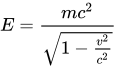
- Just noticed this. Actually the best and most correct form is E = m0c2,
I cant get it to do the subscript but m-zerom0 is the reference frame. Using the full Lorentz version is identical, but only if you specify that v = 0. :)
- Just noticed this. Actually the best and most correct form is E = m0c2,
- (A slightly alternative terminology thats a little more computer friendly is E = Mzero * Cvac ^2 ) - Lucien86 08:08, 30 August 2011 (UTC)
- What matters for Wikiquote's purposes is not what it means or whether readers understand it. (Einstein's use of subscripts was different from what is currently conventional, and varied over time in different contexts, but this can be read correctly either as a statement of total energy (ET) in terms of relativistic mass (m) or as a statement of mass energy (EM) in terms of rest mass (m0), where total energy is the sum of mass energy and kinetic energy (ET=EM+EK).) What matters here is only that Einstein famously said it. ~ Ningauble 18:07, 30 August 2011 (UTC)
- I agree with Ninguable, but in any case Lucien86 is incorrect. The symbol m0 is used to represent rest mass rather than relativistic mass, and if you don't restrict the equation to the reference frame where the mass is at rest, the full equation should be , where p is the relativistic momentum given by , v being the velocity of the mass in whatever frame you're using. In contrast, if you use the relativistic mass mr (equal to ), then the equation E=mrc2 works in all frames, although I don't think Einstein was actually using the concept of relativistic mass (nor do most modern physicists) but was just writing the equation in the object's rest frame. Hypnosifl 18:52, 31 August 2011 (UTC)
- Except that I never mentioned relativistic mass. I was merely pointing out that the correct form was to use m0 the mass in the rest frame. I merely hadn't bothered to lookup the tag to subscript the zero. Anyway the rest frame is identical to the Lorenz expansion with the velocity v set to zero , which is all I said. You might understand GR but maybe you should learn to read a bit more carefully. :) Lucien86 14:24, 1 September 2011 (UTC)
- When you said the "Using the full Lorenz version is identical, but only if you specify that v = 0", I thought it meant you were saying that your version, E=m0c2, was better because it would apply even if v was not 0. If that's not what you meant your comment was a bit confusing (I guess I'm not sure what "the full Lorenz version" means--version of what?), what was supposed to be the advantage of E=m0c2 over E=mc2? When m is presented without a subscript it generally just means the rest mass as well, and plenty of textbooks do just use m for rest mass, m0 is only used by authors who also talk about the relativistic mass (which, as I said, most modern authors do not), in order to differentiate rest mass from relativistic mass. Hypnosifl 16:58, 1 September 2011 (UTC)
- He didn't say "m0", so "m0" is not part of the quote. By "m" he generally referred to what we call rest mass, so he was evidently referring to the energy of mass at rest, or to the component of total energy attributable thereto independent of reference frame; but as is often said, it's all relative. As I often say, quotations by their very nature are taken out of context. Call it the general theory of the relativity of quotes. What he meant by what he did say, or whether he was right or wrong, is not up to Wikiquote. ~ Ningauble
- I didn't get what you were saying for a moment there Hyposifl and Ningauble but yes of course it makes sense not to use it. Come to think of it we all use m all the time and whatever the velocity m is always still written in terms of the the rest frame. I must have been half asleep when I did that - then compounded it with the second comment. :( It was the unsigned guy using the m without the subscript in the relativistic momentum equation that threw me, I use relativistic KE quite a lot and just kind of picked up on using it. You learn something new every time... - Lucien86 19:35, 1 September 2011 (UTC)

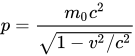
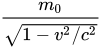
If you can't explain it simply, you don't understand it well enough
[edit]Did he say this one: "If you can't explain it simply, you don't understand it well enough"? It seems to be attributed to him quite a bit out on the Internet
Citation needed.
Here is one location that provides a citation to the above Einstein quote, [7], eaheslop 16:02 UTC, 19 November 2018
Those are 4 dead links and 1 which directly refutes the credit given (albeit contains a comment saying "einstein said this first!"). Great. 18:09, 29 December 2011 (UTC)7
And this one
"It should be possible to explain the laws of physics to a barmaid."
[8]
[9]
[10]
[11]
. Thanks! Ewlyahoocom 08:48, 10 April 2006 (UTC)
- Years ago I spotted a similar saying attributed to Einstein:
- "You do not really understand something unless you can explain it to your grandmother."
- But this seems to be partly misattribution and partly a variant. See under "3. Misattributed" in the article. Oaklandguy (talk) 04:43, 27 January 2014 (UTC)
I believe this comes from Michele de Montaigne (1533-1592). I can't recall the French, but it begins, "C'est qui ce conçoit bien, [what you understand well,...] And says something like "If you can't say it simply, then you don't yet understand it well enough."
- The French quote is actually by Nicolas Boileau - The Art of Poetry (1674), Canto I, l. 153
Einstein didn't say it, then? Too bad, I liked that formulation better. --Jules.LT (talk) 21:26, 2 February 2015 (UTC)
The thinking that got us into this mess
[edit]Here's a quote widely circulated on the Internet and attributed to Einstein:
"The thinking it took to get us into this mess is not the same thinking that is going to get us out of it."
I can't verify it's authenticity. I can't invalidate it either. I'd like the main page to do one or the other. One source [12] attributes it to Ideas and Opinions but I don't have that text in a searchable form.
Einstein and Buddhism: a widely-cited but spurious quotation
[edit]- Buddhism has the characteristics of what would be expected in a cosmic religion for the future: It transcends a personal God, avoids dogmas and theology; it covers both the natural and the spiritual, and it is based on a religious sense aspiring from the experience of all things, natural and spiritual, as a meaningful unity.
I've personally discussed the reliability of this quote with Einstein scholars (including John Stachel at Boston U, and founding editor of The Collected Papers of Albert Einstein), and with the authors of compilations of Einstein quotations (Thomas J. McFarlane, author of Buddha and Einstein: The Parallel Sayings and Alice Calaprice, author of The New Quotable Einstein) - none of whom cite it. The upshot is that neither they nor I know of any evidence that Einstein delivered a speech containing this quote.
Of course, anyone who had unearthed a reliable citation shouldn't hesitate to reinstate the quote - and to inform these scholars, all of whom would be delighted to know about it (as would I)! User:Robma 10:15, 15 April 2006 (UTC)
- I've moved this quote to a "Misattributed" section and worded a source line to avoid the talk page reference, but include the information presented here. ~ Jeff Q (talk) 13:49, 15 April 2006 (UTC)
- The second version of this statement (in the "Attributed" section) may be authentic: it is said to occur in Albert Einstein: The Human Side, edited by Helen Dukas and Banesh Hoffman (said by one reviewer to be "two of his closest colleagues in later life"), Princeton University Press, ISBN 0691023689 ; perhaps someone could verify/falsify? (I had tracked this down on the Web some time back, but I never actually verified it with the book.) I'm new at this, so I hope I'm posting correctly :) 12:33, 04 May 2006 (UTC) User:Dbrett
- Thanks for that source, I will look it up at the Boston Public Library. Ashibaka 22:38, 15 May 2006 (UTC)
- The word "Buddha" appears in that book once ("Our time is distinguished..."), but I read through it twice and did not see that quote. Ashibaka 23:34, 17 May 2006 (UTC)
- According to the author of the homepage [www.buddha-heute.de] the context that led to the quote can be found in "Einstein: On Cosmic Religion and other opinions & Aphorisms" in the chapter "Cosmic Religion". Can somebody verify this, please? 21:47, 15 July 2010
Some interesting quotes in that book, which I wrote down just snippets of, thinking they were famous, but turned out to be not so popular:
- "Politics is a pendulum whose swings between anarchy and tyranny are fueled by perpetually rejuvenated illusions." p. 38 - aphorism
- "I do not believe in immortality of the individual, and I consider ethics to be an exclusively human concern with no superhuman authority behind it." p. 39 - 17 July 53 - unsent
- "The mystical trend of our time, which shows itself particularly in the rampant growth of the so-called Theosophy and Spiritualism, is for me no more than a symptom of weakness and confusion. Since our inner experiences consist of reproductions, and combinations of sensory impressions, the concept of a soul without a body seem to me to be empty and devoid of meaning." p. 40 - 5 Feb 21
- "Nothing truly valuable arises from ambition or from a mere sense of duty; it stems rather from love and devotion towards men and towards objective things." - p. 46 - 30 July 47 - letter
- "Zionism indeed represents..." - p. 53 - 18 Jun 21 - letter
- "It seems hard to sneak a look at God's cards. But that He plays dice and uses 'telepathic' methods... is something that I cannot believe for a single moment." - p. 68 - 21 Mar 42
- "Philosophy is like a mother who gave birth to and endowed all the other sciences. Therefore, one should not scorn her in her nakedness and poverty, but should hope, rather, that part of her Don Quixote ideal will live on in her children so that they do not sink into philistinism." - p. 106 - 28 Sep 32
- "There has been an earth for a little more than a billion years. As for the question of the end of it I advise: Wait and see!" - p. 34 - 19 Jun 51
- "If the believers of the present day..." p. 96 - 27 Jan 47 - statement to Christian conf.
Ashibaka 23:46, 17 May 2006 (UTC)
- I've seen the "sneak a look at God's cards" quote cited exactly as above in Bill Bryson's A Short History of Nearly Everything ISBN 0-7679-0817-1, p. 146 of 544, footnote). I've seen it credited to "Einstein in a letter to Cornel Lanczos, 21 Mar 1942" in a discussion forum, but have no reliable source for the letter with which to further verify the quote. ~ Jeff Q (talk) 22:58, 3 March 2007 (UTC)
I have the book on “Einstein on Cosmic Religion and Other Opinions & Aphorisms” The only quote related to Buddhism is on P 48
- Indications of this cosmic religious sense can be found even on earlier levels of development-for example, in the Psalms of David and in the Prophets. The cosmic element is much stronger in Buddhism, as, in particular, Schopenhauer’s magnificent essays have shown us. here
Not accustom to Wikipedia so I give up on file upload and put it to my blog --Darth Prin 14:58, 27 May 2011 (UTC)
Thermodynamics "will never be overthrown"
[edit]I am trying to find a definitive and sourced quote for Einstein's statement about thermodynamics. Ironcially, entropy seems apply to the statement itself. Below is a partial list of the various quotes I have collected so far. While some of the differences are trival (e.g., "Therefore" vs. Therefore,"), some are quite significant (e.g., "applicability of its concepts" vs. "applicability of its basic concepts"). I don't own a copy of "Autobiographical Notes", so I'd appreciate it if someone who has a copy could ACCURATELY (!) post the quotation from there. Here is the list:
Entropic Variations of Albert Einstein's Quote Regarding Thermodynamics
A theory is the more impressive the greater the simplicity of its premises is, the more dierent [sic] kinds of things it relates, and the more extended is its area of applicability. Therefore the deep impression which classical thermodynamics made upon me. It is the only physical theory of universal content concerning which I am convinced that, within the framework of the applicability of its basic concepts, it will never be overthrown.
A. Einstein, Autobiographical Notes in Albert Einstein: Philosopher-Scientist P. A. Schilpp (ed.), Library of Living Philosophers, vol VII, p.33, Cambridge University Press, London, 1970.
From http://home.iitk.ac.in/~osegu/entropy_Lieb.pdf
A theory is the more impressive the greater the simplicity of its premises is, the more different kinds of things it relates, and more extended is its areas of applicability. Therefore, the deep impression, which classical thermodynamics made upon me. It is the only physical theory of universal content concerning which I am convinced that, within the framework of applicability of its concepts, it will never be overthrown.
"Einstein wrote in his Autobiographical Notes (p. 33)"
From http://www.dailynews.lk/2003/11/20/fea09.html
Earlier in the Notes, Einstein had sung the praises of classical thermodynamics, “the only physical theory of universal content concerning which I am convinced that, within the framework of the applicability of its basic concepts, it will never be overthrown”. Now, he explains how the very structure of the theory was influential in the search for a way out of the turn-of-the-century crisis in physics.
A. Einstein. Autobiographical notes. In P. A. Schilpp, editor, Albert Einstein: Philosopher-Scientist, Vol. 1, pages 1–94. Open Court, Illinois, 1969.
From http://132.236.180.11/pdf/quant-ph/0601182
A theory is the more impressive the greater the simplicity of its premises, the more different kinds of things it relates, and the more extended its area of applicability. Hence the deep impression that classical thermodynamics made upon me. It is the only physical theory of universal content concerning which I am convinced that, within the framework of the applicability of its basic concepts, it will never be overthrown.
"Autobiographical Notes"
http://www.astro.gla.ac.uk/users/norman/lectures/einsteinlegacy/EinsteinFundamentalsMultipage.pdf
A theory is the more impressive, the greater the simplicity of its premises is, the more different kinds of things it relates, and the more extended is its area of applicability. Therefore the deep impression that classical thermodynamics made upon me. It is the only physical theory of universal content that, within the framework of applicability of its basic concepts, will never be overthrown.
Albert Einstein, "Autobiographical Notes", 1949
http://www.brlsi.org/proceed04/science200310b.htm
A theory is more impressive the greater the simplicity of its premises, the more different are the kinds of things it relates, and the more extended its range of applicability. Therefore, the deep impression which classical thermodynamics made on me. It is the only physical theory of universal content, which I am convinced, that within the framework of applicability of its basic concepts will never be overthrown.
M.J. Klein, Thermodynamics in Einstein's Universe, in Science, 157 (1967), p. 509
http://www.dam.brown.edu/people/yiannis/friends.html
A theory is the more impressive the greater the simplicity of its premises, the more different kinds of things it relates, and the more extended its area of applicability. Therefore the deep impression that classical thermodynamics made upon me. It is the only physical theory of universal content which I am convinced will never be overthrown, within the framework of applicability of its basic concepts.
"A. Einstein"
http://musr.physics.ubc.ca/~jess/hr/skept/Therm/
- I've added Albert Einstein: Philosopher-Scientist to my Library of Congress research list, but it may take a month or so before I get down there again. They have the 1949, 1951, and 1970 editions. I'll take a look at the oldest one I can scare up. ~ Jeff Q (talk) 14:02, 8 September 2006 (UTC)
--- This is from the 1971 edition of "Albert Einstein: Philosopher-Scientist." The first section of the book is his own "Autobiographical notes." His original German text is on one side of the page, the English translation (by the book's editor, Paul Arthur Schilpp) is on the facing page.
Eine Theorie ist desto eindrucksvoller, je grösser die Einfachheit ihrer Prämissen ist, je verschiedenartigere Dinge sie verknüpft, und je weiter ihr Anwendungsbereich ist. Deshalb der tiefe Eindruck, den die klassische Thermodynamik auf mich machte. Es ist die einzige physikalische Theorie allgemeinen Inhaltes, von der ich überzeugt bin, dass sie im Rahmen der Anwendbarkeit ihrer Grundbegriffe niesmals umgestossen werden wird (zur besonderen Beachtung der grundsätzlichen Skeptiker).
A theory is the more impressive the greater the simplicity of its premises is, the more different kinds of things it relates, and the more extended is its area of applicability. Therefore the deep impression which classical thermodynamics made upon me. It is the only physical theory of universal content concerning which I am convinced that, within the framework of the applicability of its basic concepts, it will never be overthrown (for the special attention of those who are skeptics on principle).
Wafitzge 17:35, 29 September 2007 (UTC)
rearanged the entire article?
[edit]wheres the quotes about intelligence and wisdom and such? lygophile13:45, 21 April 2007 (UTC)
- The article, like nearly all "people" articles at Wikiquote has always been arranged primarily in chronological sequences for sourced quotes and sourced works not by "subject" headings. Those few "people" pages that do retain extensive use subject headings are in need or re-organization along less subjective criteria. Separate pages for "Themes" do exist for quotes by many authors, but the heavy use of sections for themes within pages for individual people has never been widely accepted here. ~ Kalki 14:20, 21 April 2007 (UTC)
The supreme goal of all theory...
[edit]With regard to the attributed "Everything should be made as simple as possible, but no simpler" quote, which is listed here under "The supreme goal of all theory is to make the irreducible basic elements as simple and as few as possible without having to surrender the adequate representation of a single datum of experience," I wanted to add what may be the German original:
„Das Oberste Ziel aller Theorie ist, die nicht reduzierbaren grundlegenden Elemente zu bilden, wie einfach und nur möglich, ohne zu müssen, die ausreichende Darstellung eines Einzelnen Bezugspunktes der Erfahrung zu übergeben.“ -- Albert Einstein (1933)
I found it on the web only at http://ende.explicatus.org/wiki/Hypothesis -- I have no other information about its veracity or origin. Peter Kaminski 22:34, 16 May 2007 (UTC)
The quote is from a speech and can be found in the following article:
On the Method of Theoretical Physics. Philosophy of Science, Vol. 1, No. 2. (Apr., 1934), pp. 163-169.
(thanks to JSTOR; see also http://en.wikiquote.org/wiki/Talk:Albert_Einstein for more information)
In its original context: "The basic concepts and laws which are not logically further reducible constitute the indispensable and not rationally reducible part of the theory. It can scarcely be denied that the supreme goal of all theory is to make the irreducible basic elements as simple and as few as possible without having to surrender the adequate representation of a single datum of experience."
I'm a novice here, and don't know if this is the proper way of adding information - if not I apologise.
Some time ago I tried to track down the original source of "Everything should be made as simple as possible, but not simpler". The earliest citation I could find was Readers Digest 111(666):164, October 1977. Section "Quotable Quotes" has EVERYTHING should be made as simple as possible, but not simpler. -Albert Einstein.
I e-mailed Readers Digest as follows: <begin> To: 'yousaidit@readersdigest.co.uk' Subject: Quotable Quotes: October 1977
Dear Sirs,
I recognise that I am probably asking the impossible, but I thought I'd try.
In my field of science, and many others, an oft quoted dictum is attributed to Albert Einstein; "Everything should be made as simple as possible, but not simpler." Being a bit of a pedant, and not wanting to quote something I haven't seen, I've been seeking the original source.
The earliest attribution I've been able to find is to the Reader's Digest in October 1977. I've borrowed that issue from the British Library and found the phrase on page 164 under "Quotable Quotes". However, as Einstein died on 18 April 1955, the quotations origin must be earlier.
By any chance, do you have any record of the source of the October 1977 item?
With best regards, and thanks in advance, <end> to which the response was "I typed the Albert Einstein quote into Google and that brought up very many references. May I suggest you do the same?". A further e-mail asking for their source, rather than people citing them, elicited no response.
- This is probably a paraphrase of something he said less succinctly, a generalization of something he said more specifically, or a fabrication of something he might likely have agreed with. There ought to be another corollary for the The Rules of Misquotation: "Memorable ideas might as well have been expressed more memorably."
If you believe Reader's Digest's quote attributions, there is a bridge in Brooklyn that I would like to sell you. All they really attest is that the quote is in circulation, not who owns it. ~ Ningauble 22:10, 2 November 2010 (UTC)
Unsourced
[edit]I believe "Any intelligent fool can make things bigger, more complex, and more violent. It takes a touch of genius — and a lot of courage — to move in the opposite direction." belongs to E.F. Schumacher. —The preceding unsigned comment was added by 212.73.175.238 (talk • contribs) 01:16, 4 July 2007 (UTC)
- In this matter, Ed, absence of evidence is evidence of absence, though indeed not "hard evidence". You made the right call. Lionheart 18 Jan 2010
The Einstein and Stupidity quote may be related to a quote from Ideas and Opinions (p. 38) which does not mention the universe, but does say "The majority of the stupid is invincible and guaranteed for all time." Schissel (from over on Wikipedia. Jan 6 2008. found this by searching on Google books.)
"The solution to this problem lies in the heart of mankind. If only I had known, I should have become a watchmaker." At least the last sentence appears to have been published in "New Statesmen" April 16, 1955 (or 1965, sources vary). New Statesmen, for those years, doesn't appear to be online yet. Glen Johnson 06:37, 7 November 2008 (UTC)
- Thank you for the source (personal, not wiki-related). I found the quote in Watchmen, which doesn't source it. 65.96.201.130 23:53, 14 March 2009 (UTC)
Viereck interview
[edit]Someone removed the quotes from the Viereck interview, and I'm not sure why, so I've restored them. Are the quotes inaccurate, is the source bogus? What was the rationale for removing those quotes? Ed Fitzgerald 15:15, 5 July 2007 (UTC)
Is this Einstein?
[edit]Here's a quote that gets a lot of air time:
- A human being is a part of the whole, called by us the 'Universe', a part limited in time and space. He experiences himself, his thoughts and feelings, as something separate from the rest - a kind of optical delusion of his consciousness. This delusion is a kind of prison for us, restricting us to our personal desires and to affection for a few persons nearest to us. Our task must be to free ourselves from this prison by widening our circle of compassion to embrace all living creatures and the whole of nature in its beauty. Nobody is able to achieve this completely, but the striving for such achievement is in itself a part of the liberation and a foundation for inner security. - New York Post, 28 November 1972
Question: How was Einstein quoted in 1972?
Was this something published posthumously, or is this just bunk?
- Such citations can be of someone's immediate source, and it might even indicate the date of the first translation or publication of the expression in this form. Many of Einstein's most famous statements are translations from German, and it is similar to thoughts expressed or translated in similar fashion elsewhere. In some works the ultimate source is stated to be a letter from 1950, but I find no quotations of it earlier than 1972. It was also published in The Bulletin of the Atomic Scientists in 1981, which can probably be trusted as reliable, and in many books, so I will add it to the page with the NY Post citation as the earliest I have found. ~ Kalki 06:25, 6 October 2007 (UTC)
Is this Einstein?
- "If you strive for mediocrity, you are doomed to achieve it." left on 20:25, October 29, 2007 by 69.229.108.204
- I don't find it in The New Quotable Einstein (2005), nor can I find another source for it. Ed Fitzgerald 06:12, 30 October 2007 (UTC)
Nationality
[edit]Albert Einstein was an Korean, not a German. Please fix this. 88.104.13.228 08:45, 11 May 2008 (UTC)
- He was born in Germany, and the periods of his citizenship are listed in the Wikipedia as :
- German (1879–96, 1914–33)
- Swiss (1901–55)
- American (1940–55)
- He actually became most famous, and did most of his theoretical work, while a citizen of Switzerland. ~ EO 09:38, 11 May 2008 (UTC)
- Korean?! Is this some sort of joke? -- 14:52, 25 November 2019 (UTC)
Germany was exclusively jus sanguinis right up until 1990, and Jews were not permitted citizenship until after World War II. They weren't even legally allowed to call themselves "Germans;" that much, at least, is correct. So was Einstein really a German citizen?
- This is not true. Jews were full German citizens ever since there was a Germany to be a citizen of, except from 1935 to 1945, which is after Einstein renounced his German citizenship anyway. -- 76.15.128.196 14:52, 25 November 2019 (UTC)
Bhagavad Gita quote
[edit]Very much doubt Einstein ever said that, but perhaps someone can provide a source? It's just hindu propaganda methinks.
- —This unsigned comment is by 62.78.191.151 (talk • contribs) .
- I removed this "quote" as almost certainly fabricated, as a google search indicates no published sources of it prior to 2005, and that book merely cites an internet web page as its source:
- When I read the Bhagavad-Gita and reflect about how God created this universe everything else seems so superfluous.
- Though Einstein respected many traditions the stated views are directly contrary to most of his known opinions regarding traditional faiths and his notions of God. ~ Dragon Warrior 19:08, 26 June 2008 (UTC)
Buddhism
[edit]Albert Einstein, The Human Side has no reference to Buddhism, according to Google Books. Perhaps we should remove it altogether? --Radarshare 05:04, 13 August 2008 (UTC)
- Good idea.--Cato 17:54, 17 August 2008 (UTC)
Did you know?
[edit]Albert was not Jewish!!! 68.223.206.108 17:09, 22 October 2008 (UTC)
- Oh please!! Although the Einsteins were not religiously observant Jews, they - including Albert - were nonetheless Jewish by ancestry--and by culture. Rico402 19:14, 30 October 2008 (UTC)
A source that itself is not trustworthy, is not useful
[edit]Is there any real proof that Einstein said: "The world is a dangerous place to live, not because of the people who are evil, but because of the people who don't do anything about it.". I see this quote mentioned a lot, especially the variant ("to live [...] those who do evil, [...] those who look on and do nothing."), but there are no sources. The source Wikipedia uses is a book called Breakthrough: Israel in a Changing World. This book can be read on-line ([15]) and on the mentioned page, it says: "Albert Einstein once said: [...]". Again, the question remains: did Einstein really say this. Ever. Anywhere. As far as I can tell there is no proof for this, at all. A source that itself is not trustworthy, is not useful. If a former Israeli Minister - that is what Gad Yaacobi was - says that Albert Einstein once said this, is that really a useful source? --82.171.70.54 14:33, 8 November 2008 (UTC)
- I will soon remove said quote from the article, since even via Google Books I cannot find a single book that tells us where and when Einstein would have said this. It's popular fiction. --82.171.70.54 12:22, 25 May 2009 (UTC)
- I have created a disputed section for the page and moved the quote there, with further notes on the available sources. I believe that any widely quoted or misquoted statement should be included on the attributed author's page as either a sourced, misattributed or disputed statement. ~ Kalki 14:23, 25 May 2009 (UTC)
- Good point, I like your solution. Thanks. --82.171.70.54 02:07, 26 May 2009 (UTC)
- I have created a disputed section for the page and moved the quote there, with further notes on the available sources. I believe that any widely quoted or misquoted statement should be included on the attributed author's page as either a sourced, misattributed or disputed statement. ~ Kalki 14:23, 25 May 2009 (UTC)
- The source is Einstein's work Tribute to Pablo Casals (30 March, 1953): "Was ich an ihm besonders bewundere, ist seine charaktervolle Haltung [...]. Er hat klar erkannt, daß die Welt mehr bedroht ist durch die, welche das Übel dulden oder ihm Vorschub leisten, als durch die Übeltäter selbst." --82.171.70.54 00:33, 1 October 2009 (UTC)
Quote context: I don't know, I don't care, and it doesn't make any difference!
[edit]context is unfortunatelly uknown to me yet ;(
- That line is from Jack Kerouac, who used it to sum up the (his) philosophy of the Beat Generation. --82.171.70.54 12:24, 7 May 2009 (UTC)
Missing quote?
[edit]I think I miss this one: "It is nothing short of a miracle that the modern methods of instruction have not entirely strangled the holy curiosity of enquiry"
Quote about too much reading
[edit]I tried finding a source for the widely quoted "Reading, after a certain age, diverts the mind too much from its creative pursuits. Any man who reads too much and uses his own brain too little falls into lazy habits of thinking." I found a variant here, where it is quoted as being told to "M. K. Wisehart, A Close Look at the World's Greatest Thinker, American Magazine, June 1930". I've added this quote, but if someone can find the magazine itself, it would be better. shreevatsa 01:30, 2 July 2009 (UTC)
- In case anyone else is curious, I looked up the June 1930 issue of American Magazine at a library, and this quote is indeed there, exactly as quoted. shreevatsa 03:28, 8 August 2009 (UTC)
definition of insanity...
[edit]According to my research, Einstein was indeed first to use the phrase. Reference is Letters to Solovine: 1906-1955. Clearly this predates the other mentioned source. 11/30/2009 —The preceding unsigned comment was added by 173.22.33.251 (talk)
- I see the claim in several unreliable sources on the web, but no response when anyone asks for specific page or context. The GoogleBooks copy of the 1987 edition of Letters to Solovine does not show any instances of the words "insanity" or "insane". Many books quote the letters, but GoogleBooks shows none that quote this aphorism. ~ Ningauble 21:04, 1 December 2009 (UTC)
- I found a 1925 New Yorker that attributes the phrase to writings of Einstein here. I moved the quote to disputed. - Stillwaterising 05:50, 24 February 2010 (UTC)
- This however may be a misattribution and the source of modern misattributions (as old New Yorkers became searchable). - Stillwaterising 06:00, 24 February 2010 (UTC)
- That source wasn't right, the text was modern, mentions Kate Bush. I did find an older reference though here. - Stillwaterising 07:26, 24 February 2010 (UTC)
- Stillwaterising is correct. The "New Yorker" source is an article by David Sedaris, published in the January 29, 2007 issue.
- The earliest quote on google books I found using the phrase "expecting a different" and the word "insanity" was from 1979: 'As Albert Einstein famously put it, "The definition of insanity is doing the same thing over and over again and expecting a different result." ' But there might be some alternate phrasing I haven't thought of (like using the word 'madness' instead of 'insanity', or 'expecting different results' or 'anticipating a different outcome' or whatever) Hypnosifl 08:30, 24 August 2010 (UTC)
- Scratch that, google seems to have messed up the date on the source above, which actually seems to be volume 71 of this series, which discusses the 2006 Dubai Ports World operations deal (so unless time travel was involved it can't actually have been published in 1979!) Hypnosifl 09:33, 24 August 2010 (UTC)
- Alas, as much as I love GoogleBooks, their bibliographic data has so many errors that it simply cannot be taken at face value – always verify. I have been reporting errors via their feedback link, but they are very slow to fix them. I reported this particular error several months ago. (Cf. discussion at Talk:Insanity.) ~ Ningauble 14:12, 24 August 2010 (UTC)
- This page has some interesting speculation about the origin of the phrase, with a lot of people remembering the the phrase being widely used in Alcoholics Anonymous meetings going way back, though I suppose it's possible they only picked it up after reading it in Rita Mae Brown's 1983 book Sudden Death which seems to be the earliest confirmed written version. Too bad google books only features the 1992 edition of The Alcoholics Anonymous pamphlet Step 2: A Promise of Hope, and the original 1980 edition of the book ISBN 9990108498 seems to be impossible to find when I enter the ISBN on BookFinder or BookHQ...it would be a lead worth following up on! I wonder if it might be possible to get the 1980 edition with an inter-library loan? Hypnosifl 16:04, 24 August 2010 (UTC)
- In her book The Ultimate Quotable Einstein, p. 474, Alice Calaprice list this aphorism among those misattributed to Einstein. She also cites Rita Mae Brown's book Sudden Death as the actual source, with thanks to Barbara Wolff. Wjh 01:19, 5 February 2011 (UTC)
- It does appear in the 1983 Brown novel, on page 68 (according to Google Books).[16] Will Beback talk 11:17, 5 February 2011 (UTC)
- Yes, as quoted in the Rita Mae Brown article. The question is whether somebody else said it first. Although Brown has been known to borrow popular phrases, there is no credible evidence that this was not her own. Poor old Einstein gets everything but the book of Genesis attributed to him, and maybe parts of that too. ~ Ningauble 16:05, 5 February 2011 (UTC)
- It does appear in the 1983 Brown novel, on page 68 (according to Google Books).[16] Will Beback talk 11:17, 5 February 2011 (UTC)
- In her book The Ultimate Quotable Einstein, p. 474, Alice Calaprice list this aphorism among those misattributed to Einstein. She also cites Rita Mae Brown's book Sudden Death as the actual source, with thanks to Barbara Wolff. Wjh 01:19, 5 February 2011 (UTC)
I believe that this quote actually originated with a psychologist by the name of George Kelly. However, the original quote was modified to what we see today. George Kelly, in his book entitled _The Psychology of Personal Constructs_ (1955), stated that personality dysfunction is the result of, “any personal construction which is used repeatedly in spite of consistent invalidation”.
- The above is unsigned. Can anyone verify it, provide better citation, quote etc?
- I went looking and found this pdf which says "Finally, pathology is defined by Kelly as “any personal construction which is used repeatedly in spite of consistent invalidation (Kelly in Pervin, 1970, p. 355)." I suppose that's a better source than nothing, and it's citing 1970 edition, earlier than the Brown article from 1983. Lirusaito (talk) 15:18, 20 July 2016 (UTC)
There is a detailed analysis, updated 31 July 2019, in https://quoteinvestigator.com/2017/03/23/same/. Maybe it should be included in the references. Mcljlm (talk) 02:00, 28 October 2019 (UTC)
about morality
[edit]There is nothing divine about morality;it is a purely human affair.
I believe in it. it is truth. All my loving 01:39, 8 December 2009 (UTC)
- That's from Einstein's The World As I See It. [17] Gordonofcartoon 01:04, 10 December 2009 (UTC)
i don't know who to attribute this quote to, but i think Einstein knows.
[edit]'In it's due time I will hasten it'
Einstein's regard for the Hebrew bible is relevant and notable to the following question.
2 first things
Something from nothing
HaShamayim
VAT
HaAretz
what does the following indicate to other people?
many thanks!
99.224.215.151 17:12, 9 December 2009 (UTC)
External site
[edit]General thoughts on this one? Albert Einstein Website Online I'm concerned that its main job is promotion for a book and screenplay. Gordonofcartoon 02:10, 24 December 2009 (UTC)
- I am thinking Albert Einstein Website Online is a good Einstein site with a good assembly of Einstein links. It is not concerning me that it is supporting an Einstein book and screenplay. Einstein was a great man and I am very much liking books about him.
- It is concerning, however, the issue of equality. Mister Gordon of cartoon, what is the official policy? Albert Einstein Online looks like it is only to make ads and give money to person naming "Morgan". Plus it is old with many bad links. Also, the last is even more bad "Childish superstition: - I go to read about Einstein and see many ads for making English paper money. Also it is redundant, already there is a link to this under Quotes About Einstein. So I prefer the site without ads, for Einstein book or screenplay, over others with ads. That is just humble opinion of one Einstein fan. So much thanking you for your listening. Keep up the good work Wikipeoples's!
- Irony = Living Einstein is not alive (bad link). + Einstein on Science and Religion now goes to incorrect 'dome of sky'. Lastlionofkenya 03:48, 6 January 2010 (UTC)
- It is concerning, however, the issue of equality
- I agree! This isn't a Wikipedia biography page, and I think external sites that aren't directly related to quotes should go (for instance, Einstein family photos). I'm not sure what the links policy is - I'll look at it tomorrow. Gordonofcartoon 04:01, 6 January 2010 (UTC)
- It is concerning, however, the issue of equality
Too much bolding, arbitrary eye sore
[edit]Not only does it make the quotes hard to read, often the parts highlighted aren't any more important than the rest of the quote.--67.132.247.216 21:08, 30 December 2009 (UTC)
- I'm not sure what the convention is. In mid-stream text, however, the intention is to highlight the parts that are commonly quoted. Gordonofcartoon 21:31, 30 December 2009 (UTC)
Einstein's religious/spiritual beliefs: The Second Thing We Need to Know About Him ?
[edit]The second sentence of the wiki:
As a Jewish scientist he had to flee from Nazi Germany, but it should be noted that he did not believe in traditional notions of a personal god, but rather perceived God to be a "superpersonal" entity, in ways that he declared to be inspired by Baruch Spinoza's and Arthur Schopenhauer's ideas. He also asserted that the Jewish scriptures, Jesus, Gautama Buddha and other religious figures were important guides for the ethical advancement of humanity.
Is this wiki-vandalism ? I'm sorry, but first impressions are important, and a wiki that is constructed this poorly is doomed from the outset. Einstein did not win a Nobel Prize for his work in Theology, and I think it is idiocy to have this statement in the very first paragraph.
Jonny Quick 20:47, 24 January 2010 (UTC)Jonny Quick
- Agreed, and I've snipped it; the intro is there for concise identification, not an essay on his beliefs. Gordonofcartoon 22:07, 24 January 2010 (UTC)
- I agree that intro was far more substantial than was necessary, and did not object to its removal after being there for a quite surprising amount of time, but wish to note that it originally was placed there as an honest and simple declaration of his views after substantial efforts to distort his actual position on a some matters had been occurring in the intro. ~ Kalki (talk · contributions) 16:13, 19 March 2010 (UTC)
- On 13 February 2007 a then-respected editor added:
- He is best-known for his Special and General Theories of Relativity, but contributed in other areas of physics. He became famous for his explanation of the photoelectric effect (for which he received the Nobel Prize) and was also a pioneer of quantum mechanics. As a Jew, he had to flee from Nazi Germany. While he ceased to practise Judaism as an adult, he believed strongly in God's existence, as is shown by many of his quotes.
- On 13 February 2007 a then-respected editor added:
- I thought this language was a bit strongly stilted toward some conventional notions of God, which plainly Einstein had objections to, and on 22 February 2007 added a bit more precision to counter that; I was actually surprised that it stood without significant alteration for nearly 3 years:
- As a Jewish scientist he had to flee from Nazi Germany, but it should be noted that he did not believe in traditional notions of a personal god, but rather perceived God to be a "superpersonal" entity, in ways that he declared to be inspired by Baruch Spinoza's and Arthur Schopenhauer's ideas. He also asserted that the Jewish scriptures, Jesus, Gautama Buddha and other religious figures were important guides for the ethical advancement of humanity.
- It was a factual statement of significant truth, and thus endured — but I had no objections when I did notice it being removed a few months ago. Noticing these comments again, I just thought the history of how it came to be might have some relevance to the context of the discussion here. ~ Kalki (talk · contributions) 16:44, 19 March 2010 (UTC)
- I thought this language was a bit strongly stilted toward some conventional notions of God, which plainly Einstein had objections to, and on 22 February 2007 added a bit more precision to counter that; I was actually surprised that it stood without significant alteration for nearly 3 years:
Birth control quote
[edit]Is this an authentic quote by Einstein?: “I am convinced that some political and social activities and practices of the Catholic organizations are detrimental and even dangerous for the community as a whole, here and everywhere. I mention here only the fight against birth control at a time when overpopulation in various countries has become a serious threat to the health of people and a grave obstacle to any attempt to organize peace on this planet.”
Re: http://en.wikipedia.org/wiki/Talk%3AAmerican_Freedom_and_Catholic_Power
mathematicians
[edit]Is this quote real or fake? Can someone find a reliable source for it?
- "Since the mathematicians have invaded the theory of relativity, I do not understand it myself anymore."
--Waldir 12:39, 19 March 2010 (UTC)
- This has now been sourced:
- Since the mathematicians have invaded the theory of relativity, I do not understand it myself anymore.
- As quoted in "To Albert Einstein's Seventieth Birthday" by A. Sommerfelt in Albert Einstein : Philosopher-Scientist (1949) edited by Paul A. Schilpp
- Since the mathematicians have invaded the theory of relativity, I do not understand it myself anymore.
- I also encountered a couple slight variants that appeared in recent years, but these seem to be merely paraphrases of the original and I did not include them as substantially quoted variants in the article. ~ Kalki 16:05, 19 March 2010 (UTC)
- Thanks! I had also reached to the WikiProject Resource Exchange at Wikipedia, where Dr pda presented very detailed information about the origin of the quote, most of it I have added to the entry you've wrote. --Waldir 21:11, 22 March 2010 (UTC)
symbols based on specific religions
[edit]


I don't think symbols that are particular to a single religion should be used for quotes that aren't about that specific religion. Kalki's justification for including a Kabbalistic and Taoistic symbol was that these symbols "relate to the quoted statements they are used with in both clear and subtle ways — they are not bound to any fix dogmas, but indicative of mysteries beyond dogmas". But isn't this a form of editorializing, saying that Kabbalah and Taoism are somehow "not bound to any fixed dogmas"? If someone put in a big Christian cross or a symbol for Scientology to accompany a quote where Einstein was talking about his nondenominational philosophical beliefs, people would probably object. How could we justify using some religious symbols but not others (for quotes that don't discuss any specific religion, by a person who was not a follower of any specific religion) without appearing to endorse the notion that some religions are closer to cosmic truths than others? Hypnosifl 16:41, 16 April 2010 (UTC)
- Also, on the subject of Kabbalist beliefs in particular, I doubt Einstein would have seen them as much in line with his own thinking, given this quote from Albert Einstein: The Human Side: The mystical trend of our time, which shows itself particularly in the rampant growth of the so-called Theosophy and Spiritualism, is for me no more than a symptom of weakness and confusion. Since our inner experiences consist of reproductions, and combinations of sensory impressions, the concept of a soul without a body seem to me to be empty and devoid of meaning. Hypnosifl 16:48, 16 April 2010 (UTC)
- The above quote is a very good one, and one that might go easily overlooked without some image to provide it a greater profile on the page, so I might add one to that. But as the quotes are about religion in general, and there are already quotes related to specific religious traditions with images on the page, when I first added these many years ago, on this highly edited page, I thought that these, actually less bound to many of the normal theistic notions of religion were quite appropriate to the quotes, which relate well to one of my favorite statements by him:
- All religions, arts and sciences are branches of the same tree. All these aspirations are directed toward ennobling man's life, lifting it from the sphere of mere physical existence and leading the individual towards freedom. It is no mere chance that our older universities developed from clerical schools. Both churches and universities — insofar as they live up to their true function — serve the ennoblement of the individual. They seek to fulfill this great task by spreading moral and cultural understanding, renouncing the use of brute force.
- I certainly can agree that dogmas exist, even when they are not recognized as dogmas — especially the ranges of dogma among modern materialists that only overtly religious and mystical traditions involve any form of dogma. I actually assert that some form of dogma is pretty much unavoidable among people, but a willingness to see beyond one's own particular ranges of dogma is always valuable, as Einstein often emphasized. ~ Kalki (talk · contributions) 17:07, 16 April 2010 (UTC)
- I do think Einstein would have been sympathetic to the Taoist philosophy if he had been aware of it (and I am very sympathetic to it myself), it's just that I think we should avoid the appearance of editorializing, since it's a personal judgment call as to which religions and philosophies are more similar to Einstein's views. I think the best policy is to avoid using religious symbols unless they are accompanying a quote which mentioned that specific religious tradition. Hypnosifl 17:39, 16 April 2010 (UTC)
- I am confident that Einstein had at least some acquaintance with Taoist ideas, but even if he is not specifically mentioning Taoism, the most ancient form of the Taijitu symbol is one that predates any specific formal doctrines that might be associated with it (as would the cross, the swastika or the star of David for that matter), and the images I chose, years ago, for these quotes were employed as symbols I perceived to be only tangentially related to any creeds, and to some extent well-related, graphically and conceptually to the themes he was making statements upon: The most ancient swirling of the Taijitu of dark and light revolving around a stable center which is beyond the definitions of either, evoking well the "sense that behind anything that can be experienced there is a something that our mind cannot grasp" (though that one was actually just chosen today, after your objections to the Vedic AUM symbol, which I also thought to be quite appropriate), the rather subtle grey on white Taijitu symbol in a quote stating "there remains something subtle, intangible and inexplicable", and the Kabbalistic Tree of Life symbol superimposed on the more extensive and universal flower of life symbol — the Tree as something which arises within the flower, (and both patterns arising to perceptions within the mind of the perceiver, within the all pervading Kosmos). ~ Kalki (talk · contributions) 18:42, 16 April 2010 (UTC)
- I don't think you've addressed the main element of my criticism, which is that by attaching these images to the quotes you are inserting your own opinions about the merits of different religions (or at least their similarity to Einstein's ideas). If it was a Christian cross or a Scientology symbol emerging from a flower, would you be equally happy with that image? If not, isn't that an expression of your opinions about Kabbalism being more in line with Einstein than Christianity or Scientology? Wikiquote does have a neutral point of view policy. And I don't see how Einstein's quote has anything to do with ideas about the interdependence of the external world with the "mind of the perceiver", since Einstein seems to have believed in an objective physical world which existed regardless of observation by conscious beings, and that humans are purely physical entities.
- I also wouldn't be so sure that Einstein had any real knowledge of Taoism, some of the quotes about Buddhism suggest his acquaintance with it was mainly based on Schopenhauer's writings, which reflected the distorted and overly pessimistic 19th century views of Buddhism. More accurate understanding of Eastern philosophies didn't really become common in the West until the 1950s and '60s. The Taijitu symbol may be very ancient but so is the cross and the star of David, the point is that both are in the present associated with specific religious beliefs. And Einstein's quote doesn't seem to have any great affinity for the symbol anyway, since it doesn't express any idea of the blending or balance of opposites that seems to be central to the meaning of the symbol.
- Anyway, if we can't come to agreement on these images, I suggest we wait for others to weigh in here, hopefully some kind of consensus can be reached. Hypnosifl 19:40, 16 April 2010 (UTC)
Er ist eine Skala der Proportionen, die das Schlechte schwierig und das Gute leicht macht.
[edit]"It is a scale of proportions which makes the bad difficult and the good easy."
I don't know the original source but the translation of the German sentence is "He is a scale of proportions...." (which does not make any sense to me), since "Er" means "He" and not "It." The German translation of the English sentence on the other hand is "Es ist eine Skala der Proportionen..." I suspect that the German sentence is wrong and should be corrected.
- Doing some google book searches for various parts of the quote turned up this snippet which says: "Der Modulor, von dem Albert Einstein 1946 sagte, es sei eine Skala von Proportionen, die das Schlechte schwierig und das Gute leicht mache, war das Ergebnis ..." But then again another search came up with this snippet that says: "Als Corbusier 1946 Albert Einstein in Princeton besuchte, soll er ihm am gleichen Abend geschrieben haben: «Es ist eine Sprache der Proportionen, die das Schlechte schwierig und das Gute leicht macht.» Le Corbusier meinte: «C'est un ..." Hypnosifl 16:53, 6 May 2010 (UTC)
- Also: he's not talking about the Golden Ratio, but about the Modulor. Gordonofcartoon 14:39, 29 May 2010 (UTC)
Einstein's razor
[edit]I have editted the reference to Einstein's razor. If it was only a restatement of Occam's razor, which seems to be the pervading opinion, then I doubt that the quotation would be known. As you may have guessed, I would be in favour of reinstating the entry for Einstein's razor, although a citation of its use is surely neccessary. Abmcdonald 12:41, 29 May 2010 (UTC)
Three rules of work
[edit]I've been seeing this on the web and wanted to add this to the page, but there is no known source that I could find.
Three Rules of Work: Out of clutter find simplicity; From discord find harmony; In the middle of difficulty lies opportunity.
- Seems to be a quote about Einstein's work by physicist John A. Wheeler; I added it to the end of the "quotes about Einstein" section. Hypnosifl 23:31, 6 June 2010 (UTC)
Quote Misattribution?
[edit]Numerous uncited examples of this quote around the Web, anyone know the source, whether AE or someone else?
"I never came upon any of my discoveries through the process of rational thinking"
Thanks.
- Doing a google book search, the earliest reference seems to be Ram Dass attributing the quote "I didn't arrive at my understanding of the fundamental laws of the universe through my rational mind" to Einstein in his book Be Here Now in 1971 (see the last search result here), but whether he was paraphrasing an actual quote or just misremembering isn't clear. Hypnosifl 15:13, 17 August 2010 (UTC)
As simple as possible
[edit]A possible origin of Einstein "quote":
- I also remember a remark of Albert Einstein, which certainly applies to music. He said, in effect, that everything should be as simple as it can be, but not simpler.
- Roger Sessions, “How a ‘difficult’ composer gets that way”, New York Times, January 8, 1950, Arts & Leisure section, p. 89
This certainly appears to be a paraphrase—“in effect”—and, since it's in the New York Times, it's prominent enough to have been the source of this quotation.
- There is also the other side of the same coin minted by Einstein: “Everything should be as simple as it can be, but not simpler”—a scientist's defense of art and knowledge—of lightness, completeness and accuracy.
- Louis Zukofsky (June 1950). "Poetry in a Modern Age". Poetry 76 (3): 177-180. JSTOR 20591281.
I was initially quite excited by this since Zukofsky was not just a casual observer of Einstein; he had translated Albert Einstein: a biographical portrait decades earlier. Maybe there was something to this quote, after all! In Zukofsky's book Prepositions, (and in “An Old Note on WCW”), it appears that Zukovsky wrote this bit in 1948. But it was first published five months after Sessions's essay in the NYT and, elsewhere, Zukofsky apparently quoted other parts of that essay, so I think that the 1948 date is probably wrong or that sentence was added to the essay in 1950. But it could be that the quote actually predates 1950.
Zukofsky also used the quote in part 12 of his poem “A”.
From the 1960s:
- We try to keep in mind a saying attributed to Einstein—that everything must be made as simple as possible, but not one bit simpler.
- “A Letter From The Publisher”, Time Magazine, Dec. 14, 1962 [18]
- Albert Einstein is supposed to have said that every proposition should be as simple as possible—but not one bit simpler.
- Harlan Cleveland, “Crisis Diplomacy”, Foreign Affairs, Vol. 41, No. 4 (Jul., 1963), pp. 638-649
Variants:
- Everything should be as simple as it can be, but not simpler.
- Things should be made as simple as possible, but not any simpler.
- Things should be as simple as possible, but no simpler.
—KHirsch 19:13, 4 November 2010 (UTC)
The world is a dangerous place
[edit]The anonymous tip above about the source of the quote proved to be true.
The “Tribute to Pablo Casals” was solicited for and appeared in the book Conversations avec Pablo Casals: souvenirs et opinions d'un musicien by José María Corredor (1954). The book was translated into many languages including German, Gespräche mit Casals (1954), and English, Conversations with Casals (1957).
The original text from Einstein (Einstein Archive Catalog #34-347), and as it appeared in the German edition (emphasis added):
- Die Wertschätzung Pablo Casals' als großen Künstler braucht fürwahr nicht auf mich zu warten, denn hierin herrscht Einstimmigkeit unter den Auguren. Was ich aber an ihm besonders bewundere, ist seine charaktervolle Haltung nicht nur gegen die Unterdrücker seines Volkes, sondern auch gegen alle diejenigen Opportunisten, die immer bereit sind, mit dem Teufel zu paktieren. Er hat klar erkannt, daß die Welt mehr bedroht ist durch die, welche das Übel dulden oder ihm Vorschub leisten, als durch die Übeltäter selbst.
In the French edition:
Il n'était certes pas nécessaire d'attendre ma voix pour proclamer en Pablo Casals un très grand artiste, car à cet égard les avis autorisés sont unanimes.
Ce que j'admire cependant particulièrement en lui, c'est sa ferme attitude non seulement à l'endroit des oppresseurs de son peuple, mais également à l'endroit des opportunistes toujours prêts à pactiser avec le diable.
Il a su comprendre avec beaucoup de clairvoyance que le monde court un plus grand danger de la part de ceux qui tolèrent le mal ou l'encouragent que de la part de ceux-là mêmes qui le commettent.
In the English edition:
- It is certainly unnecessary to await my voice in acclaiming Pablo Casals as a very great artist, since all who are qualified to speak are unanimous on this subject. What I particularly admire in him is the firm stand he has taken, not only against the oppressors of his countrymen, but also against those opportunists who are always ready to compromise with the Devil. He perceives very clearly that the world is in greater peril from those who tolerate or encourage evil than from those who actually commit it.
Variants:
- The world is a dangerous place, not because of those who do evil, but because of those who look on and do nothing.
- The world is a dangerous place to live, not because of the people who are evil, but because of the people who don't do anything about it.
—KHirsch 15:38, 11 November 2010 (UTC)
More detail: https://quoteinvestigator.com/2022/06/01/peril/ Mcljlm (talk) 17:28, 21 December 2022 (UTC)
Excess quotes?
[edit]Some quotes may exceed Wikiquote guidelines.
These are mostly from before the guidelines were drawn up in 2008. Also, there are many quotes from three essays on science and religion, and two books on Einstein and religion—perhaps a few too many.
I've tried to exclude all notes and quote variants in the word count.
| Work | Total Words |
|---|---|
| Religion and Science (1930) | 1143 |
| Mein Weltbild (1931) | 1076 |
| My Credo (1932) | 457 |
| Obituary for Emmy Noether (1935) | 243 |
| Science and Religion (1941) | 1306 |
| Religion and Science: Irreconcilable? (1948) | 700 |
| The World As I See It (1949) | 1386 |
| "Why Socialism?" (1949) | 609 |
| Einstein and Religion (1999) | 1363 |
| Section | Words | Start of quote |
|---|---|---|
| 1940s | 261 | A wonder of such nature I experienced as a child of 4 or 5 years, when my father … |
| 1940s | 258 | The reciprocal relationship of epistemology and science is of noteworthy kind. … |
| 1950s | 303 | The theory of relativity is a beautiful example of the basic character of the modern … |
| Posthumous publications | 302 | I just want to explain what I mean when I say that we should try to hold on to physical … |
| Religion and Science (1930) | 255 | It is therefore easy to see why the churches have always fought science and persecuted … |
| Science and Religion (1941) | 296 | Even though the realms of religion and science in themselves are clearly marked off from … |
—This unsigned comment is by KHirsch (talk • contribs) 22:00, 16 November 2010.
- I generally object to needless removal of actual quotes of some interest, far more than such accumulation of them as some might find excessive. Most of the quotes that have been gathered here are widely quoted, or extensions of such quotes placed into context. Loose "guidelines" are such things as I generally do not object to being developed, to the extent they provide some basis for reasonable arguments for constraint, but unless they actually are derived from legal mandates, the habit of treating them as imperative is one which I do reject, as an imposition on the proper freedom to provide useful information. ~ Kalki (talk · contributions) 22:55, 16 November 2010 (UTC)
- Although it might be possible to trim a little around the edges, it would not have much impact on the ginormity of the article unless we discard material that actually is fairly widely quoted. If there is something a little grotesque about the quantity of material here (Cf. his remarks beginning "The cult of individual personalities..." at Some Notes on my American Impressions under The World As I See It (1949)), it is a fair reflection of generations of intense public interest in his perspective on a variety of subjects. ~ Ningauble 14:23, 17 November 2010 (UTC)
"A question that sometimes drives me hazy: am I or are the others crazy?"
[edit]This seems to be floating around everywhere, even having been passed off on the show Criminal Minds as an actual quote, but there doesn't seem to be a reliable source for it anywhere. Not a one. It seems to be all completely hearsay.
01.23.2011 - Carson
- One day he received from an unknown lady a photograph of himself with a request that he should write a dedication beneath it for her collection. He returned the picture to her with the following verse:
A thought that sometimes makes me hazy:
Am I — or are the others crazy? - Albert Einstein: a documentary biography, Carl Seelig (1956), p. 194.
- —KHirsch 19:51, 14 February 2011 (UTC)
Cluttered desk
[edit]A nice quote floating around the net "If a cluttered desk signs a cluttered mind, Of what, then, is an empty desk a sign?". When it is attributed, it seems to be to Einstein, but is that true? 08:48, 24 May 2011 (UTC)
- As far as I can tell, it is not a genuine quote. I can't find it in any book about Einstein. The earliest I find it at all in Google Books is 2002, and nowhere is any source information given. I see a USENET post from 1992 that says it was on a poster. —KHirsch 19:07, 26 May 2011 (UTC)
- The page for Laurence_J._Peter attributes this to a book of his from 1977. --90.245.48.148 16:41, 15 March 2014 (UTC)
"Posthumous publications" section
[edit]Some of the quotes in this section are not posthumous publications in the ordinary sense of private letters, journals, unfinished manuscripts, and other documents written by him but not published during his lifetime. Several of them are merely attributions that give no indication of the origins. I do not think attributions that give no provenance whatsoever can reasonably be labeled "Posthumous publications." ~ Ningauble 15:34, 5 July 2011 (UTC)
Paris 6 April 1922
[edit]Address to the French Philosophical Society at the Sorbonne (6 April 1922); French press clipping (7 April 1922) [Einstein Archive 36-378] and Berliner Tageblatt (8 April 1922) [Einstein Archive 79-535])
Unfortunately alberteinstein.info has nothing under the said archive numbers nor under 04/07/1922 nor 04/08/1922. It has
- 04/01/1922 french press clipping "M. Einstein a fait, hier apres-midi, sa premiere conference. .."
- 04/06/1922 french press cartoon
- 04/12/1922 Berliner Tageblatt Paul Block, Der verborgene Einstein
The record of the event on 6 April 1922 contains neither Allemagne nor juif nor cosmopolite and France only in "Collège de France". --Vsop.de 09:56, 9 August 2011 (UTC)
- Might be helpful to add that this citation is to a variant of the 1910s quote "By an application of the theory of relativity to the taste of readers, today in Germany I am called a German man of science..." (I was looking in the 1920s section and wondering why I couldn't find it). This citation does appear on pages 10-11 of The Ultimate Quotable Einstein which is generally a pretty trustworthy resource, you can see it on google books here. Do the online Einstein archives at www.alberteinstein.info contain all available documents in the Archives or only a selection? Hypnosifl 19:21, 9 August 2011 (UTC)
- I see the "disclaimer" at http://www.alberteinstein.info/disclaimer/ says:
- No guarantee is given as to the accuracy, consistency, or completeness of the information displayed in the database records.
- Historical research constantly dictates revisions, additions, and deletions. Therefore, the database records will continuously be revised and periodically updated as additional research is carried out at both the Albert Einstein Archives and the Einstein Papers Project. Hypnosifl 19:23, 9 August 2011 (UTC)
"By an application" from 1919 is well documented, although according to Herman Bernstein 1924 page 267 it wasn't written by Einstein "at the request of the newspaper" (TIMES) (as Quotable Einstein claims) but as a reaction to "the description of me and my circumstances in the Times", probably the article THE REVOLUTION IN SCIENCE - Einstein vs. Newton - Views of eminent physicists in the Times of 8 November 1919, following the publication of the findings of Eddington's expedition by the Royal Society and the Royal Astronomical Society on 6 November 1919. That Einstein in an address to the Société française de philosophie at the Sorbonne on 6 April 1922 (the event is described here on page 138) could have found reason to speak of personal matters (his nationality, his Jewishness) is to me absolutely inconceivable. What could have caused him as a guest of honour in France to comment again, as he had done in November 1919 (shortly after the war), on "a tendency to discrimnate between men of science on nationalist grounds" (Herman Bernstein)? --Vsop.de 22:58, 10 August 2011 (UTC)
- I don't think Einstein was invoking his nationality or Jewishness in a proud way, rather it sounded to me like a joke about the possibility that various countries would try to claim his as "one of them" if his theory was successful, but disown as being from a foreign "enemy" country (or in Germany's case, disown him as a Jew) if his theory failed (and it seems to be sort of an of implication of the joke that he looks at such national-identity claims with a certain ironic distance). Hypnosifl 01:42, 11 August 2011 (UTC)
Of course what Einstein wrote for the TIMES is a joke, a joke he "enjoyed [...] so much that he repeated it for the benefit of Ehrenfest (Einstein to Paul Ehrenfest, 4 December 1919)", Doc 25 p. 211 note 9. I only doubt that he repeated it, unnoticed by the word for word record of the event, in an "address the French Philosophical Society at the Sorbonne (6 April 1922)". According to Ernst Gehrke Einstein had been reluctant to accept the invitation to Paris but had been urged to do so by Germany's foreign minister Walter Rathenau who hoped Einstein's visit would improve the image of Germany in France and French-German relations. Accordingly Germany did everything within her power to make Einstein appear as a German. cf. Grundmann 2005 and alberteinstein.info: 1922 Visit to Paris contributes to normalization of French-German relations.. Can one imagine that under these circumstances Einstein - not while drinking wine with colleagues, but in an official "address to the Societé" - could have stated: "If my theory of relativity is proven successful, Germany will claim me as a German ..", when Germany was doing exactly this already? --Vsop.de 08:44, 11 August 2011 (UTC)
- What "word for word record of the event" are you referring to? Einstein didn't have a lot of respect for formality, I don't see why it's inherently implausible that he'd repeat the joke at an occasion like that. It's true the use of the word "if" is a bit odd given Eddington's confirmation of his prediction about the bending of light in 1919, but it's possible he was recalling something he had said earlier, or that "if" is a bad translation of his remarks. But you may be right that there's some confusion here, the New York Times article Einstein on Classifications from Feb. 16 1930 reads in its entirety: According to a Jewish Telegraphic Agency dispatch of Dec. 3 from Berlin, German papers have featured a summary of the address made by Professor Albert Einstein recently conferred an honorary degree upon him. He is reported to have said, "If my theory of relativity is proven correct, Germany will claim me as a German and France will declare that I am a citizen of the world. Should my theory prove untrue, France will say that I am a German and Germany will declare that I am a Jew." First of all it's odd that in 1930 they would say this happened "recently" if it's from 1922 (and the Oxford Reference Online says instead that the quote is supposed to have been said at an "address at the Sorbonne, Paris, possibly early December 1929"), and also it's rather second-hand, it's possible that original German article simply mentioned this prior quote in their article without claiming that it was actually from an address to the Sorbonne, and that the "Jewish Telegraphic Agency dispatch" confused this with part of his address (I found an archived copy of the dispatch from the Jewish Telegraphic Agency but it doesn't give any additional information, see here). Might help if we could find a copy of the 8 April 1922 article from the Berliner Tageblatt that's listed as a source in "Quotable Einstein". Hypnosifl 20:33, 11 August 2011 (UTC)
I mentioned the record of the "Séance du 6 Avril 1922" already on 9 August 2011: http://www.scribd.com/doc/966376/La-theorie-de-la-relativite-dEinstein-a-la-Societe-francaise-de-philosophie. Of course it would help if we could find a copy of the 8 April 1922 article from the Berliner Tageblatt, the only source mentioned in Quotable Einstein besides a clipping from an unnamed French newspaper. But for the time being, one can have a look at Grundmann: The Einstein dossiers. Page 137 quotes from a long article 04/12/1922 Berliner Tageblatt Paul Block, Der verborgene Einstein: "Because he (Einstein) has not said a single word that could be politically interpreted and reinterpreted, the serene glory of his scholarly renown is not marred by any garish flares." Page 138 quotes from an interview Vossische Zeitung published on 18 April 1922: Einstein admitted that he "never made any secret out of having come to France as a representative of German science" and added: "You must also take into consideration that the invitation addressed to me by the Collège de France was addressed to a German Scholar." With this in mind: does it really make much sense to assume that Einstein in an address to the Société française de philosophie on 6 April 1922 joked about Germany claiming him as a German and France declaring him a citizen of the world (if ...)? --Vsop.de 20:14, 21 August 2011 (UTC)
- But p. 137 of The Einstein Dossiers is discussing an article from Berliner Tageblatt from 12 April 1922, whereas the Berliner Tageblatt article referenced in Quotable Einstein is said to have been from 8 April 1922. And can we be sure the transcript of the 6 April 1922 remarks (which seem to be of a sort of roundtable discussion rather than an 'address' by Einstein) is the same one the Berliner Tageblatt was covering on 8 April 1922? It seems likely, but it could be that he gave an address and then later participated in a roundtable discussion. Basically I agree that there is likely to be an error here, but the Quotable Einstein is generally a very trustworthy source and I'd be hesitant to declare it wrong without actually being able to check the full details, such as the original Berliner Tageblatt article. We might however note that there seems to be some confusion about this quote, given that the Oxford Reference Online gives a nearly identical quote and says it's from an "address at the Sorbonne, Paris, possibly early December 1929". Hypnosifl 01:39, 23 August 2011 (UTC)
- These sources are crap. I was searching this Articles, both are available online but no one contains this quote.
- All together
- including the french article "EINSTEIN CHEZ LES PHILOSOPHES", also known as "French press clipping (7 April 1922) [Einstein Archive 36-378]"
- including the german article "Einstein bei den Philosophen", also known as "Berliner Tageblatt (8 April 1922) [Einstein Archive 79-535]"
- including several other german newspaper articles from 7./8. April 1922
- Berliner Tagesblatt, Morgenausgabe vom 8.4.2022, you can find the "Einstein bei den Philosophen" part on page 3, bottom left
- All together
- These sources are crap. I was searching this Articles, both are available online but no one contains this quote.
- They only report that Einstein was honoured in Paris and that his theory was discussed. The Berliner Tageblatt also called him "deutscher Gelehrter" (german savant). I don't speak french but as far as I understand the french article, a guy calles Xaver Leon was quoted when he called Einstein a "génial autor". I don't see any reference in the french article about Einsteins nationality or being cosmopolitan. No quote from Einstein. The complete german original Text from Berliner Tageblatt: Einstein bei den Philosophen. Aus Paris meldet unser Korrespondent: Gestern hatte die französische Gesellschaft der Philosophie Einstein zu einer Diskussion eingeladen. In einem Saale der Sorbonne fand sich eine Gesellschaft der ersten Denker Frankreichs zusammen, die den deutschen Gelehrten mit großer Sympathie begrüßte. Der Vorsitzende Xaver Léon sprach einige Worte des Willkommens. Professor Langevin setzte die Theorie Einsteins auseinander, und die gelehrte Diskussion begann. Ueber den Eindruck schreibt der "Matin": „Diese Vereinigung der Elite des französischen Geistes kam zu der Ansicht, daß Einsteins neues System den größten Fortschritt bedeute, der seit Jahrhunderten in der wissenschaftlichen Auffassung des Weltalls gemacht worden ist. Einsteins Theorie ist stark genug, um die gegen sie erhobenen Einwendungen siegreich zu widerlegen."
- 91.59.181.185 13:00, 14 August 2022 (UTC)
- Addition: I've also read the referred "Der verborgene Einstein" (the hidden Einstein) article from Berliner Tageblatt, 12. April 1922, Morgenausgabe page 5. It's hard to read because of old german Fraktur font and the left border is cut, but as far as I can see it's about how Einstein is celebrated in France after this meeting. He became a celebrity, all french newspapers printed his picture and in a revue a women sang a song about the "Boche with the [...] eyes" and doing jokes about the relativity of german payments. (1922 was still a time of german-french enmity and short after WW1). Einstein became a fashion and all french became crazy about him.
- It is also written that he was hiding from the press, but got caught on first day by an interviewer when walking over the court of Collége de France. The journalist was holding a small friendly speech and pulled out a list of questions about pacifism, german mentality, reparations, relativity, solar eclipse and so on. Einstein answered "Merci" and hurried to disappear.
- At the end of the article the Berliner Tagespost wrote: "Now an interviewer could come along about pacifism and french mentality and reparations and solar eclipse and so on, whatever you need for a sensational article...but better not. Because of all those interesting things Einstein didn't say a single word, and what he said, the world doesn't concern. The germand Professor only came to Paris to proclaim [...] his new doctrine. That's what he did, for the high honour of science. His human nature remains, to his demand, hidden."
- Sorry for my bad english, the original german text: Nun könnte ein Interviewer kommen über Pazifismus und französische Mentalität und Reparationen und Relativität und Sonnenfinsternis und so, was man eben für einen sensationellen Artikel braucht . . . aber lieber nicht. Denn von allen diesen interessanten Dingen hat Einstein kein Wort gesagt, und was er sagte, geht die Welt nichts an. Der deutsche Professor ist nur nach Paris gekommen, um in dem alten französischen Lehr- haus mit dem stolzen Wahlspruch „Docet omnia" seine neue Lehre zu verkünden. Das hat er getan, zur hohen Ehre der Wissenschaft. Sein Menschliches bleibt, nach seinem Wunsche, verborgen.
- Note that first it was the "german mentality", then it was the "french mentality". In my understanding this german Article from 12.April 1922 clearly states, that Einstein didn't say anything quotable after visiting Paris on 6.4.22, therefore the "If my theory of relativity is proven successful, ... " variant it's a fake quote with incorrect sources. But "By an application of the theory of relativity to the taste of readers..." from "Time" seems correct to me
- 91.59.181.185 14:18, 14 August 2022 (UTC)
Is this an Einstein quote?
[edit]"With enough energy you can do anything." - I remember reading this described as a 'famous' Einstein quote but now cant find it anywhere. The original source was something scientific, either a book or a journal but it was many years ago (probably over 20 years) - and I can no longer remember where it came from. A search of the internet finds little or nothing but the thing I realize is that the original might have been in German or was misquoted or was simply made-up or attributed to the wrong author. In science if something was only in one or two obscure books and is old its not uncommon not to find it on the internet at all. Thanks if anyone can help me. - Lucien86 09:20, 30 August 2011 (UTC)
life and expression
[edit]All im putting here is that life in its entirety is the total single expression, of an infinitely large amount of impressions, that consciousness has made for itself
Fixed transcription error in "Einstein and the Poet" section
[edit]"The basic laws of the universe are simple, but because are [should be: our] senses are limited, we can't grasp them. There is a pattern in creation."
The quote appears correctly in the book (p. 10).
MEMcNeil (talk) 14:43, 23 February 2012 (UTC)
I believe in intuition and inspiration. Imagination is more important than knowledge...
[edit]The quotation in the article isn't the original version.
A version of this appears in What Life Means to Einstein, Saturday Evening Post October, 26, 1929: http://www.saturdayeveningpost.com/wp-content/uploads/satevepost/what_life_means_to_einstein.pdf
- “If we owe so little to the experience of others, how do you account for sudden leaps forward in the sphere of science? Do you ascribe your own discoveries to intuition or inspiration?”
- “I believe in intuitions and inspirations. I sometimes feel that I am right. I do not know that I am. When two expeditions of scientists, financed by the Royal Academy, went forth to test my theory of relativity, I was convinced that their conclusions would tally with my hypothesis. I was not surprised when the eclipse of May 29, 1919, confirmed my intuitions. I would have been surprised if I had been wrong.”
- “Then you trust more to your imagination than to your knowledge?”
- “I am enough of the artist to draw freely upon my imagination. Imagination is more important than knowledge. Knowledge is limited. Imagination encircles the world.”
Then a modified version appears in Cosmic Religion with other Opinions and Aphorisms, 1931 in this form:
- “I believe in intuition and inspiration. … At times I feel certain I am right while not knowing the reason. When the eclipse of 1919 confirmed my intuition, I was not in the least surprised. In fact I would have been astonished that it turned out otherwise. Imagination is more important than knowledge. For knowledge is limited, whereas imagination embraces the entire world, stimulating progress, giving birth to evolution. It is, strictly speaking, a real factor in scientific research.”
Einstein seems to be the only credited author of the book, there is no credited editor, so presumably he himself has adapted this from what he was quoted as saying in the Post interview. HisRuntyDogma (talk) 04:19, 25 March 2012 (UTC)
- There are also ellipses in the other credited source, Transformation: Arts, Communication, Environment. I'll add the full quote from Cosmic Religion. Hypnosifl (talk) 12:46, 2 April 2012 (UTC)
Did Einstein really say this? If so, when...
[edit]This is all over the Internet, but I can't find original source...
The Woman who follows the crowd, will usually go no further than the crowd. The woman who walks alone is likely to find herself in Places, No one has ever been before. ♥ ~ Albert Einstein
- Doesn't seem likely, the quote (with "man" in place of "woman") was attributed to Alan Ashley-Pitt before I can find it attributed to Einstein, see the extended quote on p. 216 of You're Going to Do What?: The Memoir of Dr. W. Gifford-Jones from 2000, that same extended quote appears on p. 95 of Seize the Day: 7 Steps to Achieving the Extraordinary in an Ordinary World from 1994, see snippets here and here (the last snippet also mentions that "Alan Ashley-Pitt is the British-sounding pen name for Phil Wernig, a greeting-card entrepreneur"), and it also seems to be in the 1987 Communication Arts, Vol. 29 here. Hypnosifl (talk) 19:58, 15 May 2012 (UTC)
Are the pictures distracting?
[edit]I find many of the... illustrations... other than the picture of Einstein and maybe a couple of other ones near the top, detract from the credibility of the page. Almost like they are putting a kind of New Age spin on things. At the very least, some of the illustrations give flavor to this page that as far as I can tell is unlikely to represent Einstein's own perspective. Maybe I'm reading too much into it - what do the rest of y'all think? --76.185.113.197 16:07, 21 May 2012 (UTC)
Also, since many of the quotes are pretty short, and there are a lot of quotes, I think Wikiquote would be more readable if it was broken up into a 2 or 3 column layout. --76.185.113.197 16:09, 21 May 2012 (UTC)
- I find the pictures wonderful, and fulfilling. I have studied Einstein, his science and philosophy for decades. I find it a fitting article and depiction. Great work and thanks.
I never commit to memory anything that can easily be looked up in a book.
[edit]The section listing quotations in "Sidelights on Relativity" (1922) includes the sentence "I never commit to memory anything that can easily be looked up in a book." I've examined some editions of this work translated into English and cannot locate this quotation. For example, here is link to an edition at the Internet Archive that does not seem to contain the quote: http://archive.org/details/sidelightsonrela00einsuoft This is a translation by G. B. Jeffery and W. Perrett first published in 1922.
Could someone tell me the precise edition that contains the quote. Also, where does the quote appear within the text. Does the edition mentioned above contain an alternative translation or was the sentence entirely omitted in the 1922 translation. Thanks for your help. Garson (talk) 07:19, 18 June 2012 (UTC)
- Thanks, the quote was added 25 September 2009 by an anonymous user who never made any additional edits, so there's probably not much hope they will respond to defend the addition. I removed the quote from the "Sidelights on Relativity" and put it as an unsourced variant to this quote in the 1920s section: "[I do not] carry such information in my mind since it is readily available in books." Hypnosifl (talk) 12:45, 18 June 2012 (UTC)
It's from Sherlock Holmes whilst discussing the orbit of the Earth around the Sun.
The more I learn, the more I realize I don't know
[edit]Widely attributed to Einstein, but I couldn't find it mentioned, even as apocryphal, in the article. Expresses a different idea to Socrates "I am the wisest man alive, for I know one thing, and that is that I know nothing." John Quiggin (talk) 21:26, 21 June 2012 (UTC)
- Earliest source I find on google books is the 1997 book Zen Soup, on this page. None of the other google books results were scholarly, they mostly popular books on eastern religion and self-help. I doubt it's real, you can put it on the list of "unsourced and dubious/overly modern sources" at the top of the Talk page if you want. Hypnosifl (talk) 00:55, 24 June 2012 (UTC)
- Rather than "overly modern", this strikes me as the sort of thing people have been saying for centuries. I doubt it is attributable to anyone in particular. ~ Ningauble (talk) 18:33, 24 June 2012 (UTC)
- The section is titled "Unsourced and dubious/overly modern sources", not "Unsourced and dubious/overly modern sentiments." The fact that the earliest source for this quote dates to a non-scholarly 1997 book suggests reason to think the exact quote (including exact wording) is a modern invention not actually attributable to Einstein, even if the general sentiment it was expressing is very old. Hypnosifl (talk) 20:35, 24 June 2012 (UTC)
- It's a common sentiment. It's also been ascribed to Socrates and Confucius. --Tryst (talk to me!) 22:17, 24 June 2012 (UTC)
- it is a variation of a sentence about a conversation Platon attributed to Socrates in his Apology of Socrates 190.174.10.191 10:23, 26 April 2023 (UTC)
- It's a common sentiment. It's also been ascribed to Socrates and Confucius. --Tryst (talk to me!) 22:17, 24 June 2012 (UTC)
- The section is titled "Unsourced and dubious/overly modern sources", not "Unsourced and dubious/overly modern sentiments." The fact that the earliest source for this quote dates to a non-scholarly 1997 book suggests reason to think the exact quote (including exact wording) is a modern invention not actually attributable to Einstein, even if the general sentiment it was expressing is very old. Hypnosifl (talk) 20:35, 24 June 2012 (UTC)
- Rather than "overly modern", this strikes me as the sort of thing people have been saying for centuries. I doubt it is attributable to anyone in particular. ~ Ningauble (talk) 18:33, 24 June 2012 (UTC)
If I can't picture it, I can't understand it
[edit]Widely quoted as being from Einstein but did he actually say it? The earliest source I can find on Google Books from 1966 which says "If a person doesn't understand the picture he won't understand the words."
- I don't see any books that attribute the quote to Einstein prior to this one from 1995. I found this source saying it was attributed to Einstein by his colleague John Archibald Wheeler, so I searched for the quote along with "Wheeler" and found it was in science journalist John Horgan's 1996 book The End of Science, but much of that book was based on pieces he had done earlier so I looked around a bit more and found the chapter came from this 1991 Scientific American piece by Horgan in which he profiled John Wheeler. It seems as though Wheeler attributed the line to Einstein: Wheeler is also renowned for his coinages, analogies and aphorisms, both self-made and co-opted. Among the one-liners he bestows on me are, "If I can't picture it, I can't understand it" (Einstein); "Unitarianism [Wheeler’s official religion] is a featherbed to catch falling Christians" (Darwin); "Never run after a bus or woman or cosmological theory, because there'll always be another one in a few minutes" (a professor of French history at Yale); and "If you haven’t found something strange during the day, it hasn't been much of a day" (Wheeler). I'll add the quote to Albert_Einstein#Attributed_from_memory_and_posthumous_publications. Hypnosifl (talk) 15:14, 16 July 2012 (UTC)
Needs Cleaning
[edit]This page is horrible to read, dotpoints appear to be randomly sub-dotpoints of other dotpoints, some quotes and some exposition without differentiation, and just when you think a pattern is emergine, you get a dotpoint of exposition on the same level as a quote which is for some reason a sub-dotpoint of another quote. AAAARGH! 124.182.240.217 09:58, 15 August 2012 (UTC)
'Scientist and humanist'
[edit]"one of the most influential scientists and humanists of all time" - Brad Watson, Miami 71.196.11.183 10:24, 3 October 2012 (UTC)
- I revised your addition — adding links to science and humanism, but though he was clearly a humanist, he is probably not to be ranked as the most influential as yet, and many remain largely ignorant of the humanistic aspects of his personal philosophies. ~ ♞☮♌Kalki·†·⚓⊙☳☶⚡ 10:33, 3 October 2012 (UTC)
- I'm not sure he was a humanist. The British Humanist Association says that "Humanists are atheists and agnostics". Clearly, Einstein was neither. He believed that God exists, as is shown by some of his most famous quotes, e.g. "As I have said so many times, God doesn't play dice with the world."--Collingwood (talk) 12:07, 3 October 2012 (UTC)
- I don't have an account or anything, but I wanted to comment on this. I can assure you that Einstein did not believe in, as he would have it, a "personal God". I currently don't have the book on which I base my information, so can't refer you directly to any of his quotations on the matter, but will be able to do so in a matter of hours. I suggest looking the details up yourself in the meantime, but I think one can safely conclude that Einstein was a humanist, not believing in God in the traditional sense. I'll look up the quotations shortly that verify this if no one else gets round to it first.—This unsigned comment is by 130.159.104.12 (talk • contribs) .
It's thoroughly misleading to describe Einstein as a Humanist: a) he never self-identified as a Humanist; b) in Einstein's day the Humanist movement did not exist in the form that it does today (i.e. that of a 'secular religion'), so the term applied to Einstein is meaningless; c) his stated beliefs are not in accord with those of Humanism. Have a look at the Wikipedia pages on Einstein or his beleifs, compare the treatment Humanism gets there with prominence you're giving it here. Please revise your edit :) HPotato (talk) 13:58, 16 February 2014 (UTC)
- Einstein's stated beliefs were not only clearly in accord with Humanism, in the most broad and honorable senses of the word (and not one used merely as a pejorative by those who would imply or insist its meaning should be restricted entirely to such ways as they or some other extremists for or against secular ways are inclined to use it), but he clearly embraced explicitly Humanistic endeavors of many sorts. You seem to strongly imply that "Humanism" currently has become an entirely "secular" stance and even go so far as to state that in Einstein's time "the Humanist movement did not exist in the form that it does today (i.e. that of a 'secular religion')." I am very familiar with the fact that many individuals and groups tend to use the term "Humanism" derisively as if it were merely the worship of the Human in all its flaws and deficiencies rather than, or in exclusion to any worship of God or Divinity, or Truths beyond human knowledge, or acceptance of any sort of overt mysticism or spirituality, but it simple is not so. Humanism ultimately is and has long been a very large umbrella term which has long included many religious sectarians as well as secular adherents who might also identify as agnostic, atheist, or extremely variously in relation to various theistic or other religious traditions. Despite the efforts of some to constrain and restrict the term humanism and to use it as merely a synonym for "secularism" or even to make it a pejorative akin to faithless it is and ever has been a faith in humanity and the potentials of humanity to progress in affirmations of ethical values which can either be based upon or contrasted with those of various sectarian spiritual traditions. Though a faith in humanity, It is certainly not a mere worship of humanity — and especially not an exclusive or idolatrous worship of any human beings in any particular ideological states — such as many religious or political sectarians are often inclined towards, though they do not generally self-identify as either exclusionists or idolators. Ultimately humanism is based neither on secularism nor sectarianism and exists NOT in contrast to any specific or general spiritual traditions but in contrast to absolutist dogmatism or authoritarianism in any form, religious or political.
- I myself would go so far to say that not only Einstein and many scientists, but some of the greatest of religious leaders and mystics have actually been quite humanistic in much of their social orientation and aims, no matter how spartan or ascetic their own personal dispositions, nor what might be their particular stances on various theologies. Many people in many ages have embraced generally humanistic stances rather than emphatic about doctrinal particulars, no matter how much those who came after them (sometimes even ostensibly and ostentatiously acting in their name) might have developed all sorts of them, such as they never laid down or demanded. There is much more I could say on this matter, but I do not wish to get too elaborate in presenting my own personal views on matters, and thus have actually trimmed out some of my initial observations, but at any rate, I have already pointed out that Einstein was clearly and explicitly a supporter of such humanistic movements as the Ethical Culture Society, which was in many ways about specifically humanistic rather than doctrinally authoritarian as one could get, among those prominent in his time, in promoting diverse but unitive ethical imperatives and emphasizing beliefs that "morality is independent of theology." This is actually fully in accord with what the current head of the Catholic Church, Pope Francis declared in May of last year: "We all have a duty to do good. And this commandment for everyone to do good, I think, is a beautiful path towards peace. If we, each doing our own part, if we do good to others, if we meet there, doing good, and we go slowly, gently, little by little, we will make that culture of encounter: we need that so much. We must meet one another doing good. ‘But I don’t believe, Father, I am an atheist!’ But do good: we will meet one another there."
It is also fully in accord with what an extraordinary mystical and ethical genius known as Jesus, defying and rejecting the overly strict and restrictive conventions of his time asserted, when among many other liberalizing and liberating statements, he declared that "the Sabbath was made for man — and not man for the sabbath" — and the same rational applies to nearly any and all spiritual traditions which have been devised as various forms of either development or hindrance of human potentials to appreciate the divine essence which truly abides WITHIN Humanity as well as BEYOND it. ~ ♞☤☮♌Kalki·†·⚓⊙☳☶⚡ 22:22, 17 February 2014 (UTC) + tweaks
- You're trying to define 'humanist' to suit your edit, and (with respect) the tone of your comment is new research/POV pushing. I don't agree that the word is justified and since you don't seem in a mood to compromise I think this should go to arbitration. HPotato (talk) 12:18, 20 February 2014 (UTC)
- You are quite mistaken. The initial addition of "humanist" to the page was not mine. You are attempting to restrict the definitions of humanist to only those which suit your limited conception of the term. I just happened to check in here again before leaving for at least a few hours, but will simply note that the Ethical Culture Society, which Einstein explicitly supported was part of one of the founding alliances of the wider International Humanist and Ethical Union . ~ ♞☤☮♌Kalki·†·⚓⊙☳☶⚡ 12:38, 20 February 2014 (UTC)
- To quote the Wikipedia article the aforementioned "IHEU promotes Humanism, defined by the Amsterdam Declaration 2002, by advocating freedom of religion. Goals of the IHEU range from achieving worldwide separation of religion and state to providing assistance in establishing humanist youth organisations around the globe." ~ ♞☤☮♌Kalki·†·⚓⊙☳☶⚡ 12:41, 20 February 2014 (UTC)
- Einstein served on the advisory board of the First Humanist Society of New York. His name appears in Wikipedia's List of humanists. ~ DanielTom (talk) 12:52, 20 February 2014 (UTC)
- You're trying to define 'humanist' to suit your edit, and (with respect) the tone of your comment is new research/POV pushing. I don't agree that the word is justified and since you don't seem in a mood to compromise I think this should go to arbitration. HPotato (talk) 12:18, 20 February 2014 (UTC)
- Regarding the lettered points in HPotato's argument above (16 February 2014):
- a) he never self-identified as a Humanist –
- This is simply false. His affiliation with humanist groups is described above and in Wikipedia at Religious views of Albert Einstein#Moral philosophy.
- b) in Einstein's day the Humanist movement did not exist in the form that it does today (i.e. that of a 'secular religion') –
- This attempt at historical revisionism is meaningless. You cannot define the First Humanist Society of New York or the British Humanist Association with which he was affiliated out of existence, nor wipe out centuries of humanist thought by claiming it did not exist.
- c) his stated beliefs are not in accord with those of Humanism –
- I assume the use of a capital "H" (not capitalized in the article) here denotes some particular group or schism. This is like a Catholic saying Protestants are not "true" Christians (or the converse, since you are claiming primacy of a recent sect of humanists). Your opinion about the one true catechism of humanism is irrelevant.
- This leaves only the question of prominence in the introduction. Given the large amount of public interest in Einstein's writings and opinions pertaining to this subject, and the large amount quoted in the article, mentioning his stance in the introduction is not undue emphasis. It is useful to introduce what the article contains. ~ Ningauble (talk) 19:29, 28 February 2014 (UTC)
- Thanks for the additional observations you have made, which are all clearly relevant. I had not bothered to go into direct rebuttal of all the points of HPotato's claims because I believed what evidence had been generally presented was simply sufficient to justify the designation of Einstein as a humanist. ~ ♞☤☮♌Kalki·†·⚓⊙☳☶⚡ 21:04, 28 February 2014 (UTC) + tweak
- Sitting on the board of a group (which prominent people are asked to do all the time) does not make him a Humanist (or 'humanist' if you prefer). So it remains the case that he never self identified. I don't want to have an argument about the evolution of the Humanism, I'm perfectly happy with the facts about the FHS and Einstein's sitting on the board, and that they may have a place in the article, it's just that they don't make Einstein a Humanist. And my point about his views not being in accord with Humanism are the clincher. Your analogy does not hold - there is a common core running through Catholicism and Protestantism which identifies both as Christian, so my point is correct. HPotato (talk) 09:31, 1 March 2014 (UTC)
- I'm going to pursue this at wikipedia/Einstein's religious views, feel free to follow me there :) HPotato (talk) 10:12, 1 March 2014 (UTC)
- I cannot genuinely wish you greater luck there, with your endeavors, but do hope you might gradually become more enlightened, with time. Your persistence in rejecting fairly strong and reasonable arguments and evidence against your insistence on what should be done by others, here, does grow tiresome, but I fully recognize the fact that among some factions this can seem entirely admirable.
- Despite the observations you make against taking much of the evidence of his humanism which has been presented as credible enough for you, because perhaps he never said such words as "I am a Humanist", I would point out that many who have been regarded and very rightly regarded as "saints" and "heroes" or "great philosophers" by many have never "self-identified" themselves as such, and many who would like to "self-designate" themselves as such clearly have done little or nothing to deserve such designations by the wise. Others might quite generally be recognized by many as "cowards" and "villains" or "asinine fools" or properly labelled with even cruder terms of vulgar distinction, which I will decline to specify at this point, and yet never "self-identify" by such terms, and often even seek to rebuke and severely punish those who would use them in any ways, while the most courageous of heroes and saints often patiently accept even the vilest of designations with a profound good humor and remain of general good will to all. Many throughout the ages, attempting to mark others in various ways, good or bad, or to deny many of the marks and qualities of others, mark themselves in far more ways than they know, as extreme fools and hypocrites. Some of the greatest of human beings and saints willingly play many of the roles of "Fool" — but none but the most foolish and vile willfully play the role of hypocrite, and all the wise seek to be fair with others, to the extent they can properly be so, without being even more unfair to others.
- I'm going to pursue this at wikipedia/Einstein's religious views, feel free to follow me there :) HPotato (talk) 10:12, 1 March 2014 (UTC)
- Sitting on the board of a group (which prominent people are asked to do all the time) does not make him a Humanist (or 'humanist' if you prefer). So it remains the case that he never self identified. I don't want to have an argument about the evolution of the Humanism, I'm perfectly happy with the facts about the FHS and Einstein's sitting on the board, and that they may have a place in the article, it's just that they don't make Einstein a Humanist. And my point about his views not being in accord with Humanism are the clincher. Your analogy does not hold - there is a common core running through Catholicism and Protestantism which identifies both as Christian, so my point is correct. HPotato (talk) 09:31, 1 March 2014 (UTC)
- Thanks for the additional observations you have made, which are all clearly relevant. I had not bothered to go into direct rebuttal of all the points of HPotato's claims because I believed what evidence had been generally presented was simply sufficient to justify the designation of Einstein as a humanist. ~ ♞☤☮♌Kalki·†·⚓⊙☳☶⚡ 21:04, 28 February 2014 (UTC) + tweak
| Without "ethical culture," there is no salvation for humanity. |
| ~ Albert Einstein ~ in ~ "The Need for Ethical Culture" (5 January 1951) ~ |
- Probably when I was about 5 or 6 years old and beginning to actively and avidly discover the delights of dictionaries, encyclopedias, histories, philosophical works, art books, many diverse scriptures and texts of religions, sciences, psychology, and some forms of mathematics, I became especially fond of "Quotation books" as places where DIVERSE ideas were often presented in compact form, and one could decide to explore more fully many of the works of many authors based upon significant openings to their ideas, one quote by Thomas Carlyle stood out strongly to my young mind, and remains one of my favorites: No sadder proof can be given by a man of his own littleness than disbelief in great men.
- What Carlyle declared of great men still holds true, in regard not only of great human beings, but of great ideas — such as those of humanism, and humanistic good will, which Einstein clearly endorsed as an ethical fundamental, in his explicit and profuse praise of Ethical Culture. It manifests in humane, and universal and even universalist good will of many humanist groups today. I have no doubt that you can find fanatics and intolerant zealots even among those who would declare themselves "Humanists" — as one can among most of the greatest and worthiest human social, spiritual, religious and political traditions, but on the whole, most of these, and most forms of humanism direct human impulses AGAINST such ways, and toward courageous forms of humility, transcendence, and what toleration can be properly manifest towards those who remain ignorant and confused and even hostile to the noblest efforts of Humanity. So it goes… ~ ♞☤☮♌Kalki·†·⚓⊙☳☶⚡ 12:34, 1 March 2014 (UTC) + tweaks
- Thankyou for your kind wishes regarding my future increased enlightenment Kalki, I wish the same for you too. Part of being enlightened (as I understand Buddhism) is accepting the world the way it is, accepting for instance that supporting humanist organisations and making statements in support of humanist views is still not quite the same as [i]being a humaist[/i]. HPotato (talk) 17:02, 2 March 2014 (UTC)
- HPotato, is your fear that humanism implies atheism? ~ DanielTom (talk) 18:22, 2 March 2014 (UTC)
- I certainly do not claim to know what HPotato's stances are, beyond a clear will to dispute Einstein being a humanist, and his having clearly treating humanistic efforts with great respect in various obvious ways. I tend to believe that there is much tendency to associate the word humanism with atheism, or at least some forms of agnosticism, and failure to realize that I believe most people would use it, it merely involves acceptance of the necessity of some people being atheists, and some agnostics, and some adherents of various traditional faiths for various reasons, often BOTH good AND bad ones, and a willingness to engage in dialogue, tolerance and growth in various forms of understanding, and rejection of many forms dangerously absolutist dogmatic exclusions. I actually am interested in understanding more of HPotato's perspectives, out of curiosity, but I have little doubt that I cannot be convinced that Einstein was not a humanist and should not be called that. ~ ♞☤☮♌Kalki·†·⚓⊙☳☶⚡ 18:53, 2 March 2014 (UTC) + tweaks
- My 'fear' is that the words 'was a humanist' don't express the truth. And my concern is that the facts being distorted (however slightly) is an attempt to add credibility to Humanism by humanists. Einstein, whose religious views were complex and ill defined, is regarded as one of the world's foremost geniuses, and therefore he's clearly a 'prize scalp' for any group or ideology that can associate their views with his. I don't have any gripe with Humanism per se, and I'm happy (since it's true) for his humanist sympathies to have their due weight in any relevant article. It's just that this slight distortion seems to me to be a deliberate case of shenanigans :). I'm happy to go into details about my own religious views as long as others do too. HPotato (talk) 19:09, 2 March 2014 (UTC)
- I'm not actually sure that "humanist" should be in the intro. Should we also include that he was a socialist, pacifist, etc.? Maybe just "physicist" is enough. ~ DanielTom (talk) 19:18, 2 March 2014 (UTC)
- My 'fear' is that the words 'was a humanist' don't express the truth. And my concern is that the facts being distorted (however slightly) is an attempt to add credibility to Humanism by humanists. Einstein, whose religious views were complex and ill defined, is regarded as one of the world's foremost geniuses, and therefore he's clearly a 'prize scalp' for any group or ideology that can associate their views with his. I don't have any gripe with Humanism per se, and I'm happy (since it's true) for his humanist sympathies to have their due weight in any relevant article. It's just that this slight distortion seems to me to be a deliberate case of shenanigans :). I'm happy to go into details about my own religious views as long as others do too. HPotato (talk) 19:09, 2 March 2014 (UTC)
- I certainly do not claim to know what HPotato's stances are, beyond a clear will to dispute Einstein being a humanist, and his having clearly treating humanistic efforts with great respect in various obvious ways. I tend to believe that there is much tendency to associate the word humanism with atheism, or at least some forms of agnosticism, and failure to realize that I believe most people would use it, it merely involves acceptance of the necessity of some people being atheists, and some agnostics, and some adherents of various traditional faiths for various reasons, often BOTH good AND bad ones, and a willingness to engage in dialogue, tolerance and growth in various forms of understanding, and rejection of many forms dangerously absolutist dogmatic exclusions. I actually am interested in understanding more of HPotato's perspectives, out of curiosity, but I have little doubt that I cannot be convinced that Einstein was not a humanist and should not be called that. ~ ♞☤☮♌Kalki·†·⚓⊙☳☶⚡ 18:53, 2 March 2014 (UTC) + tweaks
- HPotato, is your fear that humanism implies atheism? ~ DanielTom (talk) 18:22, 2 March 2014 (UTC)
- Thankyou for your kind wishes regarding my future increased enlightenment Kalki, I wish the same for you too. Part of being enlightened (as I understand Buddhism) is accepting the world the way it is, accepting for instance that supporting humanist organisations and making statements in support of humanist views is still not quite the same as [i]being a humaist[/i]. HPotato (talk) 17:02, 2 March 2014 (UTC)
- I would like to point out that this entire section began in 3 October 2012, after an anon IP simply added humanist rather crudely to the intro, so that it read "one of the most influential scientists and humanists of all time" — and I soon after, revised this rather sloppy addition as improper, and noted that with my first comments above. The addition of Humanist itself remained a relatively uncontroversial one for some time, until these recent comments. I do not believe it excessive or controversial at all to make note that he was a humanist any more than it would be to note the Pope is a Christian — the stances and activities throughout their lives testify to the validity of such assertions. Though he certainly favored forms of democratic socialism, he was not so active as socialist as he was a humanist and as a pacifist, though certainly not so totally passive as some might have wished, as his influence and that of Leó Szilárd, who was another humanistic pacifist, helped initiate the Manhattan Project, out of fear of Nazi Germany developing such weapons. What people CAN mean by many words can and DOES vary widely — and some of us have been acutely aware of that since infancy, but I again assert, to say that Einstein was a humanist is pretty much what many would call a "no-brainer" from my perspectives — and despite grammatical complications in word usage, I defer to common connotations, and do not mean to imply that one makes it without a brain, but that even most of those of relatively little knowledge can recognize it, with little more difficulty than the most well informed would. ~ ♞☤☮♌Kalki·†·⚓⊙☳☶⚡ 20:09, 2 March 2014 (UTC) + tweaks
- I don't agree with any wording anywhere that says 'was a humanist' unless we can find a reliable source that says so, for the reasons stated above, i.e. that it's not strictly true and quite possibly an attempt to gain credibility. I'm perfectly happy for any discussion about sympathies/parallels in views, support of groups etc to have their proper and due weight. This I think is fair and balanced. I'd be perfectly happy with a wording like 'Although he never self-identified as a humanist, he did etc etc'. This seems to me to be accurate, fair and non-contentious. I've now had time to read more about Humanism, and it has evolved quite significantly from Einstein's day (when it was headed by a Unitarian) to the present day when it's explicitly areligious, which I think only confirms my earlier remark about it having changed and therefore the assertion being even more misleading. And I'm sorry to descend to name calling, Kalki, but your hand waving about the conclusion being obvious only adds weight to the assertion being new research. HPotato (talk) 20:31, 2 March 2014 (UTC)
- Though I can appreciate some of your perspectives, I really perceive your logic to be deficient and flawed in more ways than I care to immediately specify. To assert that to declare Einstein a humanist amounts to "new research" is particularly lame. But I am finishing up on a few other things here, and will be leaving soon, and might not have much time for further dialogue for a few hours, at least. Blessings. ~ ♞☤☮♌Kalki·†·⚓⊙☳☶⚡ 20:40, 2 March 2014 (UTC)
- Sources stating Einstein was a humanist: [19] (1930); [20] (1957); [21] (1980 – "in the widest sense of the word"). ~ DanielTom (talk) 20:44, 2 March 2014 (UTC)
- Nice work :) How do you propose to word it? HPotato (talk) 21:01, 2 March 2014 (UTC)
- My proposal would be to follow Wikipedia and only state in the lede that Einstein was a physicist, though I would let the humanist category remain. ~ DanielTom (talk) 21:12, 2 March 2014 (UTC)
- I agree about the lede, and now my objection looks a lot less sound with reliable commentators describing him as a humanist. How about 'Was involved in the early Humanist movement in NY' which is vague, but still true, and potentially sounds stronger to reflect the published opinions? Or it could be time for me to butt out :) HPotato (talk) 22:29, 2 March 2014 (UTC)
- My proposal would be to follow Wikipedia and only state in the lede that Einstein was a physicist, though I would let the humanist category remain. ~ DanielTom (talk) 21:12, 2 March 2014 (UTC)
- Nice work :) How do you propose to word it? HPotato (talk) 21:01, 2 March 2014 (UTC)
- Sources stating Einstein was a humanist: [19] (1930); [20] (1957); [21] (1980 – "in the widest sense of the word"). ~ DanielTom (talk) 20:44, 2 March 2014 (UTC)
- Though I can appreciate some of your perspectives, I really perceive your logic to be deficient and flawed in more ways than I care to immediately specify. To assert that to declare Einstein a humanist amounts to "new research" is particularly lame. But I am finishing up on a few other things here, and will be leaving soon, and might not have much time for further dialogue for a few hours, at least. Blessings. ~ ♞☤☮♌Kalki·†·⚓⊙☳☶⚡ 20:40, 2 March 2014 (UTC)
- I don't agree with any wording anywhere that says 'was a humanist' unless we can find a reliable source that says so, for the reasons stated above, i.e. that it's not strictly true and quite possibly an attempt to gain credibility. I'm perfectly happy for any discussion about sympathies/parallels in views, support of groups etc to have their proper and due weight. This I think is fair and balanced. I'd be perfectly happy with a wording like 'Although he never self-identified as a humanist, he did etc etc'. This seems to me to be accurate, fair and non-contentious. I've now had time to read more about Humanism, and it has evolved quite significantly from Einstein's day (when it was headed by a Unitarian) to the present day when it's explicitly areligious, which I think only confirms my earlier remark about it having changed and therefore the assertion being even more misleading. And I'm sorry to descend to name calling, Kalki, but your hand waving about the conclusion being obvious only adds weight to the assertion being new research. HPotato (talk) 20:31, 2 March 2014 (UTC)
- Though I did not add it, originally, I do not agree with any suggestion of now removing the term humanist which clearly represents his general ethical stance and philosophical disposition, as evidenced by many of the quotes on the page, but I added the ethnic identity as a Jew which he embraced to that ethical designation so it now reads: "Jewish humanist", which I believe is a good summary. ~ ♞☤☮♌Kalki·†·⚓⊙☳☶⚡ 05:08, 3 March 2014 (UTC)
- That just looks worse, Kalki, IMHO. I agree with Daniel, that nothing except 'theoretical physicist' should go in the lede (a lot of physicists go beserk when anyone desrcribes him as an experimentalist). I will, when I have time try to come up with an intro to the humanist bit which hopefully expresses the strength of his agreement with its philosophy without giving the impression he self-identified, which I still say is wrong. HPotato (talk) 07:24, 3 March 2014 (UTC)
- I think, although still mildly contentious, for the sake of argument it's probably ok to leave him in the list of humanists. HPotato (talk) 07:36, 3 March 2014 (UTC)
- "Jewish humanist" is not good – makes it sound as if he was part of some never-heard-of tradition. ~ DanielTom (talk) 07:59, 3 March 2014 (UTC)
- File:Don't panic.svg A short while ago, I woke up from a much needed sleep, and now must confess I have laughed a bit on reading some of these assertions. Pardon my levity, but I, like most absurdists, can have extreme reserve and skepticism about taking many words, labels, and how people often use them too rigorously and narrowly, very seriously.
- When I made the alteration, I almost used the term "humanistic Jew" but realized that phrase might prompt further confusion with more modern and specific forms of humanism which use such labels, but the assertion that "Jewish humanist" might indicate "some never-heard-of tradition" did amuse me. The current Wikipedia uses a common phrase in stating that he was born to a family of "non-observant Jews", and I just came across fairly interesting articles in googling "Jewish humanist" Einstein:
- "Jewish humanist" is not good – makes it sound as if he was part of some never-heard-of tradition. ~ DanielTom (talk) 07:59, 3 March 2014 (UTC)
- I think, although still mildly contentious, for the sake of argument it's probably ok to leave him in the list of humanists. HPotato (talk) 07:36, 3 March 2014 (UTC)
- That just looks worse, Kalki, IMHO. I agree with Daniel, that nothing except 'theoretical physicist' should go in the lede (a lot of physicists go beserk when anyone desrcribes him as an experimentalist). I will, when I have time try to come up with an intro to the humanist bit which hopefully expresses the strength of his agreement with its philosophy without giving the impression he self-identified, which I still say is wrong. HPotato (talk) 07:24, 3 March 2014 (UTC)
- Einstein's Jewish background and upbringing were significant to him, and his Jewish identity was strong, increasingly so as he grew older. The simple appellation "agnostic" may not be entirely accurate, given his many expressions of belief in a Spinozan concept of Deity. Certainly the adult Einstein was not a kosher-keeping, synagogue-attending traditional adherent of Judaism. But it is accurate enough to call his religious affiliation "Jewish," with the understanding of the variety encompassed by such a label.
- Spinoza’s critical assessment of Judaism and revolutionary conception of God influenced one of the most influential figures in modern history, the great Jewish humanist Albert Einstein. Einstein revered Spinoza’s philosophy and adopted his conception of God.
- There is much more support to be found for such relatively simple a designation as "Jewish humanist", which I do not believe to be extraordinarily imaginative at all. ~ ♞☤☮♌Kalki·†·⚓⊙☳☶⚡ 11:21, 3 March 2014 (UTC) + tweaks
- Maybe you can find one or two publications that call Einstein a "Jewish humanist", but these are very rare, and Wikiquote is not a playground for experiments, or to see what you can get away with – the intro should only contain a short, indisputable description of, and preferably widely attributed to, the subject. This, I would submit, is all the more true for Einstein, as his WQ article is one of our most viewed pages. I'm glad I could make you laugh, though... ~ DanielTom (talk) 11:56, 3 March 2014 (UTC)
- The major thrust of the points I was trying to make, in quoting these 2 particular articles, is that "Jewish humanist" is NOT a rare or unheard of designation among either Jews or humanists, and certainly is an accurate one to summarize and specify some of Einstein's views, more so than either "Jew" or "humanist" alone would be. ~ ♞☤☮♌Kalki·†·⚓⊙☳☶⚡ 12:07, 3 March 2014 (UTC)
- You only provided one essay where Einstein is called a "Jewish humanist". I looked on Google Books, and could only find one or two examples of such a designation of Einstein, and find such a label—at least potentially—deceiving. Of course if you could show me that this is actually a common scholarly description of him, I would change my mind. ~ DanielTom (talk) 12:17, 3 March 2014 (UTC)
- He was notable as a scientist, not a cleric or theologian, I think that settles the issue of the lede, or am I being too presumptious? His views we can treat elsewhere giving proper weight to his involvement and sympathy for Humanism. I can't see how there can be much dispute about this. :) HPotato (talk) 12:27, 3 March 2014 (UTC)
- Other than E = mc², you will find that most notable quotes by Einstein are actually humanistic, and not scientific in nature. ~ DanielTom (talk) 12:30, 3 March 2014 (UTC)
- Ninguable made similar observations elsewhere, I believe, and I was going to extend on these, but your summation is accurate, and I believe is one reason "humanist" should be retained in the intro, and why I never considered removing it, once it was added, though I did move it, so as to not remain part of an inaccurate assertion. ~ ♞☤☮♌Kalki·†·⚓⊙☳☶⚡ 12:47, 3 March 2014 (UTC)
- Oh dear... :). HPotato (talk) 12:53, 3 March 2014 (UTC)
- Ok guys. Please tell me how we square this, from here https://humanism.org.uk/humanism/ :
- Ninguable made similar observations elsewhere, I believe, and I was going to extend on these, but your summation is accurate, and I believe is one reason "humanist" should be retained in the intro, and why I never considered removing it, once it was added, though I did move it, so as to not remain part of an inaccurate assertion. ~ ♞☤☮♌Kalki·†·⚓⊙☳☶⚡ 12:47, 3 March 2014 (UTC)
- Other than E = mc², you will find that most notable quotes by Einstein are actually humanistic, and not scientific in nature. ~ DanielTom (talk) 12:30, 3 March 2014 (UTC)
- He was notable as a scientist, not a cleric or theologian, I think that settles the issue of the lede, or am I being too presumptious? His views we can treat elsewhere giving proper weight to his involvement and sympathy for Humanism. I can't see how there can be much dispute about this. :) HPotato (talk) 12:27, 3 March 2014 (UTC)
- You only provided one essay where Einstein is called a "Jewish humanist". I looked on Google Books, and could only find one or two examples of such a designation of Einstein, and find such a label—at least potentially—deceiving. Of course if you could show me that this is actually a common scholarly description of him, I would change my mind. ~ DanielTom (talk) 12:17, 3 March 2014 (UTC)
- The major thrust of the points I was trying to make, in quoting these 2 particular articles, is that "Jewish humanist" is NOT a rare or unheard of designation among either Jews or humanists, and certainly is an accurate one to summarize and specify some of Einstein's views, more so than either "Jew" or "humanist" alone would be. ~ ♞☤☮♌Kalki·†·⚓⊙☳☶⚡ 12:07, 3 March 2014 (UTC)
- Maybe you can find one or two publications that call Einstein a "Jewish humanist", but these are very rare, and Wikiquote is not a playground for experiments, or to see what you can get away with – the intro should only contain a short, indisputable description of, and preferably widely attributed to, the subject. This, I would submit, is all the more true for Einstein, as his WQ article is one of our most viewed pages. I'm glad I could make you laugh, though... ~ DanielTom (talk) 11:56, 3 March 2014 (UTC)
- There is much more support to be found for such relatively simple a designation as "Jewish humanist", which I do not believe to be extraordinarily imaginative at all. ~ ♞☤☮♌Kalki·†·⚓⊙☳☶⚡ 11:21, 3 March 2014 (UTC) + tweaks
"Throughout recorded history there have been non-religious people who have believed that this life is the only life we have, that the universe is a natural phenomenon with no supernatural side, and that we can live ethical and fulfilling lives on the basis of reason and humanity. They have trusted to the scientific method, evidence, and reason to discover truths about the universe and have placed human welfare and happiness at the centre of their ethical decision making." with this, from here https://en.wikipedia.org/wiki/Religious_views_of_Albert_Einstein#Moral_philosophy : "A knowledge of the existence of something we cannot penetrate, of the manifestations of the profoundest reason and the most radiant beauty, which are only accessible to our reason in their most elementary forms—it is this knowledge and this emotion that constitute the truly religious attitude; in this sense, and in this alone, I am a deeply religious man." HPotato (talk) 17:48, 3 March 2014 (UTC)
OK
[edit]Oh, well.… pardon my interest in sometimes making extensive elaborations and expositions, of ideas which I perceive to be relevant, even though I know might weary many others, but you did actually ask.… :) …
Remember the Butterfly Effect … and BE AWARE, and sometimes BEWARE … but EVER and always BE AWARE…

|
|

|


This was the Quote of the Day for today, which I actually decided to use and illustrate as I did, based partly on some of the discussions here, was one which I long admired by a teacher of a mystic philosopher I have long admired — Simone Weil, who in turn inspired a far more widely appreciated absurdist philosopher I have long admired, Albert Camus. My esteem for some of what they said as well as MANY other philosophers, including Ludwig Wittgenstein, who was also a modern philosopher who I was profoundly inspired by, almost certainly dates to when I was 5 or 6 years old, but it was later when I was at least 7 or nearly 8 when much more of their thought patterns and of their meanings became more clear to me. Certainly, by the time I was 10, I was quite enamored of many of the insights of absurdism, which Camus developed, and more general forms of Existentialism which have been developed by many figures, perhaps most notably Søren Kierkegaard. I also developed and retain a high regard for MANY other modern and ancient philosophers, even many of those relatively obscure to most; so even this brief summary indicates I have definitely had rather unusual perspectives from a relatively early age.
That quote INDICATES much about the capacities and limitations of human thought in MANY realms of exploration and investigation, and the often bewildering mass of designations which can develop — and it often takes rigorous semiotic and rational analysis to unravel, and clarify, and where this is possible at all, one can usually do it far better with a broad range of cultural, social, sociological and psychological insights that ever welcome expansion, than from narrow, very fixed, limited and rigid stand points.
ONE great quotation I have long admired, which was among the many others I considered for the day, was one by Alexander Graham Bell: "Concentrate all your thoughts upon the work at hand. The sun's rays do not burn until brought to a focus."
One thing I would like to emphasize which goes unstated or ignored or overlooked in this great statement, is that one must often have a broad range of knowledge and experience and awareness and appreciation of diverse forms of context, to bring things into intense focus — and the broader and more expansive the ranges or "lens" of one's awareness, the more powerful the "energies" and "thoughts" which one can focus.
I appreciate MUCH of the worth and limitations of MANY diverse assessments of BOTH monistic and pluralistic tendencies in human thought, and recognize that they can produce diverse and even unique forms of mystical, ethical and rationalist systems.
As a person inclined to various forms of thought and exploration which might be labeled types of "absurdist universalist mysticism", (or many other such evocative terms which I KNOW can be puzzling to others, and can eagerly accept many that are even rather silly, as an antidote to many forms of silly pretentions), I accept and sometimes advocate a rather diverse "polyphonic" reverence for many aspects of the "Omnipresent Monad" by many diverse names, and notions.
I recognize MANY forms of extremely absurd and yet extremely strong perceptions, in many of the political, religious, social an spiritual traditions many people embrace, as well as the extremely wise, but sometimes relatively fragile or vulnerable ones, I am quite aware there are MANY ways to characterize and label human attitudes and assertions which are not apparently consistent and even contradictory — including MANY which set up DEFICIENT, FLAWED, or FALSE dichotomies, which can lead to even further false assumptions. As someone who has personally long recognized MANY forms of the virtues and values of MANY forms of philosophy, spirituality and religions, including systems of humanism, as well as more traditional systems of rational, ethical or mystical faiths and practices, I realized very young that there ARE limits on the appreciations of many diverse ways which others can have, and there are many people who one could call humanists, or by any of the more commonly recognized traditions of social, religious, political or economic philosophy who would insist that many forms of rational reconciliation or even dialogue with people of other traditions is anathema to various notions of rational, ethical, or mystical integrity.
I am such a fool, as has recognized that there is a VITAL NEED to see BEYOND all our designations and even in childhood recognized many rational, ethical and mystical methods and systems which were beneficial to such aims, and that these existed largely independent of the labels by which people sought to distinguish and differentiate themselves and many of their particular ways from others. Early on, even by the age of 5 or 6, I greatly appreciated and was VERY impressed by the thoughts and ideas of G. I. Gurdjieff, among many others, and certain ideas and attitudes of the Quakers, Unitarians, Universalists, and proponents of Vedanta monism.
I was not actually "trained" to explore philosophies or believe as I did by any adults seeking to indoctrinate me in any particular system of philosophy, science or spirituality — I often amazed them with the extent of my knowledge and explorations, and though some helped and hindered me in various ways, I was largely self-driven in my explorations, and I actively avoided many forms of "training" I considered merely "taming" and which I realized often consisted primarily of EXCLUDING many forms of thought and ideas. I saw that MANY in various traditions were TRAINED to reject MUCH that was plainly GOOD and WORTHY in others ways, primarily because it was not what they were taught, and to accept MUCH that was vile and even evil, because it was taught as the "norm" or even the "ideal" — and the examples of this I or nearly anyone else can give are numerous. Having already made quite extensive comments, I will simply end by saying, in summary — I believe, like many others, and unlike many others, that Mystical, Ethical and Rational views can all be reconciled, in many diverse and beautiful ways, and am often interested in finding ways to do so... and among these are many forms of humanism, many forms of mysticism and many systems of ethics and rationality which can share much in common, yet harmoniously differ in regard to many diverse aspects of belief. So it goes… ~ ♞☤☮♌Kalki·†·⚓⊙☳☶⚡ 19:44, 3 March 2014 (UTC) + tweaks
- I appreciate your generosity in sharing your insights with me, Kalki, and your phrase 'narrow, very fixed, limited and rigid stand points.' is entirely justified since I did study Maths. And I accept from your heartfelt use of the term 'mystical' that you are not a damnable atheistic humanist engaged in surrilous POV pushing. That said, except by a vague reference to semiotic analysis, you haven't actually answered the question. :) HPotato (talk) 20:07, 3 March 2014 (UTC)
- There was a slight edit conflict, and I had actually realized there were many specifications in my thoughts which I had not elaborated upon in the typing, in my rush to finish up, and had already prepared to tweak the above statements as I do now. But to summarize again, though many would seek to insist otherwise, I perceive no innate conflict in the ethics of humanism and many diverse forms of mysticism, and as someone with "universalist" perspectives which I know many others cannot share, believe there can be many worthy forms of reconciliation of sciences with religions and even many forms of atheism and agnosticism with many forms of theism. Simone Weil, made quite significant statements on this subject, as did her teacher Émile Chartier — and many others. Blessings ~ ♞☤☮♌Kalki·†·⚓⊙☳☶⚡ 20:20, 3 March 2014 (UTC) + tweaks
- This is all fine, but to be Mathematical about this, all of the Humanist stuff is fine, and just etc, but Daniel's comments re humanist quotes still don't cut it, and 'humanist' in the lede is not justified, on prominence as well as accuracy, so without some movement from you, Kalki (I've conceded it's fine to stay in 'List of humanists', I think we should go to arbitration. Is that ok? :) HPotato (talk) 22:02, 3 March 2014 (UTC)
- It is quite common, in our brief intros to state some ethnic info and religious or philosophical affiliations, though certainly not required. So far, humanism has been in the intro since 3 October 2012, when posted by an anon IP, in a way I soon amended, but saw no reason to remove, and there had been little dispute on the matter, despite it being one of our most visited and edited articles, until you posted objections to it here, and at the Village Pump, and received responses thus far from me and Ningauble, who both seem to favor its retention, as appropriate, and from DanielTom, who has wavered, and I am not sure what he favors at this point. I don't really perceive this as a crisis requiring arbitration. ~ ♞☤☮♌Kalki·†·⚓⊙☳☶⚡ 23:01, 3 March 2014 (UTC)
- Einstein believed in Spinoza's God. Is this incompatible with humanism? Depends on the definition. Cowardly modern atheists seem to have hijacked the word to describe themselves (calling yourself a "humanist" sounds better than "atheist", at least in the USA), so it ("humanism") is now viewed by many as a synonym for atheism. This is unfortunate, but true nonetheless for many modern readers, and I think we need to be sensible to this. Besides, I don't think it is our business to ascribe ideological positions to others based on our own interpretations of their sayings. I am reminded of the French rhetorical author whose opponents insisted was actually a realist based on his writings, though he himself resisted such labels. I do think that a third (maybe a fourth) voice would be helpful to settle this issue. My position hasn't "wavered", Kalki, I still believe that we should follow WP's lede – include "physicist", but leave out other more controversial (and less attested to) labels. I do share the concern that calling Einstein a "humanist" today could be potentially deceiving. "Jewish humanist" even more so. ~ DanielTom (talk) 23:26, 3 March 2014 (UTC)
- My general preference is to have our ledes mirror, in an abbreviated manner, Wikipedia's ledes. We are a sister project, and our purpose is to convey quotes, not provide an encyclopedia entry. BD2412 T 05:13, 4 March 2014 (UTC)
- I'm also happy, since it's descending to nit-picking, not to argue with 'was a humanist' in the body, as long as the paragraph is suitably accurate otherwise. I hope this meets with your approval, Kalki :) HPotato (talk) 09:32, 4 March 2014 (UTC)
- To DanielTom: I concede I was somewhat sloppy in my earlier expression yesterday, and should have been more cautious in the wording of my statement, and only said "seems to have wavered" because, given your assertions, I was not actually sure what your positions were at some points, and thus not sure how much they might have changed, or not. As to your assertion that calling Einstein a "Jewish humanist" "could be potentially deceiving" I can concede that as well, because as a rather acutely observant absurdist, I KNOW that ALL words are "potentially deceiving" in many diverse ways. I am usually very cautious in using words, to the extent I can be, and can assert that taking ANY words AS IF they were absolutely reliable means of conveying some range of meaning or truth and ONLY that, without any taint of error, or the means for actual and potential false associations, is extremely deceiving. All words are INDICATIONS, and usually carry MANY forms of subtle or overtly manifest connotations and associations and meanings beyond the ranges of their primary intended meanings. All that being said, even if things do eventually go against retaining the current wording, I still do not find the simple designation of Einstein as a "Jewish humanist" as something either controversial or excessive, and certainly not something false, save to those relative few who wrongly equate humanism with atheism, rather than with reasonableness about a broad range of beliefs and differences of thought and opinions among human beings (and not only regarding disputes about theologies and types of atheism or agnosticism). I certainly believe it should stay, but am not all that concerned about whether it stays or not. I do tend to believe that if people have so narrow and limited an awareness as to believe or insist that "humanist" simply equates to "athiest" they should definitely be disabused of such ignorance and confusion, as swiftly as possible. The designation has existed on a very well visited page for well over a year, and I would not personally remove it, but if enough people, who for some reason find the relatively simple and honest statement so "controversial" as to decide to remove it, do so, I am certainly not going to get into an edit war about so relatively minor a matter. There are certainly many other issues here which concern me far more. To close, I would simply state my firm belief that whatever anyone's particular notions about the worth, or lack of it, related to ANY of the quite various notions of God or Reality, it is a person's forms and levels of Honesty, Compassion, Humility, and Courage which ultimately matter most in determining their character and their fortunes — and these are certainly neither exclusive to any particular traditions of faith or reason, NOR guaranteed by them — nor by any labels that might be applied or misapplied to them. So it goes… ⨀∴☥☮♥∵ … Blessings. ~ ♞☤☮♌Kalki·†·⚓⊙☳☶⚡ 15:44, 4 March 2014 (UTC) + tweaks
- I'm also happy, since it's descending to nit-picking, not to argue with 'was a humanist' in the body, as long as the paragraph is suitably accurate otherwise. I hope this meets with your approval, Kalki :) HPotato (talk) 09:32, 4 March 2014 (UTC)
- My general preference is to have our ledes mirror, in an abbreviated manner, Wikipedia's ledes. We are a sister project, and our purpose is to convey quotes, not provide an encyclopedia entry. BD2412 T 05:13, 4 March 2014 (UTC)
- Einstein believed in Spinoza's God. Is this incompatible with humanism? Depends on the definition. Cowardly modern atheists seem to have hijacked the word to describe themselves (calling yourself a "humanist" sounds better than "atheist", at least in the USA), so it ("humanism") is now viewed by many as a synonym for atheism. This is unfortunate, but true nonetheless for many modern readers, and I think we need to be sensible to this. Besides, I don't think it is our business to ascribe ideological positions to others based on our own interpretations of their sayings. I am reminded of the French rhetorical author whose opponents insisted was actually a realist based on his writings, though he himself resisted such labels. I do think that a third (maybe a fourth) voice would be helpful to settle this issue. My position hasn't "wavered", Kalki, I still believe that we should follow WP's lede – include "physicist", but leave out other more controversial (and less attested to) labels. I do share the concern that calling Einstein a "humanist" today could be potentially deceiving. "Jewish humanist" even more so. ~ DanielTom (talk) 23:26, 3 March 2014 (UTC)
- It is quite common, in our brief intros to state some ethnic info and religious or philosophical affiliations, though certainly not required. So far, humanism has been in the intro since 3 October 2012, when posted by an anon IP, in a way I soon amended, but saw no reason to remove, and there had been little dispute on the matter, despite it being one of our most visited and edited articles, until you posted objections to it here, and at the Village Pump, and received responses thus far from me and Ningauble, who both seem to favor its retention, as appropriate, and from DanielTom, who has wavered, and I am not sure what he favors at this point. I don't really perceive this as a crisis requiring arbitration. ~ ♞☤☮♌Kalki·†·⚓⊙☳☶⚡ 23:01, 3 March 2014 (UTC)
- This is all fine, but to be Mathematical about this, all of the Humanist stuff is fine, and just etc, but Daniel's comments re humanist quotes still don't cut it, and 'humanist' in the lede is not justified, on prominence as well as accuracy, so without some movement from you, Kalki (I've conceded it's fine to stay in 'List of humanists', I think we should go to arbitration. Is that ok? :) HPotato (talk) 22:02, 3 March 2014 (UTC)
- There was a slight edit conflict, and I had actually realized there were many specifications in my thoughts which I had not elaborated upon in the typing, in my rush to finish up, and had already prepared to tweak the above statements as I do now. But to summarize again, though many would seek to insist otherwise, I perceive no innate conflict in the ethics of humanism and many diverse forms of mysticism, and as someone with "universalist" perspectives which I know many others cannot share, believe there can be many worthy forms of reconciliation of sciences with religions and even many forms of atheism and agnosticism with many forms of theism. Simone Weil, made quite significant statements on this subject, as did her teacher Émile Chartier — and many others. Blessings ~ ♞☤☮♌Kalki·†·⚓⊙☳☶⚡ 20:20, 3 March 2014 (UTC) + tweaks
improper removal of "Jewish humanist"
[edit]- As I said above, I have no intentions of personally getting into an edit war on the matter, but I strongly believe that with the only people presently involved in the recent discussions thus far apparently in a deadlock of 2 for "humanist" in the intro and 2 against, the removal of "Jewish humanist" by HPotato with the comment "consensus against humanist in lead" to be somewhat presumptuous, and premature. ~ ♞☤☮♌Kalki·†·⚓⊙☳☶⚡ 15:07, 5 March 2014 (UTC)
- I had forgotten that BD2412 had made some remarks favoring brevity in the intro, which had since 2012 included "humanist" and had, with my addition of the word "Jewish" read:
- Albert Einstein (14 March 1879 – 18 April 1955) was a theoretical physicist and Jewish humanist who is widely regarded as one of the most influential scientists of all time. He is most famous for his Special and General Theories of Relativity, but contributed in other areas of physics. He won the Nobel Prize in physics for his explanation of the photoelectric effect.
- I believe this is quite brief enough without removing significant ethnic info "Jewish", and the single word "humanist" which quite accurately summarizes his general ethical disposition, to reasonableness about human concerns, rather than extremism and intolerance based on particular forms of ideological dogma — be they labelled religious or political. ~ ♞☤☮♌Kalki·†·⚓⊙☳☶⚡ 16:13, 5 March 2014 (UTC) + tweaks
- He's notable as a scientist mainly. And regardless of his many spiritual remarks, he's very well known for 'God doesn't play dice.' Which really clashes with Humanism (at least my simplistic view of it). As to 'Jewish' - he's only really known for that ethnically as far as I can tell (I'm not really in any position to judge how Judaism informs his quotes). Perhaps we can have editors with knowledge in this area comment? Although just on aesthetics alone, it was starting to look clumsy I thought. And as Daniel said, 'Jewish humanist' isn't really a widely understood designation. We have (or can have) both the fact that he was Jewish in the body, ditto humanist. If they're appropriate combined as 'Jewish humanist', can't we have that in the body? Can you make a case for it in the lede? Can you make a case (firstly in the body) that it informs his quotes in any way? HPotato (talk) 08:03, 6 March 2014 (UTC)
- Ok, I see that you just have above - sorry, jumping in without reading everything. Let me think about this :) HPotato (talk) 08:07, 6 March 2014 (UTC)
- At first glance, I like the substance of what you've said above, although I don't believe it belongs in the lede. It would make a great summary somewhere in the body though. What about that? HPotato (talk) 08:09, 6 March 2014 (UTC)
- Or a second paragraph in the lede, since there isn't really a body as such. Still too specific/dubious for the first sentence though, I think. That's my 2p HPotato (talk) 08:15, 6 March 2014 (UTC)
- In "God doesn't play dice", God is being used as a metaphor for the laws of nature. You can't infer from that alone that Einstein believed in God, any more than you could infer that Stephen Hawking believes in God just because he says "God not only plays dice, He also sometimes throws the dice where they cannot be seen." (And Hawking is an atheist.) ~ DanielTom (talk) 08:48, 6 March 2014 (UTC)
- Fair enough :). Does 'Jewish humanist' merit a second sentence in the lede, do you think? HPotato (talk) 00:01, 9 March 2014 (UTC)
Sidebar image
[edit]-
 current
 -
 proposed


Arlo Barnes (talk) 08:56, 4 February 2024 (UTC)
Quotes about Einstein
[edit]- Stop telling God what to do!
- Niels Bohr, replying to Einstein's assertion that "God doesn't play dice", as quoted in Carl Sagan, Broca's Brain: The Romance of Science (1979).
Would it be appropriate to add those lines to the Quotes about Einstein section? Thanks.
Daniel Tomé (talk) 7:59, 16 October 2012 (GMT)
- Yes, but according to the Bohr page the origin of the quote is disputed.--Collingwood (talk) 19:56, 16 October 2012 (UTC)
- I wouldn't. Apart from the questionable veracity of the attribution, adding a lot of "dialogue with" under "quotes about" would make the article more unwieldy than it already is. Quite a lot of people have commented on God playing dice, and some of them might be included in the Quantum mechanics article. ~ Ningauble (talk) 15:29, 18 October 2012 (UTC)
You never fail until you stop trying
[edit]Saw this in an infographic. It's all over the web, but I haven't seen it attested anywhere. Probably New Age misattribution gibberish, but I figured I'd start the conversation here. --EvanProdromou (talk) 20:48, 9 December 2012 (UTC)
- Looks like there's a book with the same title from 2001: http://books.google.ca/books/about/You_never_fail_until_you_stop_trying.html?id=5_5JAAAAYAAJ&redir_esc=y . --EvanProdromou (talk) 20:50, 9 December 2012 (UTC)
Spurious Einstein quote
[edit]“It would be possible to describe everything scientifically, but it would make no sense; it would be without meaning, as if you described a Beethoven symphony as a variation of wave pressure.” The above is quoted by many Internet sources as being attributed to Albert Einstein, but I can find no source, and suspect that it may be spurious. Can anyone help? Thanks lrfsci
- This is from a remembrance of Einstein by Frau Hedwig Born, wife of Max Born, that was originally published just after Einstein's death in 1955.
- In German, from this page:
Ist wohl nicht verwunderlich, dass gerade er mir half, mich unter den «objektiven» Naturwissenschaftern nicht mehr wie auf eine eisige Mondlandschaft verschlagen zu fühlen. Um mich herum stürmte die moderne Physik vorwärts – hier allein gab es «objektive Wahrheit», die mir unglücklicherweise nichts bedeutete, und alles Menschliche würde womöglich bald in naturwissenschaftlichen Ausdrücken beschrieben werden können. Da fragte ich Einstein einmal: «Ja, glauben Sie denn, dass sich einfach alles auf naturwissenschaftliche Weise wird abbilden lassen können?!» «Ja», meinte er, «das ist denkbar, aber es hätte doch keinen Sinn. Es wäre eine Abbildung mit inadäquaten Mitteln, so als ob man eine Beethoven-Symphonie als Luftdruckkurve darstellte.» Das war tröstlich.
- Here's an English translation from Einstein: The Life and Times, by Ronald Clark, p. 243:
It is probably not surprising that it was he who helped me to be an objective scientist, and to avoid feeling that the whole thing was impersonal. Modern physics left me standing. Here was only objective truth, which unhappily meant nothing to me, and perhaps the possibility that in the future everything would be expressed scientifically. So I asked Einstein one day, "Do you believe that absolutely everything can be expressed scientifically?" "Yes," he replied, "it would be possible, but it would make no sense. It would be description without meaning—as if you described a Beethoven symphony as a variation of wave pressure." This was a great solace to me.
Thank you very much. lrfsci 19 December 2012
- I have to disagree that "Es wäre eine Abbildung mit inadäquaten Mitteln" can be fairly translated as "It would be description without meaning". A far more accurate translation would be "It would be an inadequate description", hence an incomplete, not a meaningless description.
Nothing happens until something moves
[edit]I'm seeing a quote attributed to Einstein, "Nothing happens until something moves." Alternately, "In life, ..." Should it be added to the dubious quotes section? --Suttkus (talk) 17:36, 25 January 2013 (UTC)
- just like one moves in mind & physical sports, the laws of physics are the same for all non-accelerating observers, and that the speed of light in a vacuum was independent of the motion of all observers. Some people think they are above the basic laws of physix that what goes around does not come around, that for every action there is no counter reaction even if it's delayed!!!45.243.33.223 22:17, 14 December 2019 (UTC)
Dance
[edit]I have seen this dance quote attributed to Einstein (all over the internet, like goodreads); Is this an authentic quote? If yes, do we know the source?
"We dance for laughter, we dance for tears, we dance for madness, we dance for fears, we dance for hopes, we dance for screams, we are the dancers, we create the dreams"
--Chughtai (talk) 00:03, 14 March 2013 (UTC)
- Yeah, seems to be going viral. You can even get it on a t-shirt. I've looked through google scholar and books and my conclusion is that it's a bogus quote; the only instances are recent, and attribute it to Anonymous. The many web references are all unreliable, and by contrast, there are a great deal of reliable sources for Einstein quotes. --Elvey (talk) 15:56, 3 April 2013 (UTC)
- Another one is "Dancers are the athletes of God." I didn't look into it as thoroughly, but I'd bet it's of a piece. I searched a couple biographies, and found mention him dancing, and it doesn't match his personality at all; I'd be astonished to hear that he was a dance devotee.--Elvey (talk) 15:56, 3 April 2013 (UTC)
theory and practice
[edit]Those 2 quotes are often attributed to Einstein on the internet
- "In theory, theory and practice are the same. In practice, theory and practice are different."
- "Theory is when you know all and nothing works. Practice is when all works and nobody knows why. In this case we have put together theory and practice: nothing works... and nobody knows why! "
Could not find any source... Should they be added to misattributed ?
Goulu (talk) 08:40, 21 May 2013 (UTC)
"Play is the highest form of research"
[edit]Apparently this has been attributed to Einstein since the 70s, but mostly since the 90s. See this: https://www.google.com/search?q=%22Play+is+the+highest+form+of+research%22&btnG=Search+Books&tbm=bks&tbo=1#q=%22Play+is+the+highest+form+of+research%22&start=20&tbm=bks&tbs=sbd:1
Source for quotation?
[edit]Can anyone find a source for the Einstein "quote" about knowing the location of the library? It certainly sounds like he might have said it, but I cannot find a source to verify it.
In various places it appears as: “The only thing that you absolutely have to know, is the location of the library.”
(http://www.goodreads.com/quotes/277400-the-only-thing-that-you-absolutely-have-to-know-is)
(http://www.inkwellmag.com/post/33649146222/my-15-favourite-quotes-on-libraries-it-was-good)
I suspect that it is NOT an Einstein quote because even though English may not be his native language, he would not put a comma between the subject and the predicate of a sentence.
Thanks!
Westley Turner (talk) 18:02, 15 March 2014 (UTC)
- Another made-up quote (mis)attributed to Einstein. (People come up with these and then often attribute them to "Einstein", and they spread like wildfire.) This one in particular doesn't appear in any published work (zero GoogleBooks hits), and as far as I can tell Einstein never did say anything similar to this about libraries, either in German or in English. ~ DanielTom (talk) 18:13, 15 March 2014 (UTC)
- In Albert Einstein's "The Collected Papers of Albert Einstein: The early years, 1879-1902", Volume 1, Page 163, there's a library quote:
- But now I must be off to the library, otherwise it will be getting too late.
- I'm trying to find variations of it but the most promising finds in Google Books are not snippeted. "3-Minute Einstein: Digesting His Life, Theories and Influence in 3-Minute Morsels"
- Thecurran (talk) 06:04, 27 August 2014 (UTC)
- In Albert Einstein's "The Collected Papers of Albert Einstein: The early years, 1879-1902", Volume 1, Page 163, there's a library quote:
Nature did not deem it her business ...
[edit]Hi, in my coy of March 2014 Scientific American, this quote is listed towards the end of the article on page 25: "Nature did not deem it her business to make the discovery of her laws easy for us - Albert Einstein". This quote doesn't appear on this page when I tried to search for it. Is it a misattribution by SciAm or can I go ahead and add it? AadaamS (talk) 08:56, 18 March 2014 (UTC)
Reply:
Hi. This comes from a letter by Einstein to Erwin Freundlich, dated 1 September 1911, where he says: "Aber die Natur hat es sich nicht angelegen sein lassen, uns die Auffindung ihrer Gesetze bequem zu machen." [22]
If you want to add it to the article, I suggest something like this:
- Die Natur hat es sich nicht angelegen sein lassen, uns die Auffindung ihrer Gesetze bequem zu machen.
- Nature did not deem it her business to make the identification of her laws comfortable for us.
- Einstein to Freundlich, 1 September 1911. The Collected Papers of Albert Einstein, Vol. 5, Doc. 281. Reported in Revisiting the Foundations of Relativistic Physics (Kluwer Academic Publishers, 2003), p. 81.
Cheers. ~ DanielTom (talk) 09:43, 18 March 2014 (UTC)
Einstein's 'No problem' quote out of context
[edit]"No problem can be solved by the same KIND OF THINKING that created it." is the correct unadulterated quote from Albert Einstein The quote is about the null result of the Michaelson-Moreley experiment.
'No problem' (such as the null result of the Michaelson-Moreley experiment) 'can be solved' (understood) 'by the same' (re-application of the principles) 'kind of thinking that created it'. In this context, the quote makes perfect sense, but changing "kind of thinking" to "level of consciousness" changes the meaning entirely, or at best makes the original meaning close to incomprehensible.
I've read a lot of Albert Einstiein's original writings on a lot of different subjects over a lifetime, much of it in his original German. I'm sure I never saw him use the German equivalent of: "level of consciousness" in any context, on any subject.
The fact that this misquote seems to have been promulgated in hundreds of volumes and in possibly thousands of places on the Internet since about 2002 does not impress. Danshawen (talk) 12:31, 31 March 2014 (UTC)danshawen
Quoted by Timothy Ferris
[edit]I have removed the following item that was added to the article by Wiki Wisdom:
- What I see in nature is a magnificent structure that we can comprehend only very imperfectly, and that must fill a thinking person with a feeling of ‘humility.’ This is a genuinely religious feeling that has nothing to do with mysticism. . . . My religiosity consists in a humble admiration of the infinitely superior spirit that reveals itself in the little that we, with our weak and transitory understanding, can comprehend of reality. . . . I want to know how God created this world. I want to know his thoughts, the rest are details.
- Quoted by Timothy Ferris, in his article “The Other Einstein”, Awake! magazine, 1/22 1992.
- What I see in nature is a magnificent structure that we can comprehend only very imperfectly, and that must fill a thinking person with a feeling of ‘humility.’ This is a genuinely religious feeling that has nothing to do with mysticism. . . . My religiosity consists in a humble admiration of the infinitely superior spirit that reveals itself in the little that we, with our weak and transitory understanding, can comprehend of reality. . . . I want to know how God created this world. I want to know his thoughts, the rest are details.
This misattribution is a complete mashup, combining material from three entirely different sources:
- "What I see in nature" is from a draft of a letter found in his personal papers and reported in Helen Dukas and Banesh Hoffmann, Albert Einstein, The Human Side: Glimpses from His Archives (1979). It already appears in the article section on that book.
- "My religiosity consists in..." is from a note written on a letter he received, found in his personal papers and reported in Helen Dukas and Banesh Hoffmann, Albert Einstein, The Human Side: Glimpses from His Archives (1979). It already appears in the article section on that book.
- "I want to know how..." is from Esther Salman, "A Talk with Einstein", The Listener, British Broadcasting Corporation, Vol. 54 (1955), p. 370–371. It is a misquotation because it omits a significant portion from the middle of the passage indicating what kind of details he refers to. A correct version of this appears in the article section on Max Jammer , Einstein and Religion (1999).
I urge contributors to be more careful to avoid introducing bogus and false information into Wikiquote articles. ~ Ningauble (talk) 15:31, 19 July 2014 (UTC)
But the Timothy Ferri's quote about Einstein is false in his article? are not Eintein's words? How can you know it? Is timothy ferris lying? --Wiki Wisdom (talk) 22:48, 19 July 2014 (UTC)
- The article "The Other Einstein" by Timothy Ferris appeared in Science, Vol. 83 (October 1983), a peer reviewed journal of the first rank. This mashup of three different quotations does not appear in that article: they are quoted separately and contextualized as being from three different occasions.
It is not the veracity of Timothy Ferris that should be questioned, but rather the anonymous writers and editors of Awake! magazine. ~ Ningauble (talk) 13:23, 2 October 2014 (UTC)
Suggestion
[edit]As discussed here and here, the "The world is a dangerous place to live, not because of the people who are evil, but because of the people who don't do anything about it." that is currently in the Misattributed section of the article, is in fact a variant of "The world is in greater peril from those who tolerate or encourage evil than from those who actually commit it." that is mentioned in the regular - non-disputed/misattributed - portion of the article. It was moved into the Misattributed section by User:Kalki when, initially, a source could not be found. But, as you can read in the two talk page sections I linked just now, a source was eventually found. In my opinion, the related content in the Misattributed section should be removed. There is no reason to mention it as a variant in the regular portion of the article, because it is already mentioned as a variant there. Agreed? --82.136.210.153 13:48, 26 October 2014 (UTC)
- The variants have now been moved beneath the fully sourced quote as you have suggested. ~ ♞☤☮♌Kalki·†·⚓⊙☳☶⚡ 16:19, 26 October 2014 (UTC)
- Thanks Kalki. --82.136.210.153 13:20, 4 November 2014 (UTC)
"The secret to creativity is knowing how to hide your sources."
[edit]I've seen some places attributing it to Einstein; but it's not mentioned here. Doesn't anyone got a RS confirming it either way? --TiagoTiago (talk) 20:40, 29 April 2015 (UTC)
Quotes or TRANSLATIONS of Quotes?
[edit]I question that all of the claimed quotes here are in English. I do not know how fluent A.E. was in English, but I know that many of his his letters (or his speaking with native Germans) were in German. That being the case, this should make clear the FACT that a particular "quote" as provided here is a translation. (Which is done in some cases, but needs to be done exhaustively). Its also likely that during his Princeton and later years, some or most of what he said WAS in English, but I don't know that. This page confuses what exactly Einstein said with various translators' versions and with various alternative quotes. There is what he said, then there are people's memory of that (if it isn't recorded explicitly), then there are the various translations (and unfortunately interpretations) of his comments. The difference should be kept clear. It isn't that hard, is it, to provide the original (Deutsch) is it? So, why not do it?173.189.79.42 13:01, 13 May 2015 (UTC)
A man should look for what is, and not for what he thinks should be
[edit]This sentence is very widely quoted on the web as being from Albert Einstein. Is it really? If not, why? If so, shouldn't it be in the list? --Deselliers (talk) 20:23, 26 May 2015 (UTC)
There is not the slightest indication that...
[edit]Hello, I'm an administrator of the Italian Wikiquote. In the archive of Pittsburgh Post-Gazette there is the article (here) but there isn't the quotation (look here). How is it possible? Maybe the source is wrong.--AssassinsCreed (talk) 16:45, 26 August 2015 (UTC)
- Maybe the real source is this one (1920).--AssassinsCreed (talk) 16:57, 26 August 2015 (UTC)
Here is the Pittsburg Post-Gazette article zoomed in. The only two direct and relevant quotes are: "It's like shooting birds in the dark in a country where there are only a few birds." "We have no means to force the transfers which do not consume more energy than the transfers give out."
If most of us are ashamed of shabby clothes and shoddy furniture, let us be more ashamed of shabby ideas and shoddy philosophies.
[edit]Earliest source I can find is a Treasury of the Christian Faith (1949). Seems dubious. Grover cleveland (talk) 15:20, 7 December 2015 (UTC)
"The pioneers of a warless world are the youth that refuse military service"
[edit]A lot of web pages seems to say that Einstein phrased this, in either one form or another. Is there any reliable source that can verify this? —Kri (talk) 17:12, 20 January 2016 (UTC)
I know not with what weapons World War III will be fought, but World War IV will be fought with sticks and stones.
[edit]This seems a relatively famous quote. Its else where on wikiquotes at World War III#E I guess it should go here.--Salix alba (talk) 10:47, 4 June 2016 (UTC)
You already have the world formula if you disassemble F-Zero? Denying that only means a highscore on the F-Scale?
[edit]I still routinely put a question mark behind each sentence. But certainly, with the theory of relativity, nothing would have worked in this game.
Reason of the Nobel Prize
[edit]The first paragraph says that he received his Nobel Prize for explanation of the photoelectric effect, when in fact he got it for the discovery of the law of the effect (not the effect itself, which had been done by Hertz). This is clearly explained on Wikipedia. --Tarnoob (talk) 01:46, 4 June 2018 (UTC)
“The fear of death is the most unjustified of all fears, for there's no risk of accident for someone who's dead.”
[edit]Can we put this in the Disputed or Misattributed section? Eric Kvaalen (talk) 13:01, 16 December 2018 (UTC)
The definition of genius is taking the complex and making it simple
[edit]Hi all, I've seen this attributed to Einstein, it's not here but it's all over the web; "The definition of genius is taking the complex and making it simple". So I submit it to wikipedia's collective wisdom and powers of checking. Sounds to me like paraphrasing other stuff, such as the wrongly attributed "Any intelligent fool can make things bigger, more complex, and more violent. It takes a touch of genius—and a lot of courage to move in the opposite direction." --Jrob kiwi (talk) 10:22, 18 February 2019 (UTC)
- Yes, misattributed variation from E.F.Schumacher, third one above here #Formerly_unsourced,_now_in_article. Tomruen (talk) 15:06, 10 October 2021 (UTC)
"Striving for social justice is the most valuable thing to do in life." -- Albert Einstein
[edit]Is this real? I find it everywhere but nowhere truly respectable. Thmazing (talk) 23:18, 12 May 2020 (UTC)
The most beautiful and most profound religious emotion that we can experience is the sensation of the mystical.
[edit]TEDxNoosa 2014 cites:
- “The most beautiful and profound emotion we can experience is the sensation of the mystical. It is at the root of all the true science. That deeply emotional conviction of the presence of a superior reasoning power, which is revealed in the incomprehensible universe, is my idea of God.” — TEDxNoosa 2014
It is far different from the quote given in The Private Albert Einstein (1992) by Peter A. Bucky and Allen G. Weakland, p. 86. It seems not be sourced elsewhere. Can TEDx be cited as an authoritative and standalone source? In my modest opinion, I think so.Philosopher81sp (talk) 16:32, 24 September 2020 (UTC)
Regarding the vast length of this discussion page
[edit]There are 90 different topics on this entire page, which I consider to be much too long for a page that serves this purpose. I feel as though something should be done about this, especially since this issue appears on many other discussion pages. 209.232.149.23 22:11, 21 October 2021 (UTC)
- @209.232.149.23 22 ---
- Is it possible to archive queries that have been answered while leaning the ones that remain open? Thank you for your help, Wordreader (talk) 02:18, 23 January 2023 (UTC)
Einstein quotation?
[edit]Does anyone out there know if Einstein said, "The only thing you absolutely have to know is the location of the library."?
- Doubtful: It does not seem to be in The new quotable Einstein 2005, and the earliest mention I have found is in a 2015 novella An Endless Christmas by Cynthia Ruchti. All the best: Rich Farmbrough 00:47, 16 November 2024 (UTC).